Vietnam told to learn from London to win global capital

The Vietnamese Government has already acted to stabilise the financial market and improve transparency. Staying the course and layering in advanced supervisory tech will help Vietnam to build a financial market that is not only large in scale but also strong in quality.

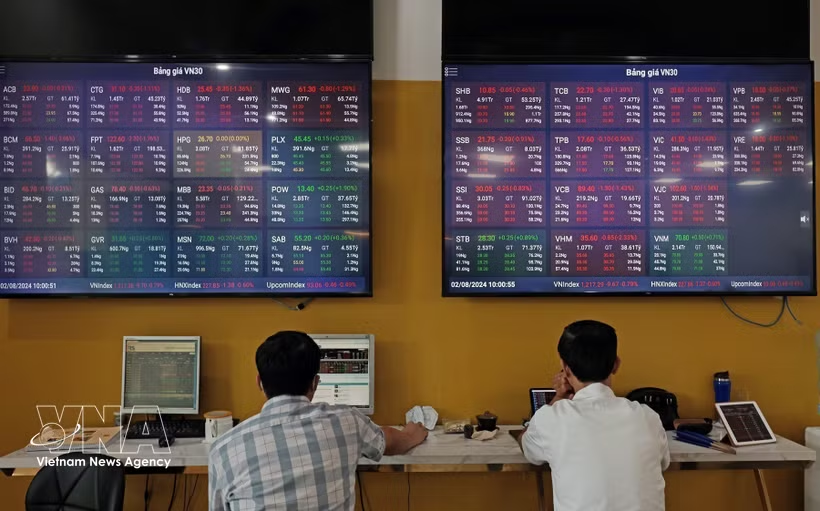
Illustrative image (Photo: VNA)

London (VNA) - Vietnam can draw on lessons from the London Financial Centre to build a globally competitive financial market for its next growth phase, Executive Director of the London Southside Chamber of Commerce Radiana Vlahova told Vietnam News Agency.

As global integration deepens, financial governance needs a mindset upgrade. London’s experience, Vlahova said, shows that regulation isn’t designed to stamp out risk but to enable informed risk-taking, and such a spirit must shape how rules are interpreted, monitored, and enforced daily.

Recent policy moves in Vietnam are pointing in this direction. Locking in that approach and applying it consistently would give the country a firmer footing to boost its credibility in global capital markets.

A top reform is drawing bright lines among financial regulators. In London, she noted, the Prudential Regulation Authority (PRA) oversees the safety and soundness of banks and insurers, while the Financial Conduct Authority (FCA) focuses on market conduct and investor protection, each with a distinct mandate and accountability. Overlapping responsibilities muddy investor expectations, and uncertainty repels capital flows.

Vietnam’s push to streamline its State apparatus offers a timely chance to carve out clearer regulatory lanes and set up transparent coordination mechanisms, creating a predictable climate for domestic and foreign investors alike.

In the race for global capital, speed is a real edge. The London Financial Centre encourages regulators to issue clear, detailed licensing timelines. The FCA is accelerating fund approvals in priority sectors, aiming to cut processing time from three months to one. London has also pioneered the regulatory sandbox, a controlled testbed for new financial products. Vietnam needs this flexibility, plus a clear legal framework for digital assets and fintech, she said.

She also called for a stronger legal foundation for corporate bond issuance, greater transparency, and homegrown independent credit rating agencies, alongside modernised oversight using an AI-driven fraud detection system and real-time compliance tracking.

According to her, the Vietnamese Government has already acted to stabilise the financial market and improve transparency. Staying the course and layering in advanced supervisory tech will help Vietnam to build a financial market that is not only large in scale but also strong in quality.

London rose to dominate global finance through an unwavering commitment to the rule of law, governance consistency, and a culture of responsible risk-taking, Vlahova said. Those universal principles underpin market confidence everywhere and are well within Vietnam’s grasp, she added.

The Ho Chi Minh Stock Exchange opened in 2000, followed by the Hanoi bourse in 2005, marking the start of Vietnam’s modern capital market. Since then, the government has steadily revamped the legal framework, from the 2006 Securities Law to its 2019 update, and pushed ahead with market upgrades, culminating in the launch of the KRX trading system in May 2025.

Under a market upgrade approved by the Prime Minister in September 2025, Vietnam seeks to join the MSCI Emerging Markets Index by 2030. The popular MSCI index, developed by Morgan Stanley Capital International, guides investment decisions for some of the world’s largest institutional investors. Hitting that target demands not just technical fixes but a higher level of institutional architecture, exactly where London’s experience can light the way.

On September 21, 2026, Vietnam will officially be classified as an emerging market by FTSE Russell, marking a milestone long anticipated by global investors./.

VNA

See more

The meeting between General Secretary of the Communist Party of Vietnam Central Committee and State President To Lam and Chairman and Chief Executive Officer of Hayleys PLC Mohan Pandithage in Colombo on May 8 (Photo: VNA)

Vietnamese leader hopes for stronger ties with Sri Lanka's Hayleys PLC

General Secretary and President To Lam said that given the complementarity of the two economies and their substantial room for growth, Vietnam wishes to enhance cooperation with major Sri Lankan enterprises, especially those with regional market networks and connectivity capabilities such as Hayleys.

The export of 1.1 million doses of vaccine lumpy skin disease (LSD) to the Republic of Korea marks an important milestone for Vietnam’s veterinary vaccine industry. (Photo: nongnghiepmoitruong.vn)

Vietnamese-made LSD vaccine enters demanding RoK market

The successful research and commercialisation of the LSD vaccine, which has been widely used in the domestic market and is gradually expanding internationally, helps affirm the position of Vietnamese veterinary vaccines globally.

General Secretary of the Communist Party of Vietnam (CPV) Central Committee and State President To Lam addresses the Vietnam – Sri Lanka Trade-Investment-Tourism Cooperation Forum in Colombo on May 8. (Photo: VNA)

Top leader urges stronger Vietnam-Sri Lanka economic connectivity

Vietnam – Sri Lanka cooperation should be viewed within the broader context of the Indian Ocean, South Asia and emerging global supply chains, and the key issue now is not potential, but swift, decisive and effective action, said Vietnam's top leader To Lam.

The meeting between Vietnamese Minister of Industry and Trade Le Manh Hung and representatives from Essar Group (Photo: VNA)

Vietnam, India step up cooperation in energy, biofuels

Vietnam encourages capable investors to participate in oil and gas, energy and energy infrastructure projects in line with the national energy development strategy, while ensuring investment efficiency and compliance with Vietnamese law.

In the first four months of 2026, total FDI inflows into Vietnam reaches 18.24 billion USD, up 32% year-on-year. (Illustrative photo: VNA)

Vietnam draws stronger foreign investment inflows despite global headwinds

In the first four months of 2026, total FDI inflows into Vietnam reached 18.24 billion USD, up 32% year-on-year. Disbursed capital was estimated at more than 7.4 billion USD, an increase of 9.8% and the highest four-month disbursement level recorded in the past five years, reflecting effective implementation of many registered projects.

A Boeing 787 aircraft of Vietnam’s national flag carrier, Vietnam Airlines, lands on its first flight at Long Thanh International Airport. (Photo: VNA)

Deputy PM stresses strategic, synchronous planning for airport system

The national airport system planning was approved by the Prime Minister under Decision No. 648/QD-TTg dated June 7, 2023. Under the planning, 30 airports (14 international and 16 domestic) are to be developed during the 2021–2030 period, with a vision to 2050 expanding the network to 33 airports (14 international and 19 domestic).

Modern machinery improves labour productivity. (Photo: VNA)

Upskilling becomes key lever for Vietnamese workforce in digital era

As the economy is pivoting to a growth model fueled by knowledge, technology and innovation, the working class, or the backbone of production, demands better professional qualifications, vocational skills, industrial discipline and work habits. Timely adaptation is the only shield against being undercut by accelerating automation, artificial intelligence and increasingly fiercer global competition.

A circular organic farming model in Khanh Hoa is delivering initial economic efficiency. (Photo: VNA)

New growth potential unlocked for Vietnamese economy

Prime Minister Le Minh Hung once stressed that cutting administrative procedures and business conditions remains one of the fastest and most effective ways to stimulate growth and strengthen confidence among citizens and enterprises. He underscored that the reform process must remain continuous and responsive to practical requirements.