Vietnam buckles down on quality FDI as global capital turns selective

In 2025 alone, the value of capital contributions and share purchases soared 54.8%, signaling that foreign players are scaling up and digging deeper into the domestic market, a powerful “vote of confidence” in the investment climate and policy framework.

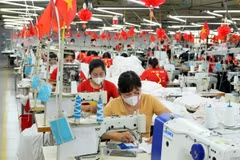
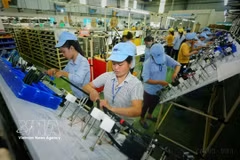
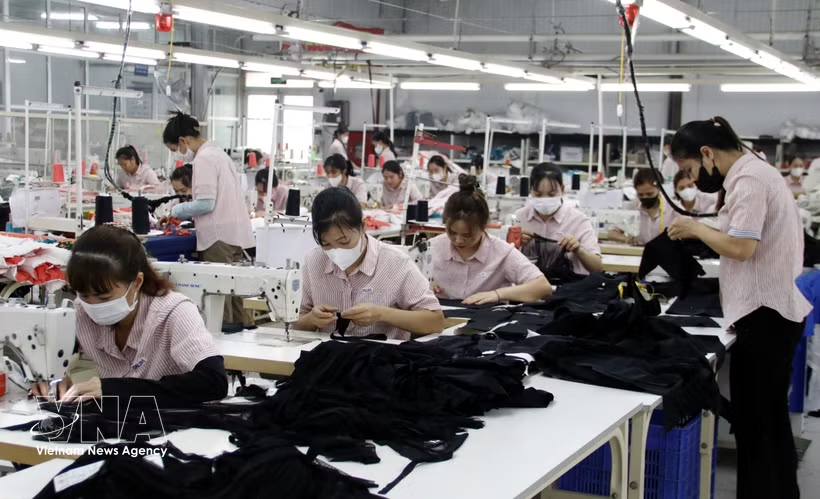
A garment factory in Bac Ninh province (Photo: VNA)

Hanoi (VNA) - Faced with geopolitical instability and spiraling trade uncertainty, Vietnam has held its ground as a magnet for foreign direct investment (FDI), reinforcing its place on the global map.

Beyond preserving headline inflows, the country is gradually lifting investment quality and stitching itself more tightly into global value chains.

Holding momentum against headwinds

The 2021–2025 period was defined by severe global economic disruptions, from the COVID-19 pandemic and geopolitical tensions, to supply chain restructuring. Despite these, Vietnam absorbed the blows better than most, emerging as one of Southeast Asia’s standout FDI destinations.

Registered FDI over the five-year span ranged from 27-38 billion USD annually, hitting roughly 38.4 billion USD in 2025. More tellingly, realised capital approached 27.6 billion USD, up 9%, the highest level in five years.

The sustained growth in disbursement showed that existing projects are steady and capital is being deployed on schedule, a direct gauge of investor confidence. At a moment when global capital remains on a tight leash, rising disbursed flows send a positive signal, anchoring the FDI sector’s role in production, exports, and overall growth.

Dr. Dang Thao Quyen from RMIT University Vietnam said the results prove FDI is moving beyond paper commitments into effective action, confirming investor confidence in the market’s operational efficiency and long-term potential.

Echoing this view, Dr. Nguyen Ba Hung, ADB Chief Economist in Vietnam, added that while registered capital captures initial interest, only disbursed capital translates into economic output. Persistently high disbursement against a volatile global backdrop underscores durable investor faith in Vietnam.

Another bright spot is the sharp rise in newly registered capital and newly licensed projects, indicating that Vietnam remains a favoured node in global supply chain diversification strategies.

A shift toward “deep investment” is also taking shape through rising adjusted capital and surging capital contributions and share acquisitions. In 2025 alone, the value of capital contributions and share purchases soared 54.8%, signaling that foreign players are scaling up and digging deeper into the domestic market, a powerful “vote of confidence” in the investment climate and policy framework.

Entering 2026, global conditions remain complex, leading to more cautious FDI flows. Yet, the first-quarter registered FDI neared 15.2 billion USD, a sharp year-on-year rise, while disbursed capital rose to about 4.6 billion USD, up 7–8%.

The FDI sector continues to dominate exports, consistently accounting for 70–75% of Vietnam’s total outbound shipments and generating a sizeable trade surplus that supports overall trade balance stability.

FDI pivots to hi-tech, deeper value chains

A signature feature of Vietnam’s FDI story is the clear upgrade in quality. Processing and manufacturing remains the anchor, absorbing 55–60% of total registered capital during 2021–2025 and vaulting to over 70% in early 2026. In 2025, it took more than 80% of total disbursed capital, underscoring Vietnam’s role as a production linchpin in global supply chains.

The pivot, however, goes beyond share gains; it’s structural. FDI is shifting from labour-intensive assembly toward higher value-added segments such as electronic components, semiconductors, precision equipment, data centres, and digital technologies, with billion-US dollar projects now entering the pipeline.

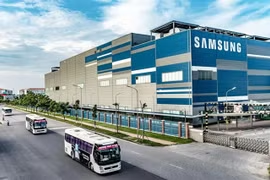
Recent major projects, particularly in the first quarter, including a 1.2 billion USD FCBGA circuit board manufacturing project in Thai Nguyen by Samsung Electro-Mechanics and a 2.2 billion USD liquefied natural gas (LNG) power project in Nghe An, illustrate Vietnam’s deepening integration into high-value rungs of global supply chains. They also a deliberate tilt toward selective, quality-driven FDI that prioritises advanced technology and domestic spillover potential.

Looking to 2026, the World Bank and ADB forecast sustained pressure on global FDI flows from high interest rates, geopolitical tensions, and economic fragmentation. Still, Vietnam holds considerable advantages to keep its edge.

According to experts, future FDI prospects hinge largely on Vietnam’s capacity for reform and adaptation. Macro stability, infrastructure quality, workforce skill upgrades, and institutional overhauls will determine whether the country can seize shifting capital flows for further breakthroughs.

Dr. Nguyen Quoc Viet from the University of Economics and Business under the Vietnam National University - Hanoi, suggested moving from “tax incentives” to “institutional and infrastructure readiness” as the foundation to draw next-generation FDI.

He also highlighted three key pillars, including strategic infrastructure spanning digital infrastructure, data systems, green energy, and urban services beyond industrial zones; a quality workforce; and a reliable institutional framework marked by transparency, stability, and predictability up to international standards.

Improving the investment climate, building out strategic infrastructure, upskilling labour, and deepening business linkages will decide whether Vietnam not only holds its position but becomes a strategic hub in global supply chains, he added./.

VNA

See more

FPT possesses AI supercomputing infrastructure that ranks among the top 500 most powerful supercomputers in the world (Photo courtesy of FPT)

FPT signs multi-million dollar AI contract with leading global materials corporation

Under the agreement, FPT will deploy applications and services powered by its comprehensive AI platform, FleziPT, developed in-house to enhance operational efficiency for the client. The AI transformation is expected to help reduce costs by up to 40% within three years, while improving service reliability and accelerating the modernisation of core technology systems.

Staff at Hai Phong Railway Station assist passengers with ticket purchase procedures (Photo: VNA)

Vietnam railways accelerate digital shift, green transition

By 2030, Vietnam’s railway sector aims to achieve sustainable growth on existing lines while playing a greater role in supporting a green and circular economy. It also focuses on improving efficiency, reducing environmental impact, and upgrading service quality.

Vietnam is said to be facing a major opportunity not only to strengthen technical connectivity but also to take a leading role in building an integrated regional energy market, moving from a national to a regional scale. (Photo: VNA)

Vietnam – A strategic link in Pan-Asia Power Grid Initiative: ADB

In an interview with the Vietnam News Agency (VNA)'s reporter, Keiju Mitsuhashi, Director for Energy Sector for Southeast Asia and the Pacific at ADB, underscored this strategic position, describing Vietnam as a “truly important” part of the broader Pan-Asia Power Grid Initiative (PAGI).

A range of new technologies will be showcased at the Vietnam International Electronics & Smart Appliances Expo (IEAE 2026). (Illustrative photo: VNA)

Global electronics brands gather at IEAE Vietnam 2026

Positioned as a dedicated trade platform for consumer electronics and home appliances, IEAE 2026 will link manufacturers, buyers and distributors, facilitating direct engagement through structured trade promotion and networking activities over the three-day event.

Deputy Minister of Finance Le Tan Can speaks at the press briefing (Photo: VNA)

Finance ministry lays out three-step formula for macro stability

Efforts will concentrate on raising total factor productivity through technology application, digital transformation, and human capital upgrades. At the same time, institutional fine-tuning, streamlined administrative procedures, and a measurably improved business environment stay on the agenda.

Illustrative image (Photo: VNA)

Budget revenue up 15.2% in four months

While still on track, the ministry flagged that fallout from the Middle East conflict and a suite of fiscal relief measures, including cuts to environmental protection tax, value-added tax, special consumption tax and fees on gasoline and aviation fuel, are starting to chip away at revenue. Collection progress and growth rates across several tax streams have decelerated from the previous year.

At an apparel factory in Bac Ninh province (Photo: VNA)

Moody’s lifts Vietnam’s outlook to "positive" on reform drive

Moody’s said Vietnam is well-positioned to windstand shocks from energy prices, transport costs and inflationary pressures arising from geopolitical movements, backed by solid growth fundamentals, strong external buffers, low foreign currency risk exposure and a diversified energy and export mix.

E10 gasoline was sold at three outlets by PVOIL Central branch in Quang Ngai in September 2025. (Photo: VNA)

PVOIL to roll out E10 gasoline nationwide from May 15

PVOIL began piloting E10 gasoline sales on August 1, 2025, in Hanoi and Hai Phong, before expanding to central and southern regions. As of April 2026, the company operated 558 petrol stations selling E10 gasoline nationwide. Initial results indicate that the product meets all technical standards, supports smooth vehicle operation, and has received positive feedback from customers.

Illustrative image (Photo: VNA)

Vietnam told to learn from London to win global capital

The Vietnamese Government has already acted to stabilise the financial market and improve transparency. Staying the course and layering in advanced supervisory tech will help Vietnam to build a financial market that is not only large in scale but also strong in quality.

A corner of Long Xuyen ward in An Giang province, a key trading hub of the Long Xuyen quadrangle region. (Photo: VNA)

Vietnam remains regional bright spot despite external risks: int’l institutions

According to the Asian Development Outlook (ADO) report released on April 10, the Asian Development Bank (ADB) forecasts Vietnam’s GDP to reach 7.2% in 2026 and remain around 7% in 2027. Sharing this view, the ASEAN+3 Macroeconomic Research Office (AMRO) and United Overseas Bank (UOB) also project growth in the range of 7–7.2%.

Manufacturing electrical and electronic components at Minda Vietnam Automotive Co., Ltd, an Indian-invested company in Phu Tho province. ( File Photo: VNA)

Vietnam, India expand trade cooperation in new growth phase

Over the past decade, Vietnam and India have continuously strengthened political trust while expanding practical cooperation across all spheres, including trade, investment, digital technology, energy, innovation and manufacturing.

Workers process pangasius for export at a factory of the Go Dang Tien Giang JSC in Dong Thap province. (Photo: VNA)

Agro-forestry-fishery exports up 5.4% in four months

Asia remained the largest export market, accounting for 44.1% of total turnover, followed by the Americas and Europe with shares of 20.9% and 15.8%, respectively. Export value to Asia rose 11.5%, Europe 3.7% and Oceania 19.8%, while shipments to the Americas and Africa fell 3.5% and 26%, respectively.