Vietnam railways accelerate digital shift, green transition

By 2030, Vietnam’s railway sector aims to achieve sustainable growth on existing lines while playing a greater role in supporting a green and circular economy. It also focuses on improving efficiency, reducing environmental impact, and upgrading service quality.

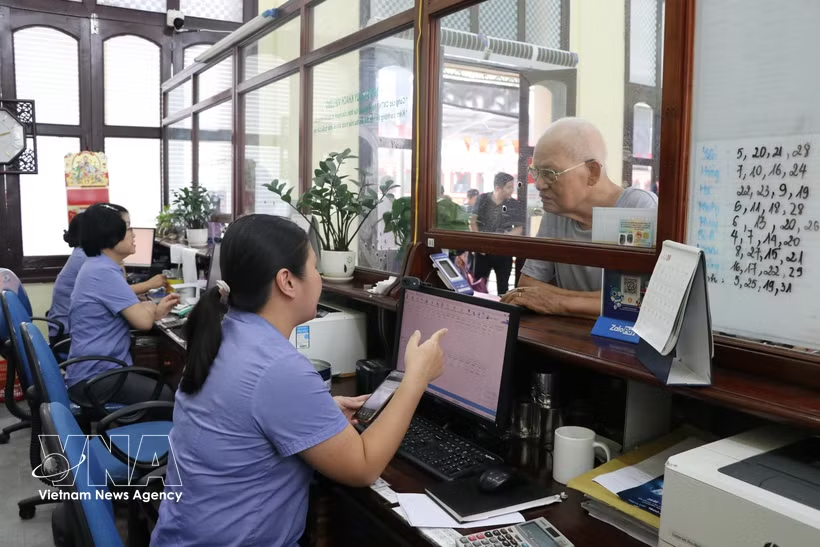
Staff at Hai Phong Railway Station assist passengers with ticket purchase procedures (Photo: VNA)

Hanoi (VNA) – Vietnam’s railway sector is advancing digital transformation and adopting cleaner energy to reduce greenhouse gas emissions, improve efficiency, and regain competitiveness in the transport market.

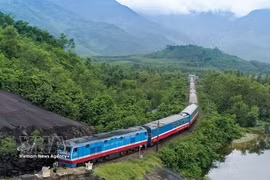
The industry currently operates 258 locomotives, 128 generators, about 4,000 carriages, and roughly 2,600 kilometres of track. Once a backbone of national transport, rail has lost market share to road, air, and waterway services in recent years.

After a downturn during the COVID-19 pandemic, the sector has rebounded, carrying around 40 million passengers and more than 5 million tonnes of cargo in 2025. While still accounting for a modest share of the market, the recovery reflects improvements in infrastructure and service quality, driven largely by digitalisation.

Nguyen Quoc Vuong, Deputy General Director of Vietnam Railways (VNR), said that the Politburo’s Resolution No. 57-NQ/TW on breakthroughs in science-technology development, innovation, and national digital transformation has opened up strategic opportunities for the sector to enhance its competitiveness.

Following this direction, VNR’s Party Committee has issued a series of resolutions and action plans focusing on six priority areas: improving institutions and digital governance; developing digital infrastructure and data; advancing railway technology and industry; promoting digital transformation in transport and services; building a digital workforce; and fostering innovation across the sector.

VNR has rolled out a range of digital tools, including e-office systems, digital signatures, e-ticketing, chatbot-based customer care, and the VNRA-MIS platform for infrastructure asset management. Technologies such as train monitoring systems, surveillance cameras, and Lidar-based warning devices have been introduced to enhance safety and operations.

An emergency response centre has also been established, enabling real-time connections to incident sites, particularly at level crossings and key traffic points.

This allows rapid assessment and response, helping minimise disruptions.

Since 2025, VNR has put in place a “digital railway” model, integrating artificial intelligence (AI), big data, and the Internet of Things (IoT) into management and operations. These applications have helped optimise performance, reduce costs, and improve service quality.

Challenges in green transition

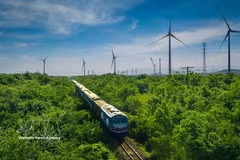
Alongside digitalisation, the sector is pursuing greener operations. Rail transport is considered energy-efficient and low-emission, accounting for just 0.2% of the economy’s total greenhouse gas emissions and about 3% of emissions in the transport sector. Expanding rail’s market share could therefore help reduce overall transport emissions.
vnanet-duong-sat.jpg
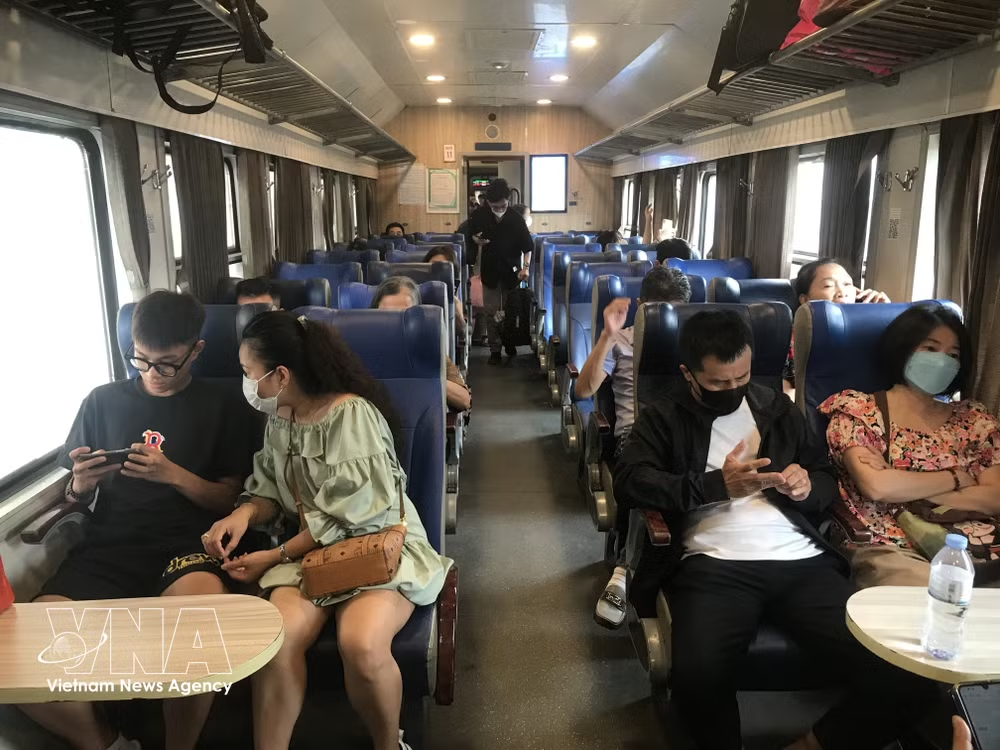
Passengers on the train carriages preparing for departure (Photo: VNA)

However, challenges remain as railways face limitations in speed, flexibility, connectivity, and transshipment capacity, as well as service quality constraints and limited investment resources.

VNR identifies five main emission sources: diesel-powered locomotives, energy use at stations and offices, maintenance activities, domestic waste, and logistics operations. Diesel consumption alone reaches about 46,000 tonnes annually, accounting for over 70% of total emissions.

To address these issues, VNR has set targets for 2030, focusing on full implementation of digital transformation and gradual modernisation of infrastructure, alongside the adoption of cleaner fuels that meet emission standards.

The corporation is pursuing four key solution groups: strengthening governance, improving management processes, developing infrastructure and technology, and enhancing human resources and innovation capacity.

By 2030, Vietnam’s railway sector aims to achieve sustainable growth on existing lines while playing a greater role in supporting a green and circular economy. It also focuses on improving efficiency, reducing environmental impact, and upgrading service quality.

With digital transformation and green transition identified as core pillars, the sector is working to remove bottlenecks in institutions, resources, and infrastructure to unlock its full potential and secure long-term development./.


VNA

See more

Vietnamese coffee products are promoted at Kaffee Campus 2026. (Photo: VNA)

Vietnam seeks stronger foothold in Germany’s premium coffee market

Industry representatives noted that Germany’s market is gradually shifting from Arabica towards high-quality Robusta as climate change affects supply. Although Vietnam remained Germany’s second-largest coffee supplier after Brazil with export turnover of 1.22 billion USD in 2025, its coffee is still largely associated with industrial processing.

Tuyen Do, Founder and Managing Partner of TVD Capital Partners, shares fundraising experience with Vietnamese enterprises. (Photo: VNA)

Vietnamese, US firms step up investment cooperation

Addressing the event, Vietnamese Ambassador to the US Nguyen Quoc Dung underscored that SelectUSA serves as a key platform enabling international investors to access the US business environment, while fostering stronger linkages between Vietnamese and US enterprises amid the deepening Comprehensive Strategic Partnership.

A corner of Hanoi city. (Photo: VNA)

Hanoi aims for over 10% growth in Q2

A Hanoi official called for the swift implementation of new mechanisms and policies, particularly the revised Capital Law, through detailed action plans, describing this as the key step to translate institutional advantages into tangible growth and help the capital achieve double-digit expansion for this year.

FPT possesses AI supercomputing infrastructure that ranks among the top 500 most powerful supercomputers in the world (Photo courtesy of FPT)

FPT signs multi-million dollar AI contract with leading global materials corporation

Under the agreement, FPT will deploy applications and services powered by its comprehensive AI platform, FleziPT, developed in-house to enhance operational efficiency for the client. The AI transformation is expected to help reduce costs by up to 40% within three years, while improving service reliability and accelerating the modernisation of core technology systems.

Vietnam is said to be facing a major opportunity not only to strengthen technical connectivity but also to take a leading role in building an integrated regional energy market, moving from a national to a regional scale. (Photo: VNA)

Vietnam – A strategic link in Pan-Asia Power Grid Initiative: ADB

In an interview with the Vietnam News Agency (VNA)'s reporter, Keiju Mitsuhashi, Director for Energy Sector for Southeast Asia and the Pacific at ADB, underscored this strategic position, describing Vietnam as a “truly important” part of the broader Pan-Asia Power Grid Initiative (PAGI).

A range of new technologies will be showcased at the Vietnam International Electronics & Smart Appliances Expo (IEAE 2026). (Illustrative photo: VNA)

Global electronics brands gather at IEAE Vietnam 2026

Positioned as a dedicated trade platform for consumer electronics and home appliances, IEAE 2026 will link manufacturers, buyers and distributors, facilitating direct engagement through structured trade promotion and networking activities over the three-day event.

Deputy Minister of Finance Le Tan Can speaks at the press briefing (Photo: VNA)

Finance ministry lays out three-step formula for macro stability

Efforts will concentrate on raising total factor productivity through technology application, digital transformation, and human capital upgrades. At the same time, institutional fine-tuning, streamlined administrative procedures, and a measurably improved business environment stay on the agenda.

Illustrative image (Photo: VNA)

Budget revenue up 15.2% in four months

While still on track, the ministry flagged that fallout from the Middle East conflict and a suite of fiscal relief measures, including cuts to environmental protection tax, value-added tax, special consumption tax and fees on gasoline and aviation fuel, are starting to chip away at revenue. Collection progress and growth rates across several tax streams have decelerated from the previous year.

At an apparel factory in Bac Ninh province (Photo: VNA)

Moody’s lifts Vietnam’s outlook to "positive" on reform drive

Moody’s said Vietnam is well-positioned to windstand shocks from energy prices, transport costs and inflationary pressures arising from geopolitical movements, backed by solid growth fundamentals, strong external buffers, low foreign currency risk exposure and a diversified energy and export mix.