Hanoi aims for over 10% growth in Q2

A Hanoi official called for the swift implementation of new mechanisms and policies, particularly the revised Capital Law, through detailed action plans, describing this as the key step to translate institutional advantages into tangible growth and help the capital achieve double-digit expansion for this year.

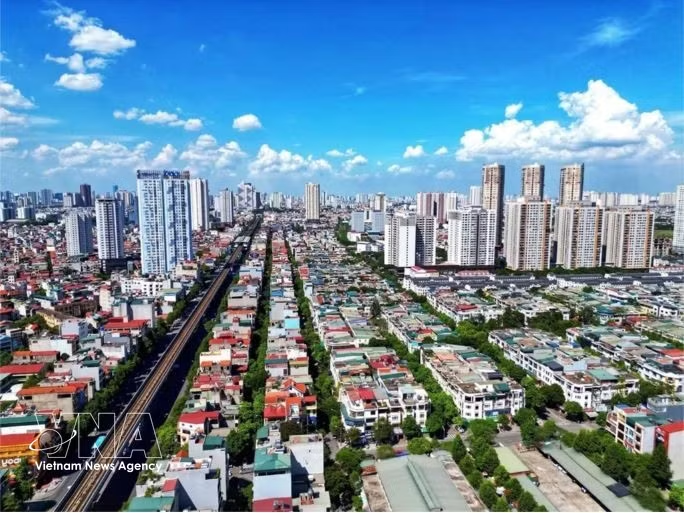
A corner of Hanoi city. (Photo: VNA)

Hanoi (VNA) – Chairman of the Hanoi People’s Committee Vu Dai Thang chaired the committee’s regular meeting on May 5, during which he underlined the requirement for the city to achieve growth of over 10% in the second quarter to fulfil the target of double-digit development for the whole of 2026.

Thang called for the swift implementation of new mechanisms and policies, particularly the revised Capital Law, through detailed action plans, describing this as the key step to translate institutional advantages into tangible growth and help the capital achieve double-digit expansion for this year.

Despite favourable conditions, Hanoi’s growth and economic restructuring have yet to meet expectations, he pointed out, calling for clearer accountability across sectors, particularly in production, urban development and construction.

He stressed that over 10% growth in the second quarter is a target that will require more decisive and coordinated measures, especially in boosting public investment, developing processing industries, high technology and infrastructure.

The chairman also highlighted the need for strong administrative reform, reducing intermediary steps and moving towards a “single focal point, single process” mechanism to shorten project timelines.

For public investment projects, agencies should quickly address procedural, pricing, and contractual hurdles so that work can start once the land is ready, preventing delays even when construction conditions are in place.

Regarding the revised Capital Law, Hanoi aims to finalise relevant resolutions and mechanisms by June 15 to enable enforcement when the law takes effect on July 1, 2026. The official affirmed that the city already has sufficient mechanisms and policies, and that decisive, coordinated execution will be key to achieving its growth targets.

At the meeting, the municipal People’s Committee reviewed and approved reports on socio-economic performance in April and the first four months of 2026, the enforcement of the revised Capital Law, and major proposals, including a low-emission zone plan within Ring Road 1 and adjustments to fees for the use of pavements and roadways.

Notably, participants examined a draft plan to pilot a “socialist commune/ward” model in Hanoi for the 2026–2030 period and beyond.

The municipal Department of Finance reported that state budget revenue as of April 28 reached 294.2 trillion VND (11.17 billion USD), fulfilling 45.3% of the annual target and equivalent to 98.2% of the same period last year. Domestic revenue totalled 279.8 trillion VND, up 3.3%, while collections from foreign trade reached 13.2 trillion VND, up 21%.

The city is accelerating export support by addressing business bottlenecks related to markets and logistics, boosting trade promotion, and facilitating cross-border e-commerce. It is also rolling out immediate and longer-term growth promotion measures while intensifying efforts to resolve constraints in public investment disbursement, site clearance and construction materials, with agencies tasked to address project-specific issues on a rolling basis.

Major infrastructure projects such as ring roads, bridges over the Red River, key highways, and flood-control systems, need dedicated inter-agency task forces to keep things running smoothly, with clear timelines for land handover, compensation, resettlement, work approval, and capital disbursement, according to local officials/.

VNA
See more

Vietnamese coffee products are promoted at Kaffee Campus 2026. (Photo: VNA)

Vietnam seeks stronger foothold in Germany’s premium coffee market

Industry representatives noted that Germany’s market is gradually shifting from Arabica towards high-quality Robusta as climate change affects supply. Although Vietnam remained Germany’s second-largest coffee supplier after Brazil with export turnover of 1.22 billion USD in 2025, its coffee is still largely associated with industrial processing.

Tuyen Do, Founder and Managing Partner of TVD Capital Partners, shares fundraising experience with Vietnamese enterprises. (Photo: VNA)

Vietnamese, US firms step up investment cooperation

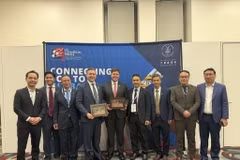
Addressing the event, Vietnamese Ambassador to the US Nguyen Quoc Dung underscored that SelectUSA serves as a key platform enabling international investors to access the US business environment, while fostering stronger linkages between Vietnamese and US enterprises amid the deepening Comprehensive Strategic Partnership.

FPT possesses AI supercomputing infrastructure that ranks among the top 500 most powerful supercomputers in the world (Photo courtesy of FPT)

FPT signs multi-million dollar AI contract with leading global materials corporation

Under the agreement, FPT will deploy applications and services powered by its comprehensive AI platform, FleziPT, developed in-house to enhance operational efficiency for the client. The AI transformation is expected to help reduce costs by up to 40% within three years, while improving service reliability and accelerating the modernisation of core technology systems.

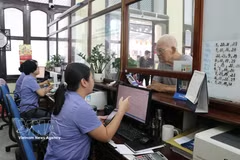
Staff at Hai Phong Railway Station assist passengers with ticket purchase procedures (Photo: VNA)

Vietnam railways accelerate digital shift, green transition

By 2030, Vietnam’s railway sector aims to achieve sustainable growth on existing lines while playing a greater role in supporting a green and circular economy. It also focuses on improving efficiency, reducing environmental impact, and upgrading service quality.

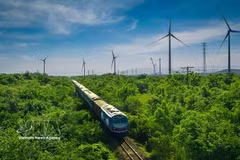
Vietnam is said to be facing a major opportunity not only to strengthen technical connectivity but also to take a leading role in building an integrated regional energy market, moving from a national to a regional scale. (Photo: VNA)

Vietnam – A strategic link in Pan-Asia Power Grid Initiative: ADB

In an interview with the Vietnam News Agency (VNA)'s reporter, Keiju Mitsuhashi, Director for Energy Sector for Southeast Asia and the Pacific at ADB, underscored this strategic position, describing Vietnam as a “truly important” part of the broader Pan-Asia Power Grid Initiative (PAGI).

A range of new technologies will be showcased at the Vietnam International Electronics & Smart Appliances Expo (IEAE 2026). (Illustrative photo: VNA)

Global electronics brands gather at IEAE Vietnam 2026

Positioned as a dedicated trade platform for consumer electronics and home appliances, IEAE 2026 will link manufacturers, buyers and distributors, facilitating direct engagement through structured trade promotion and networking activities over the three-day event.

Deputy Minister of Finance Le Tan Can speaks at the press briefing (Photo: VNA)

Finance ministry lays out three-step formula for macro stability

Efforts will concentrate on raising total factor productivity through technology application, digital transformation, and human capital upgrades. At the same time, institutional fine-tuning, streamlined administrative procedures, and a measurably improved business environment stay on the agenda.

Illustrative image (Photo: VNA)

Budget revenue up 15.2% in four months

While still on track, the ministry flagged that fallout from the Middle East conflict and a suite of fiscal relief measures, including cuts to environmental protection tax, value-added tax, special consumption tax and fees on gasoline and aviation fuel, are starting to chip away at revenue. Collection progress and growth rates across several tax streams have decelerated from the previous year.

At an apparel factory in Bac Ninh province (Photo: VNA)

Moody’s lifts Vietnam’s outlook to "positive" on reform drive

Moody’s said Vietnam is well-positioned to windstand shocks from energy prices, transport costs and inflationary pressures arising from geopolitical movements, backed by solid growth fundamentals, strong external buffers, low foreign currency risk exposure and a diversified energy and export mix.