New opportunities open for Hanoi to make stronger breakthrough: Top leader

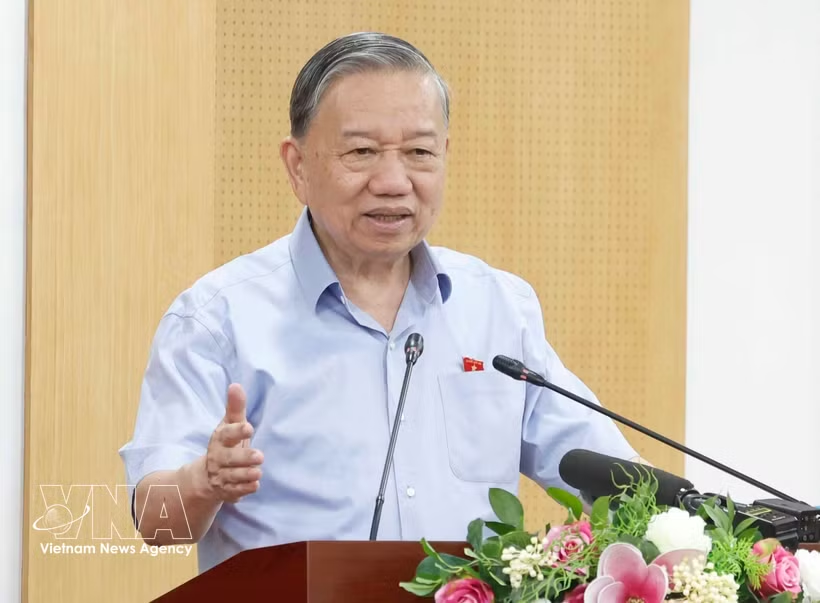
Party General Secretary and State President To Lam told voters from ten central Hanoi wards on May 4 that while Hanoi faces significant challenges, it also has unprecedented opportunities for breakthrough development befitting its role as the capital, as he and members of the city’s delegation to the 16th National Assembly met with constituents to hear their views and brief them on the legislature’s first session.

Party General Secretary and State President To Lam speaks at a meeting with voters from ten wards in central Hanoi on May 4. (Photo: VNA)

Hanoi (VNA) – Hanoi is facing major challenges but also unprecedented opportunities to make a stronger breakthrough and develop in a manner befitting its role as a capital city, Party General Secretary and State President To Lam said at a meeting with voters from ten wards in central Hanoi on May 4.

General Secretary and State President Lam and members of the Hanoi delegation to the 16th National Assembly (NA) listened to public opinions and reported on the outcomes of the first session of the newly elected legislature.

Voters welcomed the successful organisation of the election and the first session of the 16th NA, saying the election of key State leaders had strengthened public confidence.

They expressed particular support for the revised Capital Law, describing it as a strategic step that could help transform Hanoi into a more modern, orderly and dynamic city.

Many voters called on the National Assembly to further improve the quality of debate, supervision and policy review so that it can better reflect the aspirations of the people.

Food safety emerged as one of the strongest concerns. Voters warned about the spread of banned substances in livestock production, excessive preservatives, counterfeit food and poor-quality products being sold in increasingly sophisticated ways. They proposed tougher criminal penalties instead of administrative sanctions, stricter regulation of business registration on digital platforms, and clearer assignment of responsibility among ministries, sectors and local authorities.

On urban governance, voters said the two-tier local administration model had produced initial positive results. More attention should be paid to labour market management, vocational training and employment support for workers in transition.

They also urged stronger implementation of the revised Capital Law through close coordination between Hanoi and central agencies in preparing an integrated master plan aligned with national and regional planning.

Healthcare was another major issue. Voters called for clearer implementation of the Politburo’s Resolution 72 on public health protection and care, including proposals for free medical check-ups, family doctor programmes, home nursing services, and electronic health records managed at grassroots medical facilities.

Responding to the opinions, the top leader said the frank, responsible and practical feedback from voters offered valuable insights into real-life demands.

He said the issues raised covered different sectors but converged on one central requirement: the State apparatus must serve the people more effectively, policies must be more closely aligned with reality, responsibilities must be clearer, and outcomes must be more tangible.

He stressed the need to strengthen grassroots healthcare, improve preventive medicine, and raise the quality of primary medical services.

On food safety, he called for a more coherent management mechanism, clearer accountability among ministries and local authorities, and strict handling of violations. In serious cases, criminal responsibility should be considered. He also said unhygienic street food stalls, especially around schools, should not be allowed to persist.

He also highlighted the urgency of upgrading infrastructure, renovating old apartment blocks and improving urban living conditions as part of broader urban restructuring.

He said the adoption of the revised Capital Law, together with Hanoi’s 100-year master plan, has created a new institutional foundation for the capital to design policies, mobilise resources, remove bottlenecks and reorganise development space.
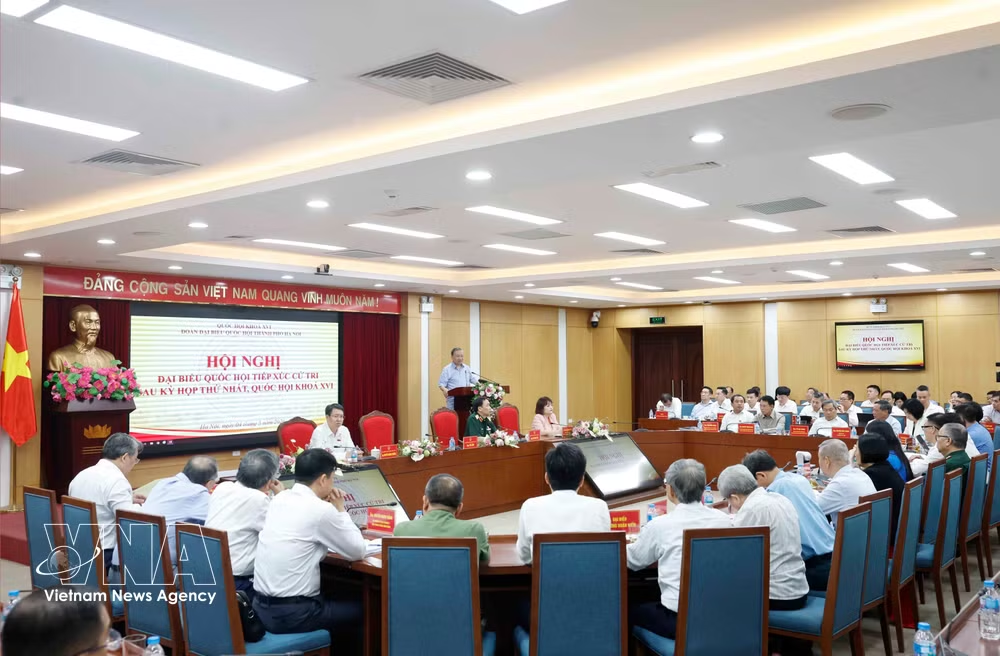
vnanet-lam2.jpg
Party General Secretary and State President To Lam speaks at a meeting with voters from ten wards in central Hanoi on May 4. (Photo: VNA)

Hanoi must move from issuing policies to implementing them, from having mechanisms to making them work, from having plans to turning them into reality, he said.

Special mechanisms, he noted, are not intended to create privileges but to resolve issues that general mechanisms cannot address quickly enough.

Priority should therefore be given to transport, environmental protection, flood control, apartment renovation, social housing, urban renewal, land management, delayed projects, food safety, primary healthcare, school safety and public service quality.

The Party chief said Hanoi must pursue faster growth, but not through the old model of expanding land use, population or urban boundaries. Future growth should rely more on institutional quality, labour productivity, science and technology, innovation, digital transformation, the green economy, knowledge-based industries, the private sector and high-quality human resources.

He also stressed that economic development in Hanoi cannot be separated from cultural and human development. The thousand-year legacy of Thang Long-Hanoi, he said, should become an endogenous resource for sustainable growth.

The leader called for stronger governance reforms, saying the Hanoi administration must be more effective, as measured by the satisfaction of residents and businesses.

He also suggested Hanoi study the idea of building a socialist ward, commune model. If successful, he said, the capital would not only become more modern and dynamic, but also more liveable, humane and civilised./.
VNA

See more

The Vietnam Education Publishing House is working to supply textbooks to localities (Photo: VNA)

Vietnam picks one textbook set for all schools, targets free books by 2030

The Ministry of Education and Training has selected the “Ket noi tri thuc voi cuoc song” (Connecting Knowledge with Life) series, published by state-owned Vietnam Education Publishing House (VEPH), from among three existing sets. The education minister approved the choice on December 26, 2025, locking in enough time for preparation before the new school year.

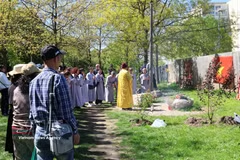
A requiem ceremony for Nguyen Van Tu held ahead of the park naming event. (Photo: VNA)

Berlin names park after Vietnamese victim of neo-Nazi violence

Nguyen Van Tu, born in 1963, was murdered on April 24, 1992, at the age of 29 amid a surge of far-right violence targeting immigrants in post-reunification Germany. His death remains a stark reminder of a difficult period for Vietnamese and other foreign communities in the country.

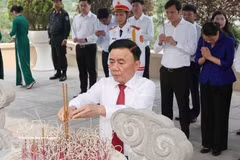
National Assembly Chairman Tran Thanh Man lays flowers in commemoration of President Ho Chi Minh, heroes and martyrs at the memorial site of the Nam Ky Uprising in Hoc Mon commune, Ho Chi Minh City, on May 4. (Photo: VNA)

NA Chairman pays tribute at Hoc Mon historic site

Writing in the memorial book, Chairman Tran Thanh Man said he was deeply moved to visit the site, which witnessed the Nam Ky Uprising on November 23, 1940 and preserved important milestones in the long struggle of the army and people of the 18 hamlets of betel gardens.

The opening ceremony of the Hoa Binh - Xuan Mai clean water plant. (Photo hanoimoi.vn)

5 trillion VND clean water plant opened in Phu Tho

Cplant’s launch marked a key milestone in developing technical infrastructure in Phu Thọ and surrounding regions, helping meet rising demand for clean water in Hanoi while supporting urban, industrial and services growth.

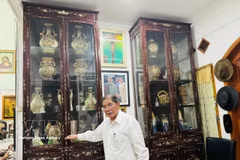
The exquisite mother-of-pearl inlaid cabinet that Lumban Sianipar meticulously brings back from Vietnam (Photo: VNA)

“Vietnam Museum” in the heart of Indonesia

The house of Lumban Sianipar, former Indonesian Defence Attaché in Vietnam, unfolds as a cultural journey through Vietnam, with walls adorned with mother-of-pearl inlay works, eggshell art, lacquer and oil paintings. Intricately crafted wooden cabinets, Bat Trang ceramics and various handicrafts are thoughtfully arranged, creating a space that is both elegant and warmly imbued with Vietnamese character.

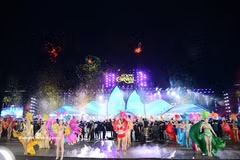
More than 1,000 amateur performers take part in Ha Long Carnaval 2026. (Photo: VNA)

Ha Long Carnaval 2026 affirms cultural industry development mindset

More than a vibrant festival, Ha Long Carnaval 2026 served as a vivid demonstration of efforts to implement Resolution No. 80-NQ/TW of the Politburo on the development of Vietnamese culture, reaffirming Quang Ninh’s evolving mindset of turning heritage into a powerful internal resource to drive breakthroughs in cultural industries in a new era.

Numerous pieces of evidence and documents related to activities of individuals in “Hoi thanh Duc Chua Troi Me” (World Mission Society Church of God) are seized. (Photo: VNA)

Quang Tri warns of religious group promoting superstition for profit

A group linked to “Hoi thanh Duc Chua Troi Me” (World Mission Society Church of God) in Quang Tri reportedly operated under a tightly organised structure with direction from an overseas “head organisation”, employing various plans to approach and psychologically manipulate individuals.

The 172nd repatriation ceremony of US serviceman’s remains held in Da Nang. (Photo: qdnd.vn)

Vietnam hands over more MIA remains to US

The remains were recovered during a recent joint Vietnam–US excavation in central Hue city. On April 27, Vietnamese and US forensic specialists conducted a preliminary examination, indicating the remains may be linked to a missing US serviceman. They will be sent to a forensic laboratory in Hawaii for further analysis and identification.

Activities within the Visit Vietnam Year – Hue 2025 attract a large number of visitors (Photo: VNA)

Ministry rolls out plan to promote national image

At its core, the plan emphasises mobilising the combined strength of the political system and society, linking communications with the promotion of cultural values and soft power of the country.

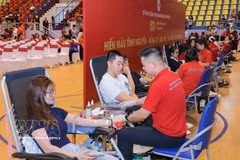
People donate blood at the launch of the Humanitarian Month 2026 in Hanoi on April 29. (Photo: VNA)

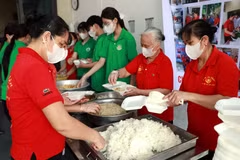
Humanitarian Month 2026 launched with community support activities

Over the past five years, Humanitarian Month campaigns have raised more than 3 trillion VND (nearly 114 million USD), assisting more than 6.6 million people. Beyond figures, the initiative has helped strengthen social trust and foster compassion across society.