Vietnam's domestic airfares rise 15-20% on fuel crunch

Supply disruptions tied to Middle East tensions have pushed fuel prices sharply higher, with physical premiums reaching as much as 39.6 USD per barrel, ACV said.

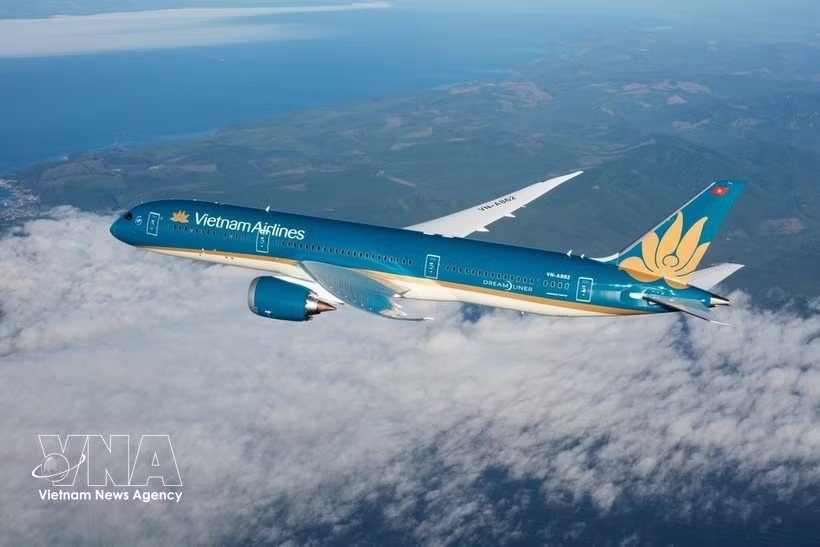
An aircraft of Vietnam Airlines (Photo: VNA)

Ho Chi Minh City (VNS/VNA) - Domestic airfares in Vietnam have risen by 15-20% on average as a fuel supply crunch linked to conflicts in the Middle East drives up costs, airport operator Airports Corporation of Vietnam (ACV) said in a newly released 2025 annual report.

The state-run company warned that both domestic and global aviation markets face mounting challenges, with shortages of Jet A1 fuel emerging as a key pressure point.

Supply disruptions tied to Middle East tensions have pushed fuel prices sharply higher, with physical premiums reaching as much as 39.6 USD per barrel, ACV said.

Domestic supply meets only about 20% of demand, leaving airlines reliant on imports from countries such as China, Thailand and the Republic of Korea (RoK), some of which have tightened exports.

Airlines have responded by cutting seat capacity in the second and third quarters of 2026, restructuring route networks and introducing fuel surcharges ranging from 20 USD to 200 USD per ticket depending on distance, the report said.

Vietnamese carriers are prioritising trunk routes linking Hanoi, Da Nang and Ho Chi Minh City, while optimising load factors and reducing overnight flights, ACV said. The measures have lowered aircraft movements at airports it operates.

The company estimates domestic ticket prices have climbed 15-20% on average, partly due to airlines withdrawing lower-priced fare classes, which has dampened travel demand, particularly for leisure trips.

Vietnam’s aviation regulator has proposed allowing fuel surcharges on domestic routes to support carriers facing rising operating costs.

Data from the International Air Transport Association showed jet fuel prices in Asia-Pacific were above 207 USD per barrel in mid-April, about 23 USD higher than the global average and roughly 2.4 times the 2025 average.

National flag carrier Vietnam Airlines estimates it could incur additional costs of 11 trillion VND to 27 trillion VND (430 million USD to 1.05 billion USD) this year due to fuel price volatility.
Budget airline VietJet Air said its costs rose by about 24 million USD in April alone with Jet A1 prices at 195 USD per barrel.

Beyond fuel pressures, ACV said the sector also faces risks from volatile exchange rates and interest rates, which could further weigh on profitability.

ACV, which operates over 20 airports nationwide, has yet to set 2026 financial targets as it reviews its business plan for shareholder approval.

The company reported revenue of 25.5 trillion VND and pre-tax profit of 13.5 trillion VND in 2025, up 12% and 6%, respectively, from a year earlier, with passenger traffic rising 9.4% to 120.3 million VND, including a 14% increase in international travellers.

As the main investor in Long Thanh International Airport, ACV reiterated its target to complete construction in the third quarter and begin commercial operations in the fourth quarter of 2026. However, it has warned of a shortfall of nearly 6,000 workers, raising the risk of delays./.
VNA

See more

Vietnamese Trade Counsellor in India Bui Trung Thuong speaks at the forum. (Photo: VNA)

Vietnam, India promote digital economy cooperation towards 25 bln USD trade target

With the strengthened Comprehensive Strategic Partnership, the rapid growth of digital economies in both countries and complementary strengths in technology, manufacturing and markets, Vietnam and India are well positioned to build a deeply connected digital trade ecosystem and enhance their participation in global value chains.

“Vietnam Economic Day” in St. Petersburg attracts crowds (Photo: VNA)

Vietnam showcases economic potential, investment opportunities in St. Petersburg

Vietnamese Ambassador to Russia Dang Minh Khoi stressed that economic cooperation between Vietnam and Russia is entering a new phase with promising opportunities for growth. He praised this year’s programme for combining a business roundtable, a youth business forum and traditional cultural and culinary activities, creating both an academic platform for dialogue and an opportunity to deepen mutual understanding between the two countries' people.

Lien Minh Agricultural Cooperative in Thai Nguyen province, provides stable employment for hundreds of its members. (Photo: VNA)

Private economic sector poised for breakthrough growth

More than a year after the Politburo's Resolution No. 68-NQ/TW on private sector development came into effect, expectations now extend beyond increasing the number of enterprises. The goal is to build a stronger business community with greater resilience, larger ambitions and the capacity to compete in global supply chains.

Milk collection at a dairy farm operated by Vinamilk at the Nhon Tan concentrated farming zone in An Nhon Tay commune, Gia Lai province. (Photo: VNA)

Self-reliance in raw materials fuels Vietnam’s dairy growth

The strategy targets annual industry growth of 12-14% by 2030, with processed liquid milk output reaching 4.2 billion litres annually. Domestic fresh milk production is projected to hit 2.6 billion litres per year, meeting 60-65% of processing demand, while milk powder output is expected to reach 245,000 tonnes annually. Per capita milk consumption is targeted at 40 litres per year.

Quang Ninh gives in principle approval to first offshore wind power plant

Quang Ninh gives in principle approval to first offshore wind power plant

Covering an area of 11.95 ha of land and water surface, the project is expected to have a designed capacity of 50 MW and will be implemented in nearshore waters of the Co To special zone. Its key components include wind turbines, a substation, a 110kV transmission line, and related auxiliary facilities.

At Nghi Son 2 thermal power plant in Thanh Hoa province. (Photo: VNA)

Vietnam’s national standards strategy for 2026–2035 approved

The strategy envisions a modern, open standards system welded to international norms, serving as a piece of soft institutional infrastructure, a policy tool and a technical backbone for state governance. It also casts standards as an engine of innovation, digital transformation, green transition and sustainable development.

Shrimp harvesting in Ca Mau province (Photo: VNA)

Vietnamese shrimp sector seeks distinct path in global race

Nguyen Duy Hoa, Deputy Technical Director of Cargill Vietnam, said Vietnam cannot compete with Ecuador on costs nor match India in scale. Instead, the country should focus on value rather than volume or price competition, prioritising quality improvement, technology adoption and value-added products.

Wind turbine No. 3 at the V1-3 site of the Duyen Hai Wind Power Plant in Truong Long Hoa ward, Vinh Long province.(Photo: VNA)

Retail market seen driving double-digit growth

Domestic consumption is being regarded as one of the key drivers for sustaining economic growth. Following the Government’s Resolution No. 88/NQ-CP on promoting the domestic market and stimulating consumption, many retailers have accelerated the expansion of distribution systems, invested in technology and improved supply chains.

Cargo containers are handled at Gemalink International Port, Ho Chi Minh City. (Illustrative photo: VNA)

Government delegation for international economic, trade negotiations established

The delegation is tasked with assisting the Prime Minister in directing ministries, sectors and localities in the negotiation, signing, coordination of ratification and approval, as well as implementation of international treaties and agreements on economic and trade matters involving the Vietnamese State and Government.

Lotte Mart Vietnam is currently distributing around 900 private-label products manufactured in Vietnam under the retailer’s strict quality control. (Photo: VNA)

RoK steps up trade cooperation with Vietnam, Malaysia

The Korean business delegation's trip aims to provide Korean firms with information on import – export trends across the ASEAN region and developments in local markets, while also offering opportunities to explore the latest industry trends and technologies.

An overview of the Vietnam-China Green Industry Cooperation and Exchange Programme held in Beijing.(Photo: VNA)

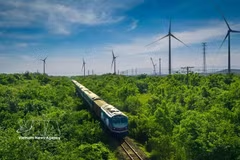
Vietnam, China boost cooperation in green industry development

The Vietnamese Embassy in China, in coordination with the International Cooperation Centre under China’s National Development and Reform Commission (NDRC), on May 18 organised the Vietnam–China Green Industry Cooperation and Exchange Programme in Beijing to strengthen policy exchanges, share experience, and promote substantive cooperation in green industry amid climate change and growing global environmental challenges.

The infrastructure of Thang Long 3 Industrial Park in Phu Tho province is comprehensive and modern, creating favourable conditions for businesses and investors. (Photo: VNA)

Strong economic conglomerates drive domestic economic growth

In manufacturing, THACO has built one of Southeast Asia’s largest automobile and mechanical engineering ecosystems in Quang Nam province, while VinFast has become Vietnam’s first electric vehicle producer, establishing a major factory in Hai Phong, listing on Nasdaq and expanding into North America, Europe and Southeast Asia.

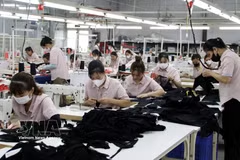
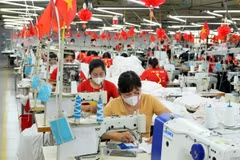
Producing garments for export to the EU market at TDT Thai Nguyen Garment Company. (Photo: VNA)

Vietnam’s textile industry draws high-tech FDI amid green, smart shift

With export turnover rising steadily in recent years and a target of 50 billion USD by 2026, Vietnam remains among the world’s top three textile exporters. Beyond its traditional appeal as a low-cost manufacturing base, the country is now positioning itself as a strategic hub for high-value and technology-driven investment.