Vietnam’s energy transition on track, poised to become regional power hub: Malaysian expert

Vietnam is entering the most challenging phase—from planning to execution—where financial, infrastructural and governance challenges are all surfacing at once. Yet this stage also clarifies opportunities. If the country can overcome systemic bottlenecks and balance security, transition and cost considerations, it has the potential to emerge as a key energy pillar in Southeast Asia.

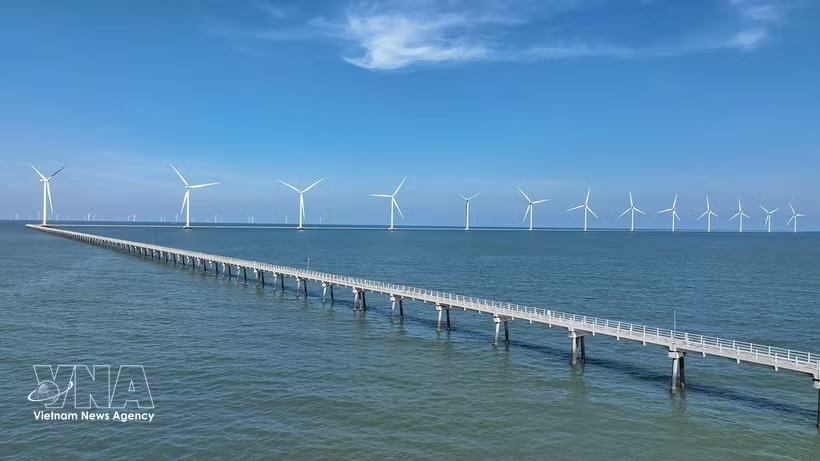
The Hoa Binh 1 and 2 wind power plants in Vinh Hau commune, Ca Mau province generate around 400 million kWh annually, contributing to the country’s energy security (Photo: VNA)

Hanoi (VNA) – Vietnam’s current energy roadmap is on the right track and highly ambitious, reflecting a shift from a “supply security” mindset to one focused on building a modern energy system, reflecting the country’s strong determination to modernise its economy under the vision of Party General Secretary and State President To Lam, according to a Malaysian scholar.

Talking to the Vietnam News Agency’s correspondents in Malaysia, Collins Chong Yew Keat, an analyst on foreign, security, and strategic affairs at University of Malaya (UM) said amid mounting geopolitical volatility, Vietnam faces a pivotal opportunity to recalibrate its energy model toward sustainability, self-reliance and regional competitiveness. According to the expert, this process centres on reshaping the power mix by increasing the portion of renewables and gradually reducing reliance on coal-fired power. This is not only an environmental imperative but also an economic strategy to leverage Vietnam’s strengths in offshore wind and solar energy. Specifically, the country aims to raise the share of non-hydropower renewables to 21% by 2030, while cutting coal share from 52% to 43%, tapping into two of Southeast Asia’s fastest-growing energy sectors (wind and solar power).
vnanet-dien-117.jpg
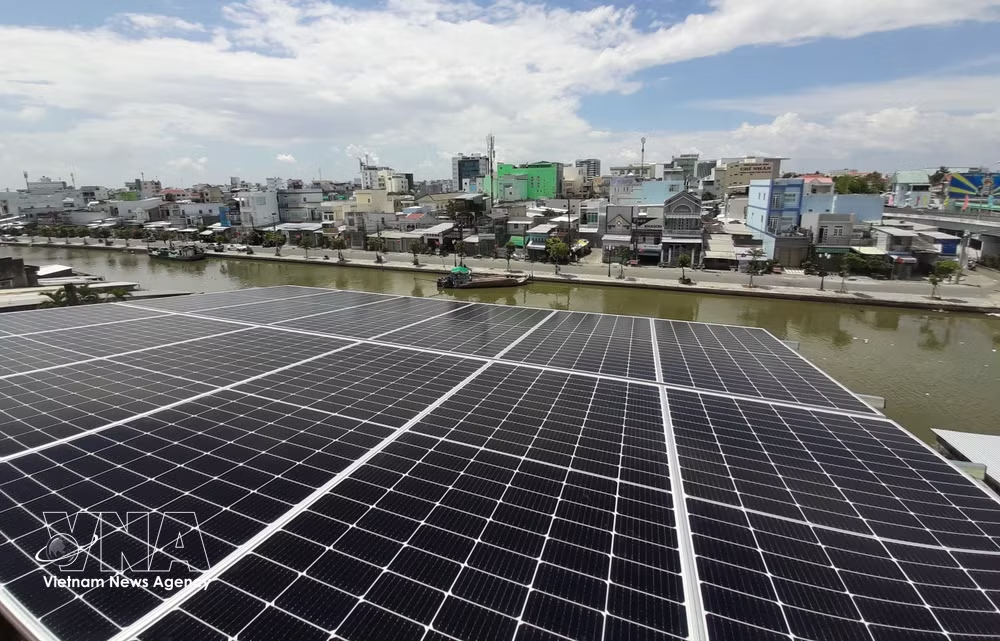
A rooftop solar power system installed at a household (Photo: VNA)

Collins stressed that Vietnam’s opportunity goes beyond meeting domestic demand, extending to the potential to become a regional hub for clean electricity supply. Power interconnection projects with Malaysia and Singapore mark initial steps toward joining the ASEAN Power Grid—an emerging regional energy architecture.

This means Vietnam could evolve from being merely an “energy consumer” into a “strategic supplier,” he said.

At the same time, market-based mechanisms such as direct power purchase agreements (DPPA) are also helping build a more flexible energy ecosystem, attracting investment while enabling businesses to meet stringent decarbonisation requirements across global supply chains, thereby safeguarding export competitiveness, he noted.

However, the path to realising green energy ambitions still faces serious systemic challenges, with the transmission network emerging as a key bottleneck. Grid congestion and curtailment have directly undermined the economic efficiency of many projects, reflecting a classic risk where the pace of power generation approvals outstrips grid upgrades.

To address this, Collins stressed the need to enhance system flexibility through investments in energy storage, reserve capacity, improved forecasting and digitalised grid management. Equally critical are consistent regulations and bankable policies, as the sector’s capital needs are substantial and investor confidence remains sensitive to policy uncertainty.

He cautioned that replacing fuel dependency with reliance on imported technology is not a sustainable solution. Vietnam, he said, must strengthen domestic capabilities across technology and material supply chains. Another key element under consideration in Vietnam’s evolving energy security strategy is the potential revival of nuclear power. If properly managed, nuclear energy could provide stable, low-emission baseload supply, complementing the intermittency of wind and solar while ensuring a balanced energy portfolio, avoiding overreliance on any single fuel source or technology.

More broadly, the concept of energy security in the new era is evolving from a narrow focus on supply to a system-wide approach encompassing grid infrastructure, digital systems, cybersecurity and technology supply chains, Collins said, stressing that Vietnam should treat energy transition and energy security as a unified strategy rather than separate objectives.

The scholar said in this context, prioritising early investment in grid and storage infrastructure while maintaining affordable energy prices will be crucial to avoid economic shocks. He advised that Vietnam should avoid pursuing decarbonisation pathways in a way that would trigger sharp shocks to industrial and household electricity prices.

He also recommended competitive bidding, electricity market reforms and targeted support for vulnerable groups, instead of broad subsidies that distort the market.

Strategic optionality will also be vital for resilience, including fuel stockpiling, diversification of LNG and oil supplies, and the development of domestic manufacturing for selected clean energy components, he noted.

According to the expert, Vietnam is entering the most challenging phase—from planning to execution—where financial, infrastructural and governance challenges are all surfacing at once. Yet this stage also clarifies opportunities. If the country can overcome systemic bottlenecks and balance security, transition and cost considerations, it has the potential to emerge as a key energy pillar in Southeast Asia.

In that scenario, energy security will evolve from a defensive shield into a strategic lever to elevate national standing, offering a long-term solution to challenges at present, he said./.

VNA

See more

At the welcome ceremony (Photo: VNA)

Vietnam recovers 28 sets of martyrs' remains from Laos during 2025–2026 dry season

During the 2025–2026 dry season, Teams 584 and 589 under the Quang Tri provincial Military Command’s Political Department surveyed sites, gathered information, and recovered 28 sets of remains of fallen soldiers in the Lao provinces of Savannakhet and Khammouane, delivering a measurable boost to the Government’s 500-day campaign to accelerate the mission.

Illustrative image (Photo: VGP)

Vietnam sets fines up to 50 million VND for fake news on social media

The decree stiffens penalties to 30–50 million VND for sharing content that distorts history, denies revolutionary achievements, undermines great national unity, insults religions, or incites gender or racial discrimination, provided no criminal liability is triggered.

A technician at the Digital Transformation Centre under the Department of Science and Technology of Khanh Hoa province performs cybersecurity tasks. (Photo: VNA)

Vietnam strengthens protection of human, civil rights in cyberspace

With more than 85 million Internet users, over 127 million active mobile subscriptions and approximately 79 million social media accounts, Vietnam’s digital space is not only a major driver of the digital economy but also a strategic domain for national defence, security safeguarding and the protection of human and civil rights.

Pham Thi Thanh Tra, member of the Party Central Committee's Secretariat, Deputy Prime Minister and head of the National Steering Committee 515, along with other delegates, pays tribute to the fallen heroes. (Photo: VNA)

Memorial, reburial service held for 80 martyrs repatriated from Laos

Over the past four decades, the special task forces of the Vietnamese and Lao governments, together with Vietnam’s Ministry of National Defence, Military Region 4 Command and Nghe An province, have closely coordinated with Lao localities to search for and repatriate 12,897 sets of remains of Vietnamese volunteer soldiers and experts who sacrificed in Laos.

Representatives of the Primorye Region Association of Friendship with Vietnam lay flowers in tribute to President Ho Chi Minh. (Photo: VNA)

Flower tribute ceremony honours President Ho Chi Minh in Russia

Consul General Nguyen Viet Kien stressed President Ho Chi Minh’s reputation and career transcended Vietnam’s borders to inspire liberation movements worldwide, and that his ideas on the right to self-determination, peace, and friendship among nations remain deeply relevant today.

Copyright infringement has become widespread, highly organised and increasingly sophisticated. (Illustrative photo: VNA)

No tolerance for digital copyright infringement

According to experts, copyright protection in the digital era cannot rely solely on manual enforcement but requires integrated technologies such as content recognition systems, digital fingerprinting, rapid takedown tools, source tracing, advertising controls and financial monitoring.

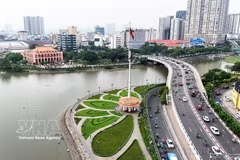
Hanoi approves 100-year master plan, with Red River as a hub. (Photo: VNA)

Hanoi shapes future city with AI, TOD, 1,153km metro network

According to the new master plan, Hanoi's study area spans all 126 wards and communes within Hanoi’s administrative boundary, covering roughly 3,359.84 sq.km. Its population is projected to reach around 14–15 million by 2035, 15–16 million by 2045, and 17–19 million by 2065, with a long-term cap of no more than 20 million residents.

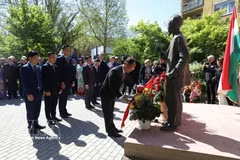
Vietnamese Ambassador to Russia Dang Minh Khoi, Chairman of the St. Petersburg Committee on External Relations Evgeny Grigoriev, Vice Chairman of the committee Vyacheslav Kalganov, and Deputy Chairman of the Legislative Assembly of the city Nikolay Bondarenko led a delegation in laying red carnations before the statue of President Ho Chi Minh (Photo: VNA)

President Ho Chi Minh’s 136th birthday observed in RoK, Russia

On the occasion of the 136th birthday of the late Vietnamese leader (May 19, 1890–2026), Professor Park Yeon Kwan, Head of the Department of Vietnamese Language at Hankuk University of Foreign Studies, described him as a great sage whose strategic decisions carried the vision of the times.

The Red River Scenic Boulevard Axis is designated as one of nine key development corridors of Hanoi. (Photo: VNA)

Hanoi details multi-billion-USD Red River scenic boulevard axis project

Under the capital’s master plan with a 100-year vision, the Red River Scenic Boulevard Axis is designated as one of nine key development corridors of Hanoi. It is envisioned as a central green spatial corridor, while also functioning as an economic, commercial, service, cultural, creative, and urban development axis along the Red River.