Beyond take-off: Vietnam’s push to climb the drone value chain

Momentum increased in October 2025 with the launch of the Vietnam Low-Altitude Economy Alliance (LAEP), co-founded by FPT CEO Nguyen Van Khoa and VinaCapital CEO Don Lam. The alliance brings together technology firms, investors, start-ups and industry experts with the goal of positioning Vietnam as a global drone hub.

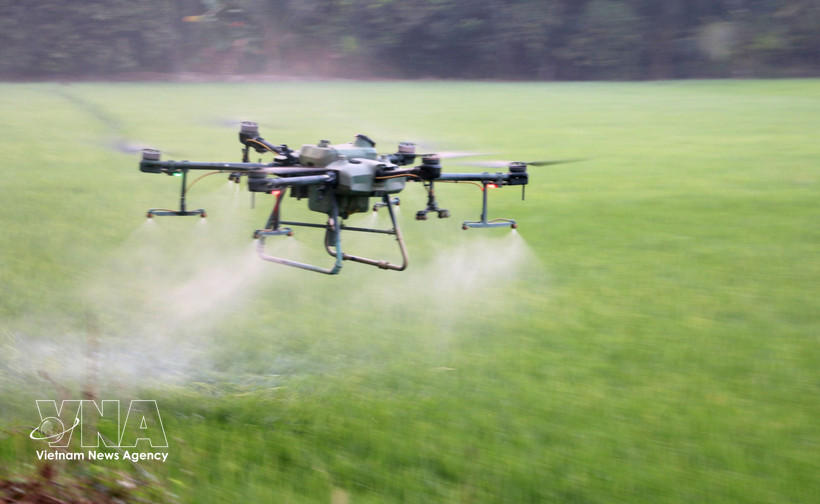
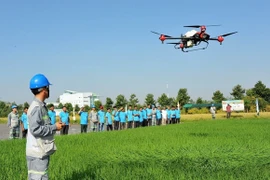
Farmers in An Giang use drones for pesticide spraying, helping save costs, labour and time. (Photo: VNA)

Hanoi (VNA) – The emerging low-altitude economy is unlocking a market worth hundreds of billions of US dollars as drones and air taxis move toward real-world deployment, yet Vietnamese firms remain largely confined to service roles, lacking control of core technologies and facing an uncertain position in the race to capture the “low-altitude skies.”

A race gaining altitude

The low-altitude economy covers economic activities conducted in lower airspace, ranging from drone delivery and infrastructure inspection to precision agriculture and electric vertical take-off and landing (eVTOL) air mobility.

Morgan Stanley estimates the sector could reach 9 trillion USD globally by 2050, signalling that low-altitude airspace is evolving into a new economic frontier rather than remaining an experimental field. Leading markets are moving beyond aircraft production to develop integrated ecosystems that combine manufacturing, software, data platforms and services.

In Vietnam, however, the industry is still in its infancy. Current activities are concentrated mainly in three areas: agricultural drones, commercial aerial imaging and infrastructure monitoring.

Agricultural applications have grown the fastest. Drones are increasingly used for crop spraying, seeding, fertilisation and monitoring plant health, helping farmers improve productivity while addressing labour shortages.

Companies such as AgriDrone Vietnam, SunDrone, Dronel and CT Drone have built business models around unmanned aerial systems. Most rely on imported drones, largely sourced from China, while focusing on operational services. Their customer base ranges from individual farmers to major agricultural firms including Hoang Anh Gia Lai, Bayer, ADC and Loc Troi.

A common model has emerged in which companies sell equipment, train operators and provide outsourced spraying services while building local drone fleets. While this approach generates quick revenue, it also reflects a structural constraint: the highest-value segments remain tied to technology ownership, which domestic firms have yet to achieve.

In commercial filming and photography, drones have quickly become standard tools across industries from real estate to tourism promotion. However, low barriers to entry have intensified competition, driving down service prices and squeezing profit margins.

Infrastructure inspection, though less visible, may offer more sustainable growth. Drones are increasingly deployed to monitor power transmission lines, track construction progress and conduct terrain surveys, supporting safer and more efficient operations.

Overall, Vietnamese companies remain active mainly at the application layer, importing equipment, providing services and training personnel, while higher-value areas such as design, manufacturing, software systems, batteries and sensors continue to be dominated by foreign players.

Ambitions for a drone hub

Momentum increased in October 2025 with the launch of the Vietnam Low-Altitude Economy Alliance (LAEP), co-founded by FPT CEO Nguyen Van Khoa and VinaCapital CEO Don Lam. The alliance brings together technology firms, investors, start-ups and industry experts with the goal of positioning Vietnam as a global drone hub.

FPT Chairman Truong Gia Binh described the moment as a rare opportunity for Vietnam to move beyond applications and participate in research and development, component manufacturing, unmanned traffic management systems and supporting infrastructure. The alliance aims to foster thousands of supporting enterprises, create around one million high-quality jobs and generate tens of billions of US dollars in economic value over the next 10–15 years.

Tran Anh Tuan, CEO of the Vietnam UAV Network, said Vietnam’s strengths in precision engineering, software, hardware and artificial intelligence could help the country integrate more deeply into global drone supply chains. He added that several US companies are exploring Vietnam as part of ongoing supply-chain diversification.

Challenges ahead

Significant obstacles remain. Technological capability is the most immediate barrier, as drone manufacturing requires deep integration of hardware, software, AI and battery technologies, demanding substantial investment and advanced research capacity.

The domestic market is also relatively small and fragmented. While demand is growing, it has yet to reach the scale needed to support large industrial players.

Regulatory constraints pose another challenge. Drone operations still require permits tied to specific locations and timeframes, complicating efforts to scale deployment. Airspace management and national security considerations further add to operational complexity.

Even if regulations become more flexible, questions about commercial viability persist. Drone delivery can be faster but more costly, while air taxis promise time savings yet remain financially out of reach for mass adoption. Even in advanced economies, many business models have yet to prove sustainable profitability.

Experts believe opportunities remain open for Vietnam, but through a more practical strategy. Rather than competing directly in core technology development, domestic firms could focus on segments with clear demand.

In precision agriculture, drones help reduce costs and increase yields. In infrastructure monitoring across power, oil and gas, and construction, they enhance safety and operational efficiency. Meanwhile, software and data services offer opportunities to develop flight management platforms, analytics solutions and integrated digital systems./.
VNA

See more

Delegates launch cross-border QR code payment services between Vietnam and China (Photo: VNA)

Vietnam–China QR payment expansion boosts tourism, business opportunities

The launch marks a significant step forward in digital payment connectivity, helping to facilitate trade and tourism flows between the two countries. Under the new arrangement, Chinese tourists can use Alipay - a member wallet of Ant International - to scan VIETQRGlobal codes and make direct payments at merchants within NAPAS’ network across Vietnam.

The programme showcases a wide range of food products with clear origins and traceable production processes (Photo: VNA)

Vitality of Vietnamese Goods programme kicks off

The programme showcases a wide range of food products with clear origins and traceable production processes, including Khanh Hoa bird’s nest, Truong Giang macadamia nuts from Lai Chau, Sadu herbal tea. These products not only meet essential consumption needs but also align with growing consumer demand for safe, transparent, and nutritious food.

The Ho Chi Minh Museum’s Ho Chi Minh City branch will be connected with a park and square, alongside the expansion of Nguyen Tat Thanh Street and the development of public services. (Photo: VNA)

Ho Chi Minh City plans large-scale film studio complex

The initiative is part of broader efforts to strengthen the city’s cultural and entertainment sectors, which are currently constrained by the lack of large-scale venues for events, performances and film production.

Many private enterprises have invested in the service and real estate sectors in Da Nang. (Photo: VNA)

Empowering businesses to achieve double-digit growth

Addressing these issues is critical. Chairman of the Vietnam Chamber of Commerce and Industry (VCCI) Ho Sy Hung urged the Government to strengthen its role as a facilitator of development, shifting from administrative control to proactive support for businesses. This includes ensuring a transparent, predictable and competitive business environment, eliminating legal inconsistencies and enabling fair access to resources.

Financial buildings in central Ho Chi Minh City along the Saigon River, facing the Thu Thiem Peninsula in An Khanh ward. (Photo: VNA)

Vietnam’s international financial centre strengthens global foothold

According to the latest Global Financial Centres Index 2026 (GFCI 39), Ho Chi Minh City ranked 84th out of 120 financial centres worldwide, climbing 11 positions compared with 2025. Within ASEAN, the city now ranks third behind Singapore and Kuala Lumpur, overtaking Bangkok and Jakarta.

Reference rate steady on April 3 (Photo: VNA)

Reference rate steady on April 3

With the current trading band of +/- 5%, the ceiling rate applicable for commercial banks during the day is 26,362 VND/USD, and the floor rate 23,852 VND/USD.

Deputy Prime Minister Mai Van Chinh visits a Vietnamese booth at the 22nd CAEXPO (Photo: VNA)

CAEXPO - effective channel for Vietnam-China cooperation

CAEXPO serves as an important gateway for Vietnamese businesses entering the Chinese market. Over 22 editions of CAEXPO, Vietnam has featured nearly 4,300 booths and around 2,200 enterprises. Numerous Vietnamese products, such as coffee, wood products, and footwear, have penetrated the Chinese market through CAEXPO, achieving rapid transitions from exhibition to product display.

Leaders of the ITPC and the Oregon business delegation chair the forum (Photo: VNA)

Ho Chi Minh City promotes logistics supply chain cooperation with US state

According to Cao Thi Phi Van, Vice Director of ITPC, the forum took place amid steadily deepening Vietnam–US relations. The US remains Vietnam’s largest export market and a key economic partner, with 1,539 valid investment projects worth more than 12.5 billion USD nationwide. In Ho Chi Minh City alone, US investors operate 915 projects with total registered capital of 7.6 billion USD, ranking seventh among 136 foreign investors in the city.

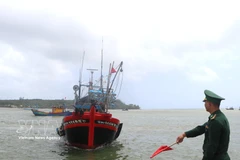
A border guard requests a fishing vessel to dock for verification of its entry and exit logs (Photo: VNA)

Vietnam issues new control procedures to tackle IUU fishing

Under Decision No. 1111/QD-BNNMT issued by the Ministry of Agriculture and Environment, the new process regulates the inspection and supervision of foreign vessels engaged in fishing, transport or transhipment of seafood when calling at Vietnamese ports for import, temporary import for re-export, transit or transhipment activities.

A Vietnamese representative introduces Vietnam Expo trade fairs (Photo: VNA)

Vietnam, India look to boost business connectivity through Vietnam Expo 2026

Addressing the opening session, Trade Counsellor of Vietnam in India Bui Trung Thuong highlighted the steady growth of bilateral economic relations, noting that two-way trade reached approximately 16.5 billion USD last year. However, he stressed that the figure remains modest compared to the substantial potential of the two economies, which are highly complementary in structure.

The first quarter's domestic revenue, estimated at 738.6 trillion VND, represented 33.6% of this year's target and rose 12.2% compared to the same period in 2025. (Illustrative photo: VNA)

State budget revenue up 10.2% in Q1

A range of fiscal support measures have been implemented to help stabilise the market and support businesses although they are expected to reduce budget revenue in the coming period.

Yaris Cross is Toyota’s top-selling model in March 2026. (Photo: Toyota)

Toyota sales in Vietnam double in March

Of the total, domestically assembled completely-knocked-down (CKD) vehicles numbered 1,800 units while completely built-up (CBU) imports dominated with 6,343 units, signalling a clear rebound in the auto market after a period of subdued demand.