Vietnam, Mexico promote practical, sustainable agricultural cooperation

Nam affirmed Vietnam’s wish to further enhance agricultural cooperation with Mexico and expressed the country's readiness to create favourable conditions for Mexican enterprises in boosting agricultural exports to the Vietnamese market.

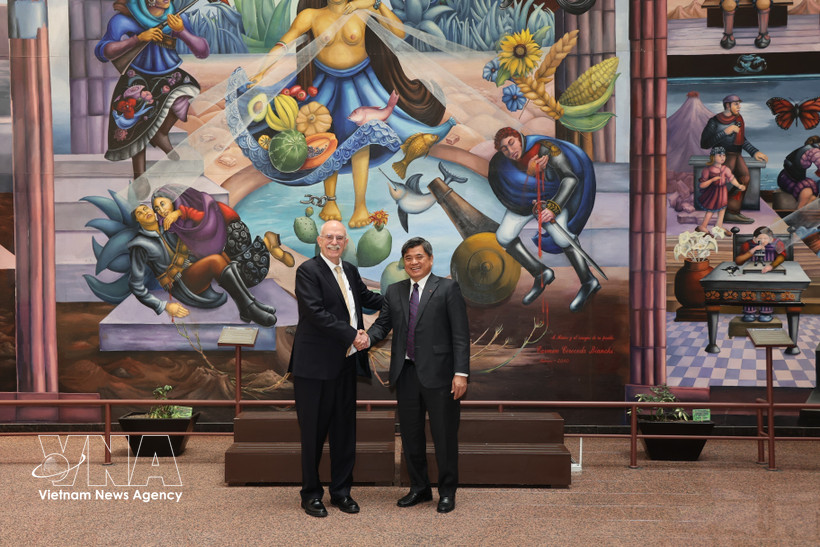
Deputy Minister of Agriculture and Environment Tran Thanh Nam and Mexican Secretary of Agriculture and Rural Development Julio Berdegué Sacristán in Mexico City. (Photo: VNA)

Mexico City (VNA) – A delegation from the Ministry of Agriculture and Environment, led by Deputy Minister Tran Thanh Nam, is paying a working visit to Mexico from April 1-4.

During the visit, the delegation held working sessions with leaders of Mexico’s Secretariat of Agriculture and Rural Development, the Mexican Business Council for Foreign Trade, Investment and Technology (COMCE), and the National Institute of Forestry, Agriculture and Livestock Research (INIFAP). They also conducted field visits to study modern agricultural production models in the country.

At talks with Mexican Secretary of Agriculture and Rural Development Julio Berdegué Sacristán, both sides reviewed the outcomes of past cooperation and discussed issues of mutual concern, including strengthening food security, expanding markets for key agricultural products, improving food safety standards, and promoting cooperation in climate-resilient smart agriculture.

Nam affirmed Vietnam’s wish to further enhance agricultural cooperation with Mexico and expressed the country's readiness to create favourable conditions for Mexican enterprises in boosting agricultural exports to the Vietnamese market.

For his part, Sacristán noted that Vietnam and Mexico share many similarities in agricultural development. Both countries have long-standing agricultural traditions with large farming populations, playing a crucial role not only in ensuring food security but also in driving economic growth, preserving cultural identity, and supporting sustainable rural development. He also highlighted common challenges faced by both nations in the 21st century, including climate change, resource constraints, and the need to transition towards sustainable, high value-added agricultural models.

The two sides proposed several measures to strengthen cooperation in the coming period, focusing on promoting delegation exchanges at all levels, establishing specialised working groups to address obstacles in agricultural trade, and further opening markets for each country’s key products.

At the working session with INIFAP, both sides reviewed the implementation of their memorandum of understanding signed in 2018 and outlined future cooperation directions, particularly in sharing advanced agricultural technologies, scientific research collaboration, and training high-quality agricultural personnel.
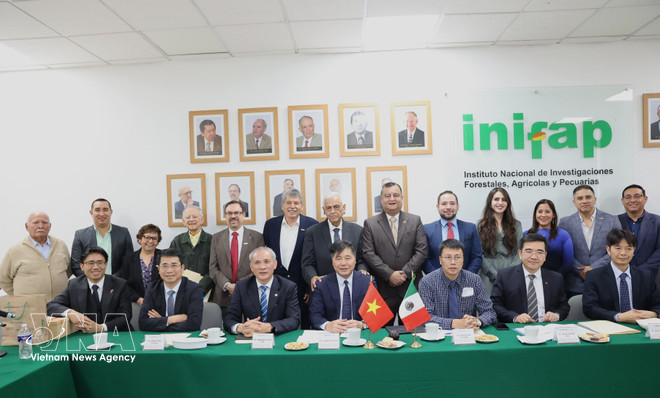
vnanet-vn-mexico.jpg
At the working session between the Vietnamese delegation and the National Institute of Forestry, Agriculture and Livestock Research (INIFAP) in Mexico City. (Photo: VNA)

Meanwhile, at the discussion with COMCE, the two sides explored practical and effective approaches to advancing bilateral agricultural cooperation. The discussion centred on connecting business communities, supporting small- and medium-sized enterprises, and strengthening bilateral agricultural trade.

Both sides agreed to leverage the complementary strengths between Vietnam’s production and export-oriented agriculture and Mexico’s advantages in technology, mechanisation and international trade promotion systems, thereby enhancing added value and competitiveness across agricultural value chains.

In the time ahead, they are expected to formalise cooperation through the signing of a memorandum of understanding, while promoting trade facilitation, technology transfer, and the implementation of specific joint projects in areas such as livestock vaccines, innovation and market development./.
VNA

See more

The meeting between General Secretary of the Communist Party of Vietnam Central Committee and State President To Lam and Chairman and Chief Executive Officer of Hayleys PLC Mohan Pandithage in Colombo on May 8 (Photo: VNA)

Vietnamese leader hopes for stronger ties with Sri Lanka's Hayleys PLC

General Secretary and President To Lam said that given the complementarity of the two economies and their substantial room for growth, Vietnam wishes to enhance cooperation with major Sri Lankan enterprises, especially those with regional market networks and connectivity capabilities such as Hayleys.

The export of 1.1 million doses of vaccine lumpy skin disease (LSD) to the Republic of Korea marks an important milestone for Vietnam’s veterinary vaccine industry. (Photo: nongnghiepmoitruong.vn)

Vietnamese-made LSD vaccine enters demanding RoK market

The successful research and commercialisation of the LSD vaccine, which has been widely used in the domestic market and is gradually expanding internationally, helps affirm the position of Vietnamese veterinary vaccines globally.

General Secretary of the Communist Party of Vietnam (CPV) Central Committee and State President To Lam addresses the Vietnam – Sri Lanka Trade-Investment-Tourism Cooperation Forum in Colombo on May 8. (Photo: VNA)

Top leader urges stronger Vietnam-Sri Lanka economic connectivity

Vietnam – Sri Lanka cooperation should be viewed within the broader context of the Indian Ocean, South Asia and emerging global supply chains, and the key issue now is not potential, but swift, decisive and effective action, said Vietnam's top leader To Lam.

The meeting between Vietnamese Minister of Industry and Trade Le Manh Hung and representatives from Essar Group (Photo: VNA)

Vietnam, India step up cooperation in energy, biofuels

Vietnam encourages capable investors to participate in oil and gas, energy and energy infrastructure projects in line with the national energy development strategy, while ensuring investment efficiency and compliance with Vietnamese law.

In the first four months of 2026, total FDI inflows into Vietnam reaches 18.24 billion USD, up 32% year-on-year. (Illustrative photo: VNA)

Vietnam draws stronger foreign investment inflows despite global headwinds

In the first four months of 2026, total FDI inflows into Vietnam reached 18.24 billion USD, up 32% year-on-year. Disbursed capital was estimated at more than 7.4 billion USD, an increase of 9.8% and the highest four-month disbursement level recorded in the past five years, reflecting effective implementation of many registered projects.

A Boeing 787 aircraft of Vietnam’s national flag carrier, Vietnam Airlines, lands on its first flight at Long Thanh International Airport. (Photo: VNA)

Deputy PM stresses strategic, synchronous planning for airport system

The national airport system planning was approved by the Prime Minister under Decision No. 648/QD-TTg dated June 7, 2023. Under the planning, 30 airports (14 international and 16 domestic) are to be developed during the 2021–2030 period, with a vision to 2050 expanding the network to 33 airports (14 international and 19 domestic).

Modern machinery improves labour productivity. (Photo: VNA)

Upskilling becomes key lever for Vietnamese workforce in digital era

As the economy is pivoting to a growth model fueled by knowledge, technology and innovation, the working class, or the backbone of production, demands better professional qualifications, vocational skills, industrial discipline and work habits. Timely adaptation is the only shield against being undercut by accelerating automation, artificial intelligence and increasingly fiercer global competition.

A circular organic farming model in Khanh Hoa is delivering initial economic efficiency. (Photo: VNA)

New growth potential unlocked for Vietnamese economy

Prime Minister Le Minh Hung once stressed that cutting administrative procedures and business conditions remains one of the fastest and most effective ways to stimulate growth and strengthen confidence among citizens and enterprises. He underscored that the reform process must remain continuous and responsive to practical requirements.