Vietnam–China QR payment expansion boosts tourism, business opportunities

The launch marks a significant step forward in digital payment connectivity, helping to facilitate trade and tourism flows between the two countries. Under the new arrangement, Chinese tourists can use Alipay - a member wallet of Ant International - to scan VIETQRGlobal codes and make direct payments at merchants within NAPAS’ network across Vietnam.

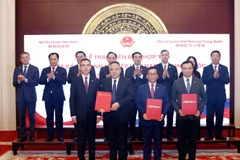
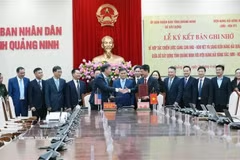
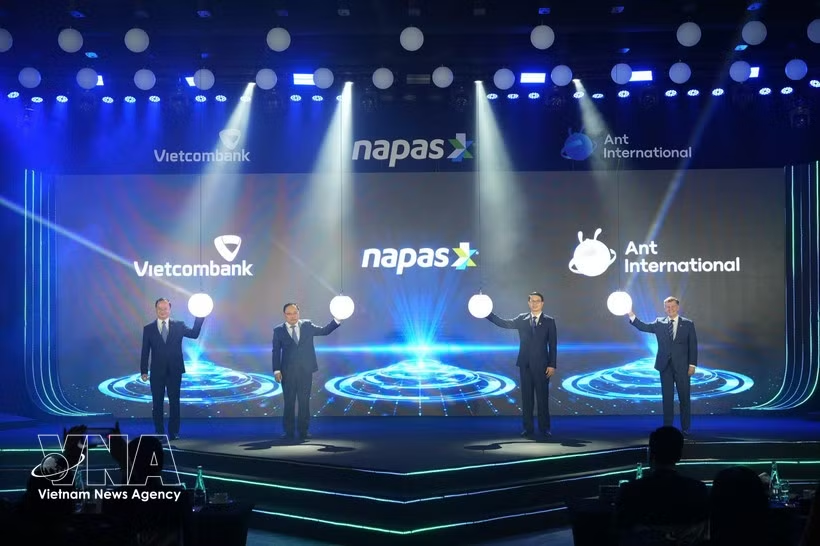
Delegates launch cross-border QR code payment services between Vietnam and China (Photo: VNA)

Hanoi (VNA) – The National Payment Corporation of Vietnam (NAPAS), in collaboration with Ant International - a unit of China-based Ant Group, and Vietcombank, on April 3 announced the expansion of cross-border QR code payment services between Vietnam and China.

The launch marks a significant step forward in digital payment connectivity, helping to facilitate trade and tourism flows between the two countries. Under the new arrangement, Chinese tourists can use Alipay - a member wallet of Ant International - to scan VIETQRGlobal codes and make direct payments at merchants within NAPAS’ network across Vietnam.

Bilateral QR transactions are processed through the integrated infrastructure of NAPAS and Ant International, alongside Vietcombank’s settlement system, enabling direct payments in local currencies - the Chinese yuan and the Vietnamese dong.

The rollout comes as China remains one of Vietnam’s largest sources of inbound tourists. Cross-border QR payments are expected to enhance visitor convenience by offering familiar payment methods, while enabling businesses in retail, services and tourism to better tap into international customer flows.

At the event, NAPAS CEO Nguyen Quang Minh said the corporation is steadily building a cross-border payment platform that ensures security, high performance and scalability in line with international standards. He described the partnership with Ant International as a milestone, connecting Vietnam’s national retail payment infrastructure with one of China’s largest payment ecosystems, which serves over one billion users.

Vietcombank CEO Le Quang Vinh noted that cross-border QR payments are emerging as a widely adopted solution in international transactions. As the designated settlement bank, Vietcombank has committed significant resources to the project to deliver a “home-like” payment experience for Chinese users, while opening new growth opportunities for millions of Vietnamese merchants.

vnanet-qrcode2.jpg
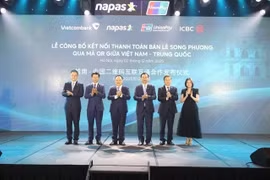
From April 3, more than one billion Chinese users of Alipay can conveniently make payments in Vietnam. (Photo: VNA)

Ant International President Douglas Feagin highlighted Vietnam’s strong potential for cross-border QR deployment, citing rapid digital transformation, a dynamic payment ecosystem and robust tourism growth. He emphasised that the initiative not only serves travellers but also enables small- and medium-sized enterprises to access global customers.

According to the State Bank of Vietnam, the initiative aligns with bilateral cooperation commitments on retail payment connectivity. Authorities are also working to soon enable outbound payments, allowing Vietnamese users to scan QR codes in China.

Once fully implemented in both directions, the system is expected to significantly drive tourism and trade growth between the two countries, while reinforcing Vietnam’s position in the regional digital economy./.

VNA

See more

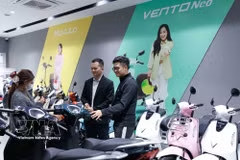
Hanoi’s roadmap to implement low-emission zones from July is providing a strong boost to the electric two-wheeler market (Photo: VNA)

Low-emission zone roadmap drives electric two-wheeler boom in Hanoi

From July 1, Hanoi will introduce time-based or area-based restrictions on petrol-powered motorcycles within Ring Road 1, with plans to expand coverage across the entire zone by 2028 and extend to areas within Ring Road 3 by 2030. The policy is expected to reshape travel habits for millions of urban residents.

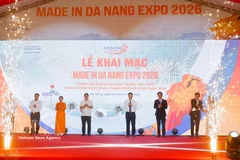
Delegates at the opening ceremony of the Made in Da Nang Expo 2026 (Photo: VNA)

Nearly 300 firms join Made in Da Nang Expo 2026

Speaking at the opening ceremony, Vice Chairman of the Da Nang People’s Committee Tran Chi Cuong said the exhibition is a large-scale trade promotion event aimed at showcasing products, connecting markets, and helping businesses enhance competitiveness while expanding domestic and export markets.

 Green production, standardised value chains key to fruit, vegetable sector growth

Green production, standardised value chains key to fruit, vegetable sector growth

Facing mounting pressure from increasingly stringent domestic and international standards, Vietnam’s fruit and vegetable sector is accelerating its shift toward green, safe, and sustainable production models. Beyond changing farming practices, localities and businesses are stepping up efforts to standardise value chains and build brands to achieve growth targets for 2026.

Hiep Phuoc Industrial Park in Ho Chi Minh City. (Photo: VNA)

Southern industrial real estate enters strategic growth phase

Key industrial hubs in the south, including Ho Chi Minh City, Dong Nai and Tay Ninh, are transitioning from a period driven largely by supply expansion and rising land prices to a more refined growth model. This new phase is shaped by infrastructure upgrades, supply chain restructuring, product improvement and greater emphasis on operational performance.

The launch of the Vietnam National Brand Week 2026 on April 16 (Photo: VNA)

Vietnam National Brand Week 2026 opens

Running from April 16 to 23 nationwide, the Vietnam National Brand Week 2026 marks the 18th anniversary of Vietnam Brand Day (April 20, 2008 – 2026).

Ca Mau is currently home to more than 5,200 fishing vessels, including nearly 1,900 boats measuring over 15 metres in length, and all have been equipped with vessel monitoring systems. (Illustrative photo: VNA)

Ca Mau drives changes among fishermen to tackle IUU fishing

Ca Mau is stepping up communication campaigns to disseminate legal regulations on IUU fishing, highlight recent enforcement results, and convey recommendations from the European Commission (EC)’s fifth inspection mission to fishing communities and relevant stakeholders.