Chinese tourists can make QR code payments in Vietnam from December 2

Under the plan, by early 2026, the reverse payment direction will also be completed, enabling Vietnamese travellers to use the apps of NAPAS member banks to scan QR codes for payment in China. Once fully operational in both directions, the system will form a complete cross-border QR payment ecosystem that supports tourism, trade and consumer spending between the two nations.

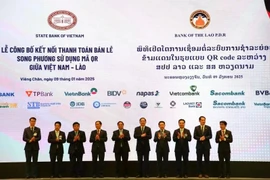
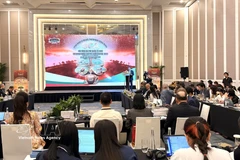
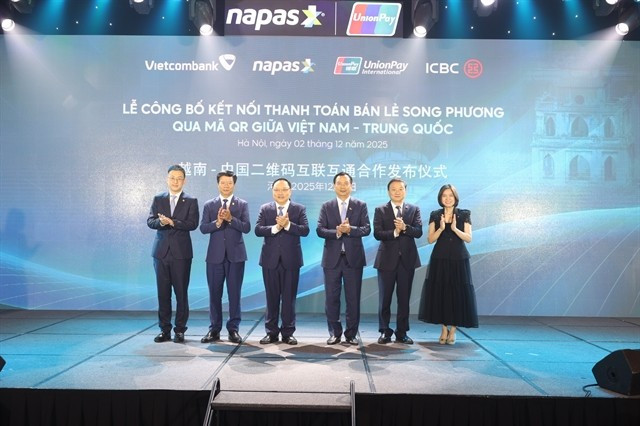
The ceremony launching the QR-code retail payment connectivity between Vietnam and China (Photo courtesy of NAPAS)

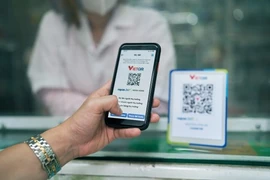
Hanoi (VNA) – From December 2, Chinese visitors to Vietnam can use their familiar mobile payment apps to scan VIETQR Global codes and make direct payments at shopping, dining and tourist locations nationwide.

The announcement was made at a ceremony in Hanoi launching bilateral QR-code retail payment connectivity between Vietnam and China. The event was organised by the National Payment Corporation of Vietnam (NAPAS), UnionPay International (UPI) of China, the Industrial and Commercial Bank of China (ICBC), and the Joint Stock Commercial Bank for Foreign Trade of Vietnam (Vietcombank).

Major retailers and service providers, including Central Retail supermarkets, Highlands Coffee and Sun World tourist sites, are now ready to accept QR payments from Chinese travellers. The initiative is expected to offer a faster, safer and more convenient payment experience, while helping Vietnamese businesses better tap one of their largest visitor markets.

The new service follows more than a year of technical coordination since UPI and NAPAS signed an MoU witnessed by high-ranking leaders of both countries in October 2024.

Under the plan, by early 2026, the reverse payment direction will also be completed, enabling Vietnamese travellers to use the apps of NAPAS member banks to scan QR codes for payment in China. Once fully operational in both directions, the system will form a complete cross-border QR payment ecosystem that supports tourism, trade and consumer spending between the two nations.

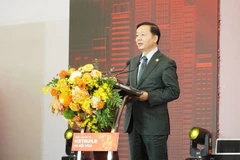
Vice President and CEO of UnionPay International (UPI) Larry Wang said that Vietnam is a key market for China in both trade and tourism, and UnionPay has already established an extensive payment network in the country. The cross-border QR initiative leverages local currency settlement mechanisms, contributing to the internationalisation of the renminbi (RMB).

Enhancing cross-border payment convenience, he said, will further facilitate economic, trade and people-to-people exchanges between China and Vietnam. UPI will continue to work with NAPAS to develop a safe and efficient regional payment ecosystem.

NAPAS CEO Nguyen Quang Minh noted that, under the guidance of the State Bank of Vietnam, NAPAS has expanded international connectivity as the operator of the national retail payment infrastructure.

The bilateral QR initiative, he emphasised, reflects close cooperation among NAPAS, UPI and participating banks to deliver seamless payments for users in both countries, strengthen financial connectivity, encourage local currency payments and promote bilateral trade and tourism./.

VNA

See more

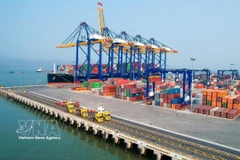
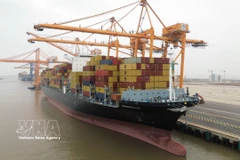
The vessel carrying the 2 millionth TEU arrives at Hai Phong Port. (Photo:VNA)

Hai Phong Port reaches 2-million-TEU milestone

Handling the 2 millionth TEU in 2025 not only demonstrates Hai Phong Port’s operational capacity and the collective efforts of its workforce, but also highlights its increasingly important role in regional and global supply chains, the confidence of shipping lines, logistics firms and the business community, and the effectiveness of policies to improve the investment climate and strengthen maritime infrastructure and services.

Melons labelled with traceability codes on display at the Song Van agricultural produce store in Ninh Binh city, Ninh Binh province. (Photo: VNA)

Tracing origins hindered by fragmented data systems

As the Government accelerates the digital economy, establishing a unified national traceability system has become a crucial move to end data fragmentation and disconnection among ministries, sectors and localities.

Hyundai unveils its new Avante Hybrid model in Seoul, the Republic of Korea, on August 13, 2020. (Photo: Yonhap/VNA)

Tax cuts poised to ignite Vietnam’s hybrid vehicle boom from 2026

Experts forecast that 2026-2030 will mark a period of strong growth for hybrid vehicles in Vietnam, a trend that will invigorate the automotive sector while supporting national objectives on emissions reduction, sustainable development and the broader transition to green mobility.

Illustrative image (Photo: VNA)

Vietnam targets 1 billion USD in banana exports

Bananas have been identified as a priority product under the Project for the Development of Key Fruit Crops to 2025, with a vision to 2030, approved in October 2022. Under the plan, banana acreage is projected to reach 165,000–175,000ha by 2030, with output of 2.6–3 million tonnes.

Deputy Minister of Foreign Affairs Nguyen Minh Hang (Photo: VNA)

Event connects Vietnamese businesses with African countries

Deputy Foreign Minister Nguyen Minh Hang held that to develop Vietnam – Africa ties more strongly and substantively, it is necessary to promote the engagement of businesses, and that the Government will create favourable conditions for them to enhance fruitful cooperation.

Deputy Prime Minister Ho Duc Phoc (R) and Independent Non-executive Chairman of AIA Mark Tucker at their meeting in Hanoi on December 12. (Photo: VNA)

AIA Group envisions long-term investment, cooperation in Vietnam

Over 25 years of operation in Vietnam, AIA has achieved positive results. Its premium revenue ranks among the top five life insurers, reaching nearly 14.83 trillion VND (563.71 million USD) in 2024 and an estimated 15.73 trillion VND in 2025, equivalent to around 10% of the market share.

A view of the 2025 Japan business roundtable in HCM City on December 12. (Photo: VNA)

Ho Chi Minh City courts Japanese investment with growth blueprint

Ha underscored the pivotal contributions of Japanese firms, which have long supported local socio-economic progress through major infrastructure projects, industrial zones and workforce training courses. To date, Japanese companies have invested more than 15 billion USD in over 2,200 projects, reflecting sustained confidence and commitment to the market.

Deputy Prime Minister Bui Thanh Son receives Kounlaphanh Vongnathy, Vice President of Phongsupthavy Group, in Hanoi on December 12, 2025. (Photo: VNA)

Lao group urged to deepen energy ties with Vietnam

Deputy Prime Minister Bui Thanh Son has commended Phongsupthavy Group as one of Laos’ leading investors supplying electricity to Vietnam, noting its pledge to ramp up power exports and actively contribute to the implementation of energy cooperation agreements endorsed by senior leaders of the two Parties and States.