Vietnam to facilitate list of 10 strategic technology groups from July 1

Under the decision, Vietnam’s strategic technology framework comprises 10 major technology groups covering key sectors critical to the country’s long-term development and competitiveness.

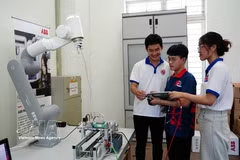
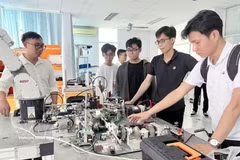
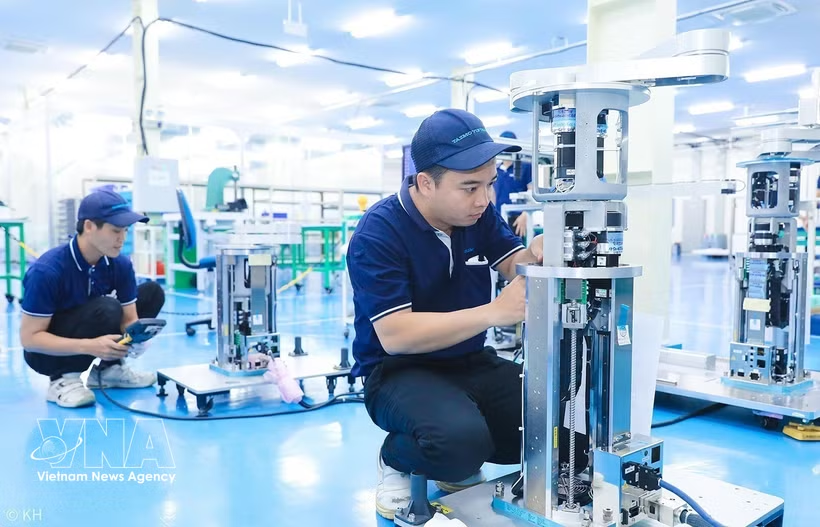
TAZMO Vietnam Company, a 100% Japanese-owned firm located in Long Hau Industrial Park of Tay Ninh province, is one of the pioneers in manufacturing robots and high-tech equipment for the semiconductor industry. (Photo: VNA)

Hanoi (VNA) – Prime Minister Le Minh Hung has issued Decision No. 21/2026/QD-TTg promulgating the list of strategic technologies and strategic technology products, set to take effect from July 1, 2026.

Under the decision, Vietnam’s strategic technology framework comprises 10 major technology groups covering key sectors critical to the country’s long-term development and competitiveness.

The strategic technology groups include digital technologies such as artificial intelligence, big data, digital twins, cloud computing, edge computing, the Internet of Things and blockchain; next-generation mobile network technologies; robotics and automation; advanced biotechnology and biomedicine; advanced energy and materials technologies; semiconductor chip technologies; cybersecurity and quantum technologies; marine, ocean and underground technologies; aerospace technologies; and high-speed and urban railway technologies.

The decision also sets out a list of 30 strategic technology products divided into two categories.

The first group consists of strategic technology products with established markets and strong potential to directly drive economic growth. These include Vietnamese large language models, virtual assistants and specialised AI systems; edge AI cameras; digital twin platforms; cloud computing platforms; blockchain infrastructure and traceability systems; 5G and 5G-Advanced equipment and systems; autonomous mobile and industrial robots; smart manufacturing solutions; and cybersecurity systems for critical infrastructure and national databases.

Other products in this group include next-generation human vaccines; cell therapies using stem and immune cells; 3D-printing-based personalised medical production systems; smart biosensor systems; advanced biological products for agriculture, livestock and aquaculture; biomass and agricultural by-product processing systems; next-generation crops and livestock developed through gene editing and biotechnology; advanced functional materials; energy storage systems and advanced batteries; green hydrogen and biofuel systems; high-voltage electrical equipment; carbon capture, utilisation and storage systems; and unmanned aerial vehicles (UAVs) alongside UAV monitoring and suppression systems.

The second group focuses on technologies expected to create new growth drivers, serve as foundational technologies for the future, and strengthen national autonomy in security and defence.

These products include specialised semiconductor chips; quantum communications, quantum computing and quantum sensing technologies; systems for deep processing of minerals, oil, gas and rare earths; deep-sea, underground and offshore energy exploration technologies; small modular nuclear reactors (SMRs); low-earth-orbit satellite constellations for Earth observation; high-speed railway construction works; and industrial platforms, vehicles and integrated systems for high-speed and urban railways.

According to the decision, the Ministry of Science and Technology will coordinate with relevant ministries and agencies to periodically review and assess the lists based on socio-economic development needs in each period, before submitting updates to the Prime Minister for approval.

The new decision will replace Decision No. 1131/QD-TTg dated June 12, 2025 on strategic technologies and strategic technology products./.

VNA

See more

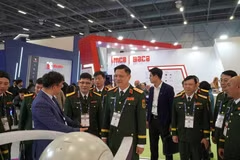
The Vietnamese delegation attends the SAHA 2026 International Defence & Aerospace Exhibition in Istanbul. (Photo: qdnd.vn)

Vietnam attends SAHA 2026 defence, aerospace exhibition in Türkiye

Vietnam’s participation in SAHA 2026 International Defence & Aerospace Exhibition in Istanbul reflects the country’s consistent policy of enhancing international defence integration and promoting defence industry cooperation towards self-reliance, self-strengthening, modernisation and dual-use development.

Vietnam, Austria seek deeper cooperation in cybersecurity

Vietnam, Austria seek deeper cooperation in cybersecurity

The Austria-Vietnam Cybersecurity Forum was held in a hybrid format in Vienna on May 5, bringing together policymakers, businesses, and experts to explore opportunities for bilateral cooperation while advancing policy dialogue on cybersecurity.

Students engage in hands-on learning through the application of digital technology software. (Illustrative photo: VNA)

Resolution 57 delivers tangible gains in digital life of citizens

The resolution has generated not only strategic momentum but also practical impact, as digital technologies are increasingly embedded in daily activities, driving socio-economic development and laying a solid foundation for rapid and sustainable growth in the new phase.

The Duc Giang General Hospital and Vietnam Post Corporation jointly launch a model applying drones to medical transport services. (Photo: hanoimoi.vn)

Vietnam charts UAV strategy as Hanoi eyes low-altitude economy

Vietnam is accelerating a national strategy to develop unmanned aerial vehicles (UAVs) as a cornerstone of its emerging low-altitude economy, with Hanoi positioning itself to pilot new governance models, regulatory sandboxes and early-stage applications in controlled airspace.

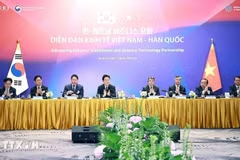
Vietnamese Prime Minister Le Minh Hung and the Republic of Korea's President Lee Jae Myung attend an economic forum in Hanoi on April 23. (Photo: VNA)

SK Group partners to build AI ecosystem in Vietnam

SK Innovation and SK Telecom signed MoUs with Nghe An province and the National Innovation Centre of Vietnam to advance AI ecosystem development and support the country’s long-term growth strategy.

CMC signs an AI cooperation deal with Korean partner FuriosaAI (Photo: CMC)

CMC signs AI cooperation deal with Korean partner

Under the agreement, CMC Global - a member of CMC Corporation - and FuriosaAI will collaborate on developing AI application software, leveraging their respective technological strengths and customer ecosystems to roll out joint projects in the coming period.

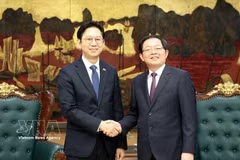
Vietnamese Deputy Prime Minister Ho Quoc Dung (R) and Deputy Prime Minister and Minister of Science and ICT of the Republic of Korea (RoK) Bae Kyung Hoon in Hanoi on April 22, 2026. (Photo: VNA)

Vietnam, RoK promote science, technology cooperation

Deputy Prime Minister Ho Quoc Dung encouraged Korean enterprises to scale up investment in Vietnam, particularly in priority sectors such as infrastructure development, high-tech electronics manufacturing, semiconductors, big data, biotechnology, and smart urban development.

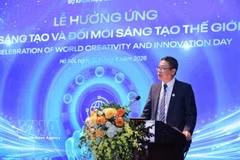
Deputy Minister of Science and Technology Le Xuan Dinh delivers opening remarks at the launching ceremony of the Scientific Innovation Competition 2026 on April 21. (Photo: VNA)

Scientific Innovation Competition opens to OVs, boosting global talent linkages

In response to World Creativity and Innovation Day 2026, the contest provides a platform for individuals and teams nationwide who are passionate about research, creativity, and practical application of science, while promoting a movement of scientific inquiry within the community, particularly among young people.

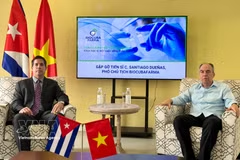
Dr. Santiago Dueñas Carrera (left), Vice President of Cuba’s BioCubaFarma group, and Cuban Ambassador to Vietnam Rogelio Polanco Fuentes at the press briefing in Hanoi on April 21 (Photo: VNA)

Biotechnology cooperation – new driver of Vietnam - Cuba relations

A representative from BioCubaFarma emphasised that the longstanding Vietnam – Cuba friendship provides a solid foundation for further advancing comprehensive cooperation, especially in science and technology – a key driver of socio-economic development and national healthcare sovereignty.

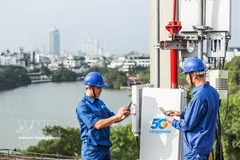
A Viettel 5G base station in Dong Hai ward, Khanh Hoa province (Photo: VNA)

Vietnam develops digital infrastructure aligned with demands of AI era

The data centre and cloud computing sector is entering a phase of redefinition. Infrastructure is no longer merely a backbone for data storage and processing, but is evolving into a foundational platform powering complex digital ecosystems—from AI and advanced analytics to real-time applications.

Workers manufacture products at Keystone Electrical Vietnam Co., Ltd. in the Lien Ha Thai industrial park. (Photo: VNA)

Vietnam turning ideas into value, aspirations into reality

Resolution No. 57 of the Politburo on breakthroughs in science-technology development, innovation, and national digital transformation is being vigorously implemented nationwide. Within this framework, innovation is increasingly recognised as a key engine for rapid and sustainable growth.