Vietnam needs groundbreaking policies to develop major tech firms: Experts

The country is now home to around 80,000 technology firms, 1.4 times higher than the figure in 2020. Total revenue of the sector in 2025 was estimated at 198 billion USD, up nearly 26% from 2024.

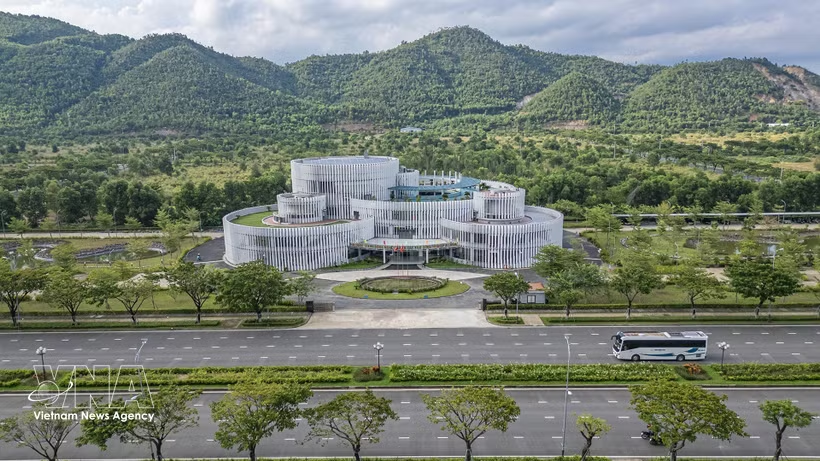
The headquarters of the Da Nang Hi-Tech Park and Industrial Zones Authority. (Photo: VNA)

Hanoi (VNA) – Vietnam needs groundbreaking mechanisms and policies to develop large-scale technology enterprises capable of mastering core technologies and shaping markets if the country wants to achieve double-digit economic growth driven by science-technology, innovation and digital transformation, experts have said.

In recent years, Vietnamese technology enterprises have steadily expanded in scale and increased their contributions to the nation's economic growth.

The country is now home to around 80,000 technology firms, 1.4 times higher than the figure in 2020. Total revenue of the sector in 2025 was estimated at 198 billion USD, up nearly 26% from 2024.

Vietnamese digital products and services have also made inroads into demanding markets such as the US, Europe and Japan, generating annual export revenue of roughly 15 billion USD and demonstrating the growing global competitiveness of Vietnamese technology.

Digital technology enterprises have become a key driving force behind new growth engines. Fifth-generation (5G) mobile coverage has reached 90% of the population, while e-commerce revenue was estimated to hit 36 billion USD in 2025, triple the figure recorded in 2020.

Digital payments have also expanded rapidly, with total value of cashless transactions in 2025 estimated at 26 times higher than the country’s gross domestic product (GDP), supported by more than 20 billion transactions.

At the same time, technology enterprises have accelerated digital transformation across sectors including energy, transport, environment, healthcare and education.

Despite the progress, experts noted that the technological capacity and competitiveness of Vietnamese enterprises remain uneven and relatively limited. Vietnam still lacks major technology corporations with sufficient financial strength, technological capability and international influence to lead supply chains and global market expansion.

A major challenge is the shortage of high-quality digital human resources, particularly in emerging fields such as semiconductors, artificial intelligence (AI) and chip design.

Analysts attributed these shortcomings to outdated management mindset that has failed to keep pace with technological advances, along with concerns over accountability that have discouraged pilot models and experimental mechanisms.

Support policies for technology firms are also considered insufficiently practical, while administrative procedures remain cumbersome and often fail to reflect the unique characteristics of technology enterprises.

In addition, many firms have still faced constraints in financial resources, governance capacity and long-term strategic vision. A lack of trust and connectivity among businesses has also hindered the formation of alliances and ecosystems which are strong enough to compete internationally.

According to experts, Vietnam must establish groundbreaking policies to nurture leading technology enterprises that can serve as “locomotives” for the broader ecosystem.

These firms would help small- and medium-sized enterprises (SMEs) gradually dominate the domestic market before expanding globally and integrating more deeply into international supply chains.

Experts also stressed that the State should act as a “major customer” by introducing procurement policies and public orders for Vietnamese digital products and services. They proposed encouraging government agencies to shift from direct public investment to the outsourcing of comprehensive digital services, helping technology enterprises secure more stable financial resources.

At the same time, Vietnam needs stronger policies to train, attract and retain high-quality technology workers.

Experts said training models should shift from “teaching what schools have” to “training what the market needs,” while expanding work-integrated learning programmes to ensure graduates possess practical skills.

They added that policy support alone would not be enough. Vietnam’s ambitions to become a new technology hub in the region and the world would also require pioneering spirit, bold mindset and a willingness among technology enterprises to take risks and pursue breakthroughs./.


VNA

See more

Deputy Prime Minister Ho Quoc Dung speaks at the meeting. (Photo: VNA)

Deputy PM demands full disbursement for sci-tech in 2026

As of May 12, total disbursed capital reached 7.95 trillion VND, equivalent to 14.78% of the Prime Minister’s plan. Of this, central budget disbursement hit 4.06 trillion VND, or 14.8% of the target, while local budget disbursement exceeded 3.88 trillion VND, or 14.75%.

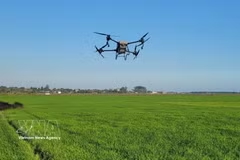
Using drones to spray pesticides in the An Nhut rice fields in Long Dien commune of Ho Chi Minh City. (Photo: VNA)

Solving technology challenge through the “three-party linkage”

According to Pham Duc Nghiem, Deputy Director of the Department of Startups and Technology Enterprises under the Ministry of Science and Technology, the “three party” linkage model involving the State, research institutes/universities and enterprises is becoming essential for developing strategic technologies. Enterprises provide practical problems, universities and research institutes develop technological solutions, while the State creates support mechanisms and policies to accelerate commercialisation.

Da Nang city's leaders present flowers to congratulate the Union of Science and Technology Associations in Da Nang on Vietnam Science and Technology Day (May 18). (Photo: VNA)

Human capital key to Da Nang’s digital economy ambitions: experts

Vo Cong Tri, Chairman of the Union of Science and Technology Associations (VUSTA) in Da Nang, described high-quality human resources as a “key driver” in the city’s transformation. Da Nang is already regarded as one of Vietnam’s leading “university cities,” with 19 higher education institutions and a high concentration of students and skilled workers. The city is also home to a growing network of science and technology organisations that are helping to foster an innovation ecosystem.

Delegates at the publication launching ceremony. (Photo: VNA)

Vietnam News Agency debuts monthly technology publication

Each 40-page issue is expected to pack 3-5 chapters, delivering a panoramic view of the global sci-tech landscape alongside in-depth analyses of emerging technology trends. The publication aims to explain strategic shifts that will shape the country’s development and examine the sci-tech, innovation and digital transformation policies of other nations.

A worker assembles ultra-precision micro-components used in semiconductor chip production. (Photo: VNA)

Vietnam prioritises 70 high technologies for strategic development

Issued under Decision No. 23/2026/QD-TTg dated May 15, 2026, the list covers a wide range of technologies, including artificial intelligence (AI), big data and data analytics, cloud and edge computing, distributed and high-performance computing, Internet of Things (IoT), blockchain, quantum technology, renewable and clean energy, advanced energy storage, AI-powered real-time disaster forecasting and warning systems, and next-generation microbiology technologies.

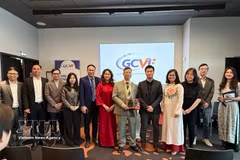
Vietnamese Ambassador to France Trinh Duc Hai (sixth from the right) and the leadership of Global Connect Vietnam France. (Photo: VNA)

Vietnamese association launched in France to foster technology, AI cooperation

In the context of the growing Comprehensive Strategic Partnership between Vietnam and France, Hai said GCVF should position itself as a bridge for knowledge and technology transfer, bringing scientific and technological achievements from France and Europe to support Vietnam’s practical development needs.

Party General Secretary and State President To Lam presents a statute of President Ho Chi Minh to VNU-Hanoi. (Photo: VNA)

Top Vietnamese leader’s vision puts scientists at core of growth drive

As the country enters a new era, the Party and State have designated sci-tech and and innovation as central priorities, Kiem said, adding that VNU-Hanoi, alongside other higher education establishments, must not only produce high-caliber talents but also function as a hub for knowledge transfer and groundbreaking innovation.

Illustrative image (Photo: VNA)

Korean robotics, AI firms interested in Vietnam

KOTRA said it is teaming up with the Korea Institute for Robot Industry Advancement to run the “K-Robot Pavilion"” at the 23rd Vietnam International Exhibition on Machinery, Equipment, Technology and Industrial Products (VINAMAC EXPO 2026) in Hanoi from May 14-16.

Party General Secretary and State President To Lam (left) and Sri Lankan President Anura Kumara Dissanayake come to lay flowers in tribute to late President Ho Chi Minh at the Colombo Public Library on May 8. (Photo: VNA)

Sri Lanka eyes breakthrough sci-tech cooperation with Vietnam

A Sri Lankan official has expressed confidence that science, technology and digital transformation will become a key driver in shifting bilateral ties from traditional friendship to a partnership grounded in innovation and inclusive economic growth.

Vietnam promotes cooperation with United Nations on crime prevention

Vietnam promotes cooperation with United Nations on crime prevention

Vietnam highly values the support of the United Nations Office on Drugs and Crime (UNODC) in strengthening national capacity in crime prevention and criminal justice, drug control, and addressing emerging challenges, particularly cybercrime, said Ambassador Vu Le Thai Hoang.

Visitors tour an exhibition showcasing technology and cultural products. (Photo: VNA)

VIPC Summit 2026 highlights Vietnam’s ambitions in strategic technologies

Through the VIPC Summit 2026, Vietnam aims to reaffirm its commitment to building a transparent, competitive and internationally integrated investment environment, while promoting new financial mechanisms and institutions to make science, technology, innovation and digital transformation strategic growth motivation in the coming years.

At the “Digital Trust in Finance 2026” forum (Photo: VNA)

Forum discusses digital trust in finance during AI era

Deputy Minister of Public Security Sen. Lieut. Gen Pham The Tung told the forum that Vietnam’s financial and banking industry is racing through a digital overhaul, creating major opportunities as the country aims for double-digit growth in 2026 and beyond.

Citizens obtain queue numbers for administrative procedures at the Public Service Center of Hanoi's Hoan Kiem ward (Photo: VNA)

All citizen-government transactions to go fully digital by 2035

Looking ahead to 2035, Vietnam envisions becoming a comprehensive and sustainable digital nation where all transactions between citizens and government agencies are conducted online. National databases, with population data at the core, will be interconnected and efficiently utilised to support smart governance and real-time decision-making.