Hanoi (VNA) – Vietnam is accelerating efforts to develop a national standards framework to support strategic technologies and strategic products, aiming to strengthen technological self-reliance and enhance national competitiveness in the new era.
The move follows the implementation of Resolution No. 57-NQ/TW issued by the Politburo on December 22, 2024 on breakthroughs in science and technology development, innovation and national digital transformation. On April 30, the Government promulgated Decision No. 21/QD-TTg on the list of strategic technologies and products. Most recently, on May 15, the Government approved the National Standards Strategy for 2026–2035 under Decision No. 876/QD-TTg.
The strategy is designed to promote the adoption of international, regional and Vietnamese standards to serve the development of strategic technologies, strategic products and key economic sectors.
Under the roadmap, Vietnam aims by 2030 to harmonise 75% of Vietnamese standards with international, regional or foreign standards of developed countries. The country also targets full compatibility between all sectors in the Vietnamese standards classification framework and Level-2 classifications of the International Classification for Standards (ICS) developed by the International Organisation for Standardisation (ISO).
Particularly in fields related to strategic technologies and products and key industries, Vietnam seeks representation in 60% of relevant technical committees under international organisations such as ISO, the International Electrotechnical Commission and the International Telecommunication Union. The country also aims to participate in IEC technical committees related to smart urban development.
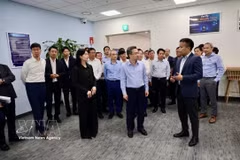
Nguyen Nam Hai, Chairman of the Commission for the Standards, Metrology and Quality of Vietnam, said the agency is accelerating the development of national standards and technical regulations for strategic technologies and products. The initiative is expected to support state management while facilitating research, development, testing and commercialisation activities.
According to Hai, Vietnam is encouraging the direct application of international and regional standards suited to domestic conditions in order to shorten standardisation timelines, improve global compatibility and enable Vietnamese technology products and services to integrate more deeply into global value chains.
The country is also striving to co-chair or lead two to three international standardisation projects in strategic technology-related fields and sign at least 20 standardisation cooperation agreements with foreign partners and international organisations.
Since the implementation of Resolution 57, the commission has focused on building a standards system capable of meeting 70–80% of management, production, business and service requirements across the economy. The strategy places particular emphasis on digital economy development, artificial intelligence, smart manufacturing, e-commerce, data economy and creative industries.
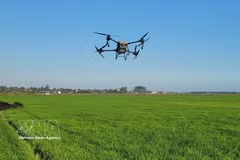
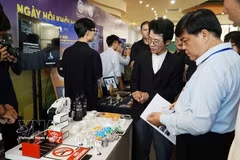
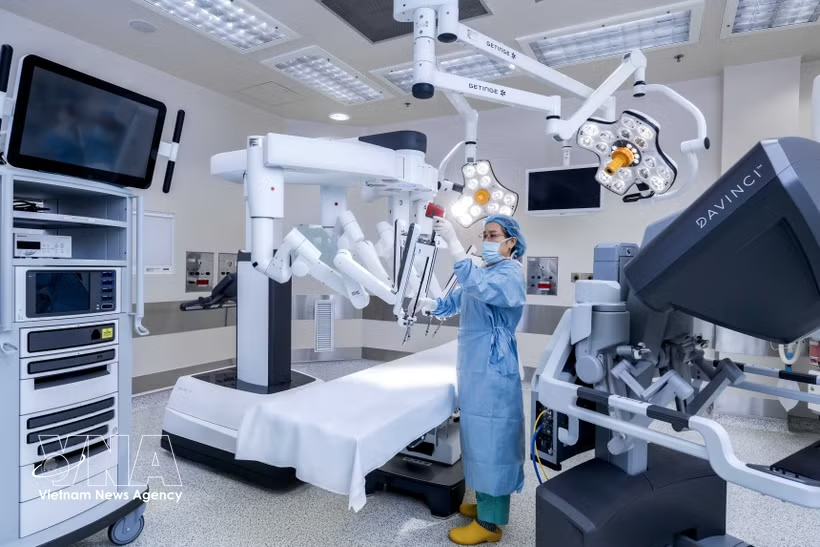
To date, around 400 national standards systems have been issued covering key sectors and products, including petrol, greenhouse gas emissions auditing methods based on the Intergovernmental Panel on Climate Change (IPCC)’s guidelines, commercial robotics, unmanned aerial vehicles (UAVs), nuclear power, traceability systems, online journalism and virtual reality technologies.
Vietnam is now transitioning from a position of merely adopting international standards toward playing a more active role in shaping them, with standards increasingly viewed as a strategic tool to improve market access, foster innovation, accelerate digital and green transformation, and strengthen long-term competitiveness./.
See more
Vietnam needs groundbreaking policies to develop major tech firms: Experts
The country is now home to around 80,000 technology firms, 1.4 times higher than the figure in 2020. Total revenue of the sector in 2025 was estimated at 198 billion USD, up nearly 26% from 2024.
Deputy PM demands full disbursement for sci-tech in 2026
As of May 12, total disbursed capital reached 7.95 trillion VND, equivalent to 14.78% of the Prime Minister’s plan. Of this, central budget disbursement hit 4.06 trillion VND, or 14.8% of the target, while local budget disbursement exceeded 3.88 trillion VND, or 14.75%.
VinFuture 2026: Global partner network expands 14-fold after six seasons
With 17,154 nominating partners from 117 countries and territories across all five continents, the scale of the prize has grown by around 16% compared with the 2025 season and more than 14-fold compared with its inaugural year in 2021.
Da Nang exhibition showcases advanced German scientific research
The exhibition reflects the important role of science within German culture while also showcasing Germany’s broad international scientific cooperation network for students and young researchers worldwide.
Solving technology challenge through the “three-party linkage”
According to Pham Duc Nghiem, Deputy Director of the Department of Startups and Technology Enterprises under the Ministry of Science and Technology, the “three party” linkage model involving the State, research institutes/universities and enterprises is becoming essential for developing strategic technologies. Enterprises provide practical problems, universities and research institutes develop technological solutions, while the State creates support mechanisms and policies to accelerate commercialisation.
Young Vietnamese intellectuals in Thailand promote innovation cooperation
Vietnamese students and intellectuals in Thailand could contribute to promoting Vietnam’s image internationally by actively organising and participating in Vietnamese cultural festivals and exchange activities.
Human capital key to Da Nang’s digital economy ambitions: experts
Vo Cong Tri, Chairman of the Union of Science and Technology Associations (VUSTA) in Da Nang, described high-quality human resources as a “key driver” in the city’s transformation. Da Nang is already regarded as one of Vietnam’s leading “university cities,” with 19 higher education institutions and a high concentration of students and skilled workers. The city is also home to a growing network of science and technology organisations that are helping to foster an innovation ecosystem.
Vietnam News Agency debuts monthly technology publication
Each 40-page issue is expected to pack 3-5 chapters, delivering a panoramic view of the global sci-tech landscape alongside in-depth analyses of emerging technology trends. The publication aims to explain strategic shifts that will shape the country’s development and examine the sci-tech, innovation and digital transformation policies of other nations.
Vietnamese association launched in France to foster technology, AI cooperation
In the context of the growing Comprehensive Strategic Partnership between Vietnam and France, Hai said GCVF should position itself as a bridge for knowledge and technology transfer, bringing scientific and technological achievements from France and Europe to support Vietnam’s practical development needs.
Top Vietnamese leader’s vision puts scientists at core of growth drive
As the country enters a new era, the Party and State have designated sci-tech and and innovation as central priorities, Kiem said, adding that VNU-Hanoi, alongside other higher education establishments, must not only produce high-caliber talents but also function as a hub for knowledge transfer and groundbreaking innovation.
Korean robotics, AI firms interested in Vietnam
KOTRA said it is teaming up with the Korea Institute for Robot Industry Advancement to run the “K-Robot Pavilion"” at the 23rd Vietnam International Exhibition on Machinery, Equipment, Technology and Industrial Products (VINAMAC EXPO 2026) in Hanoi from May 14-16.
Party official calls on Samsung Vietnam to expand R&D cooperation
The Party official highlighted Samsung’s important role in Vietnam’s economy as the country’s largest foreign investor, noting that the Samsung R&D Centre in Hanoi is the firm’s largest in Southeast Asia.
Vietnam approves digital tech blueprint through 2030, targets 55 bln USD in exports
The scheme defines digital technology as a foundational industry, positioning it as a key growth driver to lift productivity, quality, and national competitiveness.
Sri Lanka eyes breakthrough sci-tech cooperation with Vietnam
A Sri Lankan official has expressed confidence that science, technology and digital transformation will become a key driver in shifting bilateral ties from traditional friendship to a partnership grounded in innovation and inclusive economic growth.
Ho Chi Minh City eyes to attract high-tech capital with improved digital infrastructure
According to Deputy Director of the municipal Department of Science and Technology Nguyen Huu Yen, Ho Chi Minh City will continue investing in digital infrastructure and smart governance in 2026, with a target of expanding 5G coverage to 70-80% of the population.
Vietnam promotes cooperation with United Nations on crime prevention
Vietnam highly values the support of the United Nations Office on Drugs and Crime (UNODC) in strengthening national capacity in crime prevention and criminal justice, drug control, and addressing emerging challenges, particularly cybercrime, said Ambassador Vu Le Thai Hoang.
VIPC Summit 2026 highlights Vietnam’s ambitions in strategic technologies
Through the VIPC Summit 2026, Vietnam aims to reaffirm its commitment to building a transparent, competitive and internationally integrated investment environment, while promoting new financial mechanisms and institutions to make science, technology, innovation and digital transformation strategic growth motivation in the coming years.
Forum discusses digital trust in finance during AI era
Deputy Minister of Public Security Sen. Lieut. Gen Pham The Tung told the forum that Vietnam’s financial and banking industry is racing through a digital overhaul, creating major opportunities as the country aims for double-digit growth in 2026 and beyond.
All citizen-government transactions to go fully digital by 2035
Looking ahead to 2035, Vietnam envisions becoming a comprehensive and sustainable digital nation where all transactions between citizens and government agencies are conducted online. National databases, with population data at the core, will be interconnected and efficiently utilised to support smart governance and real-time decision-making.
Experts hope for expanded Vietnam-India innovation cooperation
Indian experts voiced confidence that the state visit by Party General Secretary and State President To Lam would create fresh momentum for Vietnam-India cooperation in innovation, digital technology and startups, contributing to the more substantive and effective development of the two countries’ Enhanced Comprehensive Strategic Partnership.