Hanoi court begins trial of former Health Minister over State asset losses

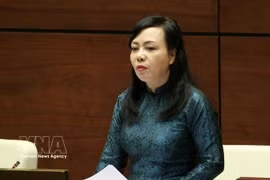
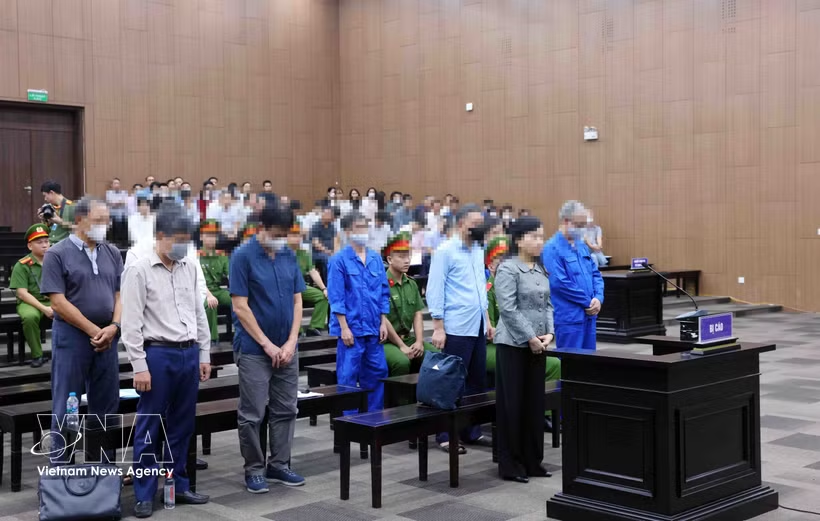
The Hanoi People’s Court on May 20 opened the first-instance trial of former Minister of Health Nguyen Thi Kim Tien and nine other defendants for violations tied to the State property management and use at the Ministry of Health (MoH) and relevant units.

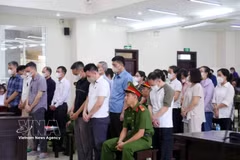
Defendants at the trial (Photo: VNA)

Hanoi (VNA) – The Hanoi People’s Court on May 20 opened the first-instance trial of former Minister of Health Nguyen Thi Kim Tien and nine other defendants for violations tied to the State property management and use at the Ministry of Health (MoH) and relevant units.

Along with Tien, six others were charged with “violating regulations on the management and use of State property, causing losses and wastefulness”, namely Nguyen Kim Trung, former Deputy Director of the Management Board of Key Medical Projects and former Deputy Director of the MoH’s Department of Medical Equipment and Works; Tran Van Sinh, former Deputy Director of the Management Board of Key Medical Construction Projects under the MoH; and Dao Xuan Sinh, former Director of the SHT Vietnam Investment, Construction and Consulting JSC; Nguyen Doan Tu, former Deputy Director of the MoH’s Department of Medical Equipment and Works; Le Van Cu, former Deputy Director of the Institute of Construction Economics under the Ministry of Construction; and Hoang Xuan Hiep, Deputy Director of the Institute of Construction Economics.

Nguyen Chien Thang, former Director of the Management Board of Key Medical Projects and Nguyen Huu Tuan, former Director of the Management Board of Key Medical Construction Projects faced charges of “violating regulations on the management and use of State property, causing losses and wastefulness” and “taking bribes”.

Le Thanh Thiem, Director of Sao Nam Song Hong Co., Ltd., was brought to trial for “fraudulent appropriation of property”.

According to the indictment, although the Prime Minister had not approved the hiring of foreign consultants for project formulation and technical and construction design for the second campuses of Bach Mai Hospital and Viet Duc University Hospital, Thang still signed proposals for Tien to issue decisions permitting the engagement of foreign consultants and approving plans for architectural design selection.

The proposals also let VK Architects and Engineers prepare and present design options and approve the results for both projects. Based on the approved plans, Thang directed subordinates, including Trung, Tuan and Sinh to finalise and legitimise contractor appointment dossiers in violation of the law, enabling the VK Studio–Institute of Medical Equipment consortium to carry out consultancy packages TV4/2014 and TV5/2014. The actions, in coordination with Sinh, caused state losses exceeding 70 billion VND (2.65 million USD).

To keep projects on schedule, Thang also directed that bidding packages not be split according to technical characteristics and delivery sequence, citing the need for synchronisation. Though the proposal lacked sufficient grounds for such non-division, Nguyen Doan Tu, then Deputy Director of the Department of Medical Equipment and Works, chaired appraisal meetings and submitted documents for Tien to approve.

Following Tien’s approval, Thang directed the preparation and approval of bidding documents, contractor selection, and launch of packages XDBM-01 and XDVD-01 in breach of regulations. The irregularities caused delays, suspension and failure to meet goals, wasting more than 733 billion VND of State assets.

The trial is expected to last one week./.

VNA

See more

The Red River Scenic Boulevard Axis is designated as one of nine key development corridors of Hanoi. (Photo: VNA)

Hanoi details multi-billion-USD Red River scenic boulevard axis project

Under the capital’s master plan with a 100-year vision, the Red River Scenic Boulevard Axis is designated as one of nine key development corridors of Hanoi. It is envisioned as a central green spatial corridor, while also functioning as an economic, commercial, service, cultural, creative, and urban development axis along the Red River.

Defendants at the appellate trial in Hanoi on May 20 (Photo: VNA)

Appeal trial opens in food safety bribery case

The total amount of bribes received by the defendants in the case exceeded 94 billion VND, with former Director of the Vietnam Food Safety Authority (FSA) Nguyen Thanh Phong alone pocketing 43.9 billion VND.

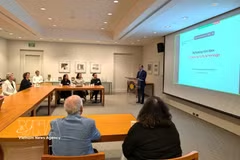
Vietnamese Ambassador to the US Nguyen Quoc Dung speaks at the seminar. (Photo: VNA)

Vietnam – US partnership expands in culture preservation, promotion

The May 18 seminar, themed “Reframing Vietnam,” at the National Museum of Asian Art (NMAA) under Smithsonian Institution in Washington, D.C., is expected to generate fresh momentum and frameworks for cooperation among cultural agencies, museums, art funds and experts from the two countries, helping bring Vietnam’s cultural image closer to American and international public in the time to come.

Visitors to an exhibition and test-drive programme for electric vehicles organised in Cau Giay ward, Hanoi, on May 16 by the municipal People's Commitee and relevant agencies. (Photo: VNA)

Hanoi proposes subsidies to accelerate shift to electric vehicles

Under a draft resolution currently open for public feedback by the municipal People’s Committee, residents with permanent or temporary residence registration in Hanoi for at least two consecutive years, who own petrol-powered motorbikes registered before the resolution takes effect, will be eligible for support when purchasing electric motorbikes priced at 10 million VND or more.

The copyright crackdown is broadly viewed as an inevitable step in Vietnam’s cultural industry development. (Illustrative photo: VNA)

Healthy digital content market in the making

The sharper crackdown is rapidly redrawing how online entertainment is distributed and consumed, while gradually reshaping public awareness and responsibility toward copyright protection.

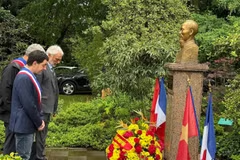
A view of Place Ho Chi Minh in Persan, France. (Photo: VNA)

Place preserving memories of President Ho Chi Minh in France

Although there is little publicly available documentation confirming exactly when Place Ho Chi Minh was established, French urban historians suggest that most streets and public spaces named after the Vietnamese leader in France emerged between the 1960s and 1980s, during the height of anti-war movements and solidarity campaigns supporting Vietnam across working-class towns and left-leaning suburbs around Paris.

Vietnamese Ambassador to Bangladesh Nguyen Manh Cuong speaks at the seminar. (Photo: VNA)

President Ho Chi Minh’s thought on national unity remains relevant today

President Ho Chi Minh's ideology of national unity continues to carry profound significance amid growing global challenges, including conflicts, social divisions and economic instability. His message of solidarity, consensus and placing national interests above sectional differences remains a valuable lesson for many developing nations.