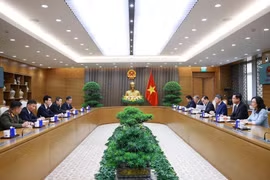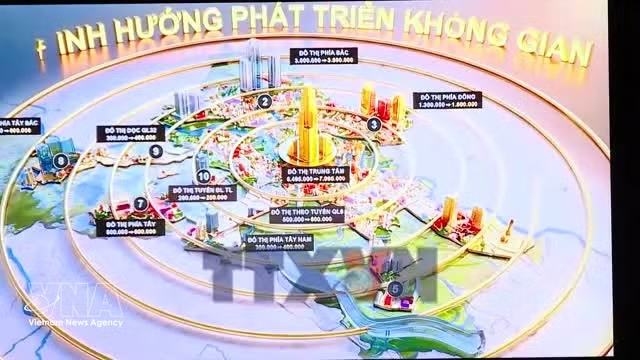
Hanoi (VNA) – The Hanoi People’s Committee on May 19 revealed a 100-year master plan that molds the capital into a “Smart – Green – Multi-polar – Multi-centre” city, with artificial intelligence (AI), transit-oriented development (TOD), and a 1,153km metro system serving as strategic growth pillars.
Previously, Hanoi ran two parallel planning frameworks, including capital planning under the 2017 Planning Law and a general capital plan under the 2024 Urban and Rural Planning Law. The duplication bred conflicts between socio-economic goals and spatial design, leaving traffic jams, flooding, and pollution unsolved and development resources squandered.
Under a National Assembly’s Resolution granting pilot special mechanisms and policies to the city, Hanoi was authorised to merge both planning systems into a single integrated master plan. Input came from the Politburo, Government, municipal Party Committee, ministries, experts, and scientists before the Chairman of the Hanoi People’s Committee signed off on May 13, 2026.
According to the master plan, the study area spans all 126 wards and communes within Hanoi’s administrative boundary, covering roughly 3,359.84 sq.km. Its population is projected to reach around 14–15 million by 2035, 15–16 million by 2045, and 17–19 million by 2065, with a long-term cap of no more than 20 million residents.
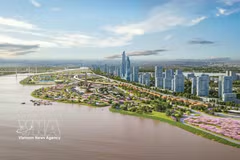
The Red River will act as the primary ecological and cultural landscape spine. Hanoi will pursue a “compact-green” growth model, densifying built-up areas while rigidly safeguarding green belts, green corridors, and ecological spaces.
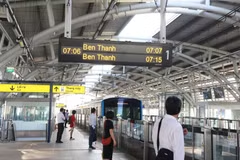
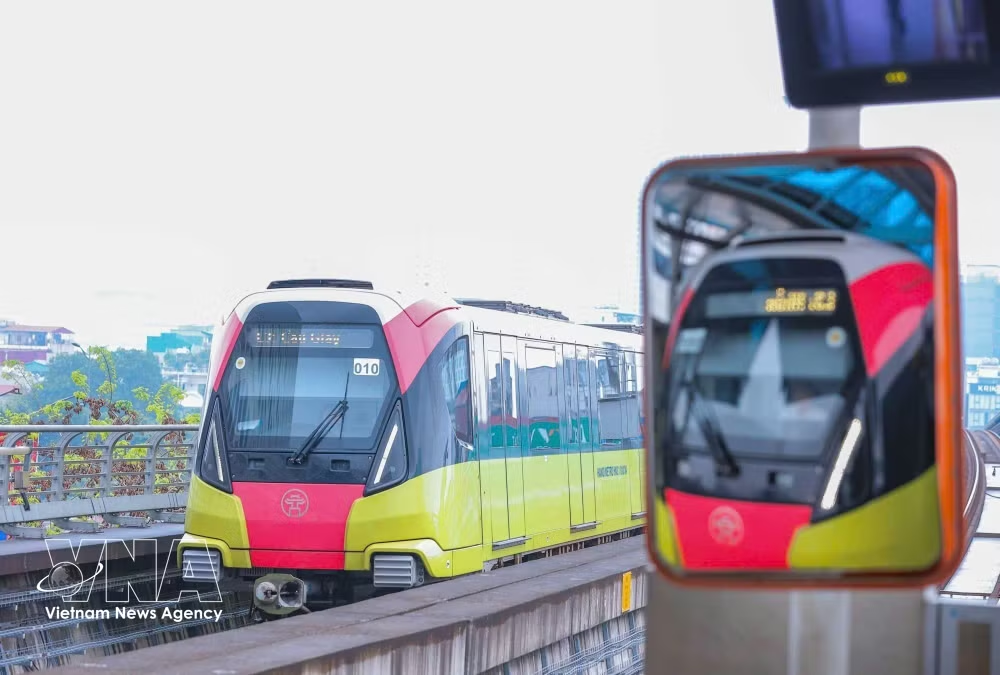
The plan’s flagship proposal is a 1,153km urban and inter-regional rail grid. Metro lines will link ring roads, radials, growth poles, and major urban centres, while knitting the capital more tightly with the surrounding Capital Region and Red River Delta.
TOD becomes the major urban development model in the new phase. Accordingly, zones around metro stations and key transport corridors will get higher density, taller buildings, and larger floor-area ratios to carve out compact, modern neighbourhoods, free up green space, and capture land value for infrastructure reinvestment.
Notably, Hanoi intends to run the city on “digital twins” and AI, tackling urban problems in real time. A hard green pivot targets net-zero emissions: public transport will switch to clean energy, and circular-economy rules will govern waste and wastewater treatment.
Spatially, the Red River is identified as a green, cultural, and economic backbone. The city will study a “Heritage Road” on both banks, turning mid-river sandbanks and alluvial lands into large ecological parks and creative hubs, all while meeting flood control requirements.
Moreover, Hanoi will fast-track subterranean development in TOD zones with underground parking and multi-use infrastructure, targeting an underground utilisation rate above 40% in the city core. It’s also studying a phased rollout of the “low-altitude economy”, paving the way for emerging technologies such as drone deliveries, medical logistics, and flying taxis.
The master plan further envisions new growth poles with breakthrough mechanisms, notably a free trade zone linked to the northern airport urban area in Dong Anh–Soc Son and a western sci-tech city in Hoa Lac. They are designed to spur innovation, relieve core-city crowding, and sharpen Hanoi’s global edge.
The municipal People’s Committee plans to announce the master plan in late June alongside the Hanoi investment promotion conference 2026./.