Hanoi (VNA) – The life and legacy of President Ho Chi Minh have not only inspired generations of Vietnamese people but have also deeply moved many scholars and intellectuals of the Republic of Korea (RoK).
On the occasion of the 136th birthday of the late Vietnamese leader (May 19, 1890–2026), Professor Park Yeon Kwan, Head of the Department of Vietnamese Language at Hankuk University of Foreign Studies, described him as a great sage whose strategic decisions carried the vision of the times.
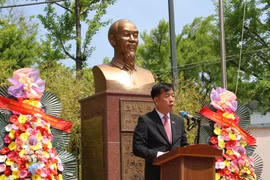
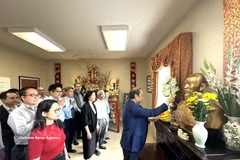
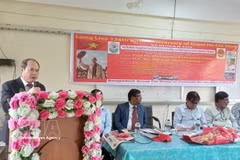
Speaking at a ceremony honouring President Ho Chi Minh held at the Vietnamese Embassy in Seoul, Professor Park expressed his honour and emotion at attending the commemorative event.
As a scholar who has devoted his career to researching and teaching about Vietnam, Park said he has always held deep admiration for the late President’s foresight and wisdom, as he not only led the Vietnamese people to independence and freedom, but was also a visionary thinker whose decisions possessed profound historical significance.
The professor noted that what moved him most while studying President Ho Chi Minh’s life was the leader’s long-term vision, even during the most difficult wartime conditions. He highlighted that even amid fierce war, President Ho Chi Minh selected and nurtured talented young people, sending them abroad for education in preparation for the country’s future development.
Quoting President Ho Chi Minh’s famous saying, “For the benefit of ten years, plant trees; for the benefit of one hundred years, cultivate people,” Professor Park said the statement reflected the late leader’s profound educational philosophy.
Meanwhile, in an interview with the Vietnam News Agency’s correspondents in Seoul, Professor Im Jin Ho from Chodang University in South Jeolla province affirmed that President Ho Chi Minh’s thought and lifestyle continue to hold significance for younger generations today.
President Ho Chi Minh, founder of modern Vietnam, was not only an outstanding revolutionary and politician, but also an exceptional military strategist and diplomat with a comprehensive understanding of both domestic and international affairs, Professor Im said.
He stressed that President Ho Chi Minh’s philosophy of “solidarity, solidarity, great solidarity” remains relevant in every era and played a decisive role in uniting the Vietnamese nation.
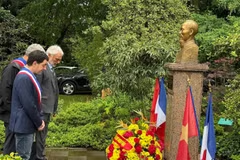
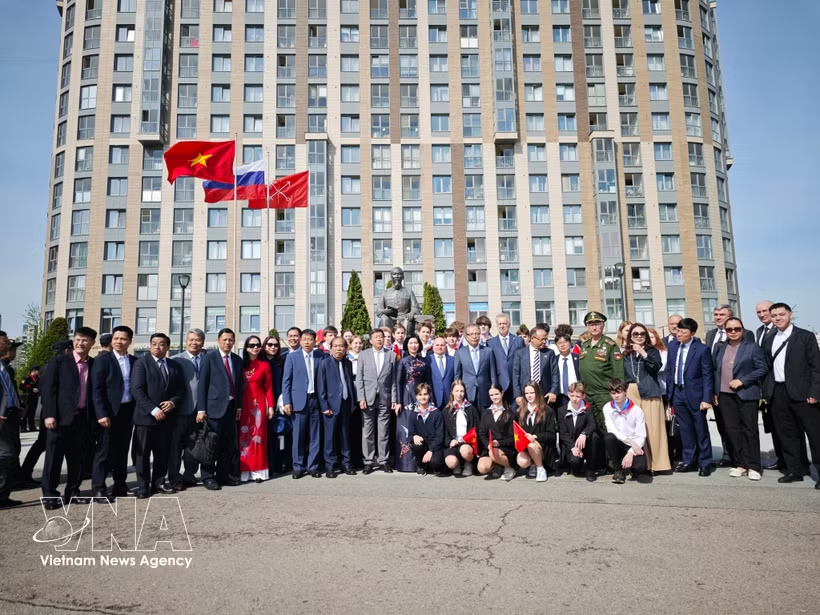
On May 19, a large number of residents and representatives from Vietnam and Russia gathered at Ho Chi Minh Square in St. Petersburg to commemorate the 136th birthday of President Ho Chi Minh. Teachers and students from School No. 488, representatives from mass organisations, former Soviet experts who had assisted Vietnam, Vietnamese students learning in the city and residents joined together in paying tribute to the late leader, who laid the foundation for the enduring friendship between Vietnam and Russia.
Vietnamese Ambassador to Russia Dang Minh Khoi, Chairman of the St. Petersburg Committee on External Relations Evgeny Grigoriev, Vice Chairman of the committee Vyacheslav Kalganov, and Deputy Chairman of the Legislative Assembly of the city Nikolay Bondarenko led a delegation in laying red carnations before the statue of President Ho Chi Minh.
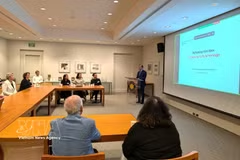
In a recorded address at the seminar on people-to-people diplomacy as a foundation for the Comprehensive Strategic Partnership, held immediately after the ceremony, St. Petersburg Governor Alexander Beglov noted that relations between Vietnam and Russia have withstood the tests of both time and history. Today, St. Petersburg and Vietnamese localities are expanding cooperation in the fields of economy, science and education, further strengthening and enriching the friendship originally founded by President Ho Chi Minh.
Vietnamese Ambassador Dang Minh Khoi recalled that St. Petersburg was the first place President Ho Chi Minh visited upon arriving in the Soviet Union more than a century ago. Inheriting President Ho Chi Minh’s thought, the Vietnamese Party and State have consistently regarded people-to-people diplomacy as one of the key pillars of Vietnam’s modern diplomacy, a role that has become even more essential amid today’s increasingly volatile global landscape./.
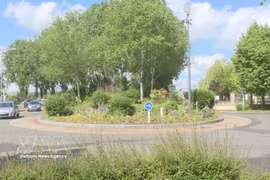
Place preserving memories of President Ho Chi Minh in France
Although there is little publicly available documentation confirming exactly when Place Ho Chi Minh was established, French urban historians suggest that most streets and public spaces named after the Vietnamese leader in France emerged between the 1960s and 1980s, during the height of anti-war movements and solidarity campaigns supporting Vietnam across working-class towns and left-leaning suburbs around Paris.