Ho Chi Minh City (VNA) – Ho Chi Minh City is moving to position green transition as a new driver of long-term growth, though experts and businesses say major hurdles in financing, infrastructure and policy mechanisms must first be addressed for the strategy to deliver its full potential.
The southern economic hub is entering a new stage of development in which growth is expected to go hand in hand with environmental sustainability and improved quality of life. Green transition is increasingly viewed as essential to preserving the city’s status as Vietnam’s economic locomotive.
As climate change impacts intensify, the push for greener development has become more urgent for the country’s largest economic centre, which contributes around one-third of the national budget. Green transition is no longer seen solely as an environmental obligation but also as a competition requirement for businesses participating in global supply chains.
Nguyen Ngoc Thang, Deputy General Director of Saigon Co.op, said that despite the substantial costs involved in meeting green and ESG (environmental, social and governance) standards, the retailer remains committed to supporting sustainable businesses and promoting environmentally friendly products.
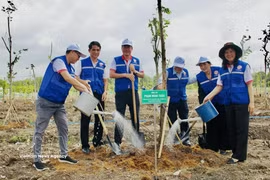
In high-tech agriculture, green transition requires long-term investment and persistence. Lam Thuy Ai, General Director of MEBI FARM, said the company spent a decade developing a circular and environmentally friendly livestock farming model located away from residential areas. The system incorporates green belts as biological air barriers, rooftop solar panels and automated processes to improve energy efficiency.
Still, the transition poses significant challenges across multiple sectors. Following administrative expansion, Ho Chi Minh City is now home to more than 14 million residents, with around 11.4 million motorbikes and 1.3 million cars. The large number of vehicles is putting mounting pressure on transport infrastructure and air quality, producing an estimated 13 million tonnes of CO2 emissions each year.
In the energy sector, the city currently has 22,355 rooftop solar systems with a combined capacity of approximately 1,832 MWp. However, Nguyen Kim Ngoc, Deputy Director of the municipal Department of Industry and Trade, said financial constraints and legal barriers are the main obstacles to further expansion.
Experts noted that while public funding remains limited and procedures are often cumbersome, many off-budget funds are prepared to support green projects through low-interest or interest-free financing. More flexible mechanisms are needed to mobilise and effectively utilise these resources.
Vice Chairman of the municipal People’s Committee Bui Minh Thanh said the city’s 2025–2030 Party Congress Resolution identifies green transition, digital transformation and innovation as three strategic pillars. Under its green transition scheme for 2025–2030, the metropolis aims to implement 10 pillars and 76 targets backed by an estimated 900 trillion VND (34.1 billion USD) in mobilised capital.
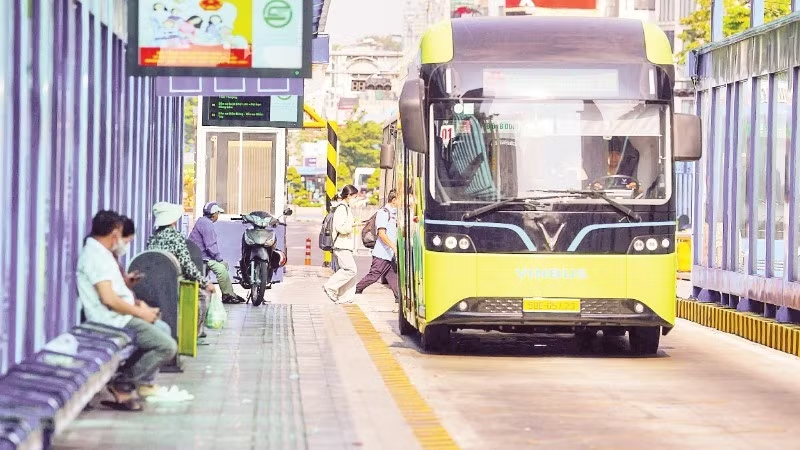
To achieve these goals, it is promoting renewable energy, energy efficiency, green hydrogen development and the target of net-zero emissions by 2050. In transport, authorities aim for all public transport vehicles to run on clean energy by 2030.
Ho Chi Minh City is also rolling out several action programmes, including an air pollution control and air quality management plan for 2026–2030 with a vision extending to 2045.
Pham Binh An, Deputy Director of the Ho Chi Minh City Institute for Development Studies, proposed the early establishment of low-emission zones in Can Gio and Con Dao before gradually expanding them to central urban areas.
He also recommended detailed regulations for different types of vehicles, tighter control of emissions from industrial and construction activities, improved urban sanitation and dust treatment, and expanded green spaces to enhance air quality.
From a regional development perspective, Ho Nguyen Thai Bao from the institute said the city’s advantages in land availability, inter-regional infrastructure and marine ecosystems following administrative restructuring could support the growth of carbon-neutral industrial zones, green logistics, green finance, renewable energy and sustainable waterway transport.
Discussing policy solutions, Dr. Phan Thuy Kieu, representing a research group at the institute, said the city should promptly finalise its green growth policy framework to stay on track for net-zero emissions by 2050, especially as emissions are expected to rise alongside urban expansion.
Green transition in Ho Chi Minh City, she said, has moved beyond slogans into a phase of concrete implementation. If effectively leveraged, it could not only help tackle environmental challenges but also pave the way for a new growth cycle driven by innovation, clean technology and higher living standards./.
See more
Conference offers insights into Nordic workplace culture
Speakers addressed a range of key issues, including managing organisations amid rapid economic shifts, effectively integrating artificial intelligence into the workplace, building high-performing teams and developing talent strategies in globally competitive industries.
Vietnam looks to stronger ties with Africa for sustainable development
Experts proposed a raft of coordinated solutions to create breakthroughs in bilateral and multilateral ties with African countries. Chief among them is the fact that Vietnam should step forward as a bridge, spearhead the expansion of knowledge-sharing forums, and roll out specialised skills training courses for African partners.
Ireland steps up dairy trade promotion in Vietnam
Data from IMARC Group showed that the Vietnamese dairy market was valued at 5.71 billion USD in 2024 and is projected to reach 13.37 billion USD by 2033, with a compound annual growth rate (CAGR) of 9.5% during the 2025–2033 period.
Maritime finance initiative launched to strengthen Ho Chi Minh City’s regional ambitions
The initiative, one of the four strategic pillars of the Vietnam International Financial Centre in Ho Chi Minh City (VIFC-HCMC), was introduced at a high-level forum held in the city.
Cross-border e-commerce drives Vietnam–India economic ties
Hang noted that cross-border e-commerce is creating fresh opportunities for bilateral cooperation. Indian products such as natural cosmetics, essential oil, herbal products, fashion items and household goods are seen as highly promising in the Vietnamese market. At the same time, Vietnamese businesses, especially small and medium-sized enterprises, are increasingly able to use digital platforms to access India’s market of more than 1.4 billion consumers.
Industrial, transport infrastructure exhibitions open in Ho Chi Minh City
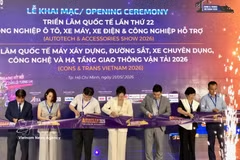
The events consist of the 22nd International Exhibition on Automobile, Motorcycle, Electric Vehicle and Supporting Industries (Autotech & Accessories 2026) and the International Exhibition on Construction Machinery, Rail Transit, Specialised Vehicles, Technology and Transportation Infrastructure (Cons & Trans 2026).
Banks shift to cash-flow lending to unlock capital for SMEs
Prof. Nguyen Trong Hoai from the University of Economics Ho Chi Minh City (UEH) suggested that Vietnam should study open finance models built on digital data adopted in several countries to improve credit access for SMEs lacking collateral.
Ninh Binh draws next-wave foreign direct investment
With an improving investment climate and upgraded industrial infrastructure, the northern province of Nin h Binh is strengthening its reputation as a reliable destination for foreign investors.
Vietnam, Bangladesh eye to foster economic ties
Addressing the forum, Vietnamese Ambassador to Bangladesh Nguyen Manh Cuong highlighted the fruitful development of the bilateral ties over the past 53 years, noting that trade turnover has consistently exceeded 1.1 billion USD despite global disruptions. The two sides are now striving to raise the figure to 2 billion USD in the coming years.
ILDEX Vietnam 2026 showcases livestock, agri-food innovation
The three-day event is jointly organised by VNU Asia Pacific and Thailand’s ITEC, serving as a platform for business networking, technology exchange and knowledge sharing in the livestock, aquaculture and food industries in Vietnam and Southeast Asia.
Gia Binh international airport project accelerated ahead of APEC 2027
Tuc described Gia Binh International Airport as a national key project requiring strict adherence to construction timelines, particularly as it is expected to be put into operation in time for the 2027 APEC Economic Leaders' Meeting. Several associated projects are also being implemented under special mechanisms to serve major national tasks.
Vietnam to host first-ever arbitration, mediation week
The event, the first large-scale forum in Vietnam dedicated to arbitration, mediation and alternative dispute resolution (ADR), will be held simultaneously in Hanoi and Ho Chi Minh City.
Reference exchange rate remains stable on May 21
With the current trading band of +/- 5%, the ceiling rate applicable for commercial banks during the day is 26,392 VND/USD, and the floor rate 23,878 VND/USD.
Gia Lai plans Tam Quan smart fishing port to lift exports
Gia Lai now operates Quy Nhon, De Gi, and Tam Quan fishing ports, with a combined cargo handling capacity of about 100,000 tonnes annually, alongside three storm shelters that can accommodate roughly 3,800 vessels.
Listing procedure reform, SOE equitisation acceleration expected to attract more foreign investors
Accelerating state-owned enterprise (SOE) equitisation, streamlining listing procedures and removing persistent legal bottlenecks are expected to expand the supply of high-quality assets and strengthen the attractiveness of Vietnam’s stock market to global investors.
Vietnam seeks higher-quality foreign investment for sustainable growth
With ongoing reforms, improving infrastructure and a growing pool of skilled workers, Vietnam is seeking to position itself not only as a manufacturing destination, but also as an emerging regional technology and innovation hub.
Forum promotes Vietnam–RoK supply chain connectivity
Cao Thi Phi Van, Deputy Director of ITPC, said that after more than three decades of cooperation, Vietnam–RoK ties are shifting from traditional manufacturing cooperation towards mastering future-oriented technologies such as semiconductors, artificial intelligence (AI), digital finance, renewable energy and global supply chains.
Fitch Ratings gives positive assessment of Vietnam’s economic fundamentals
Deputy Minister Tran Quoc Phuong stressed that Fitch’s credit assessments have enhanced Vietnam’s image and credibility in international financial markets, and provided additional motivation for the country to continue improving institutions, strengthening policy management efficiency and increasing economic transparency.
Da Nang jumps 212 spots in global startup ecosystem rankings
The strong improvement highlights the growing momentum of Da Nang’s innovation and startup ecosystem amid increasing global competition to attract technology, innovation and high-quality human resources.
Vietnam racks up 4.5-billion-USD trade surplus with Singapore on domestically-sourced goods
During the four-month period, Vietnam held its position as Singapore’s 10th largest trade partner, with bilateral trade surging 43.7% year-on-year to 18.8 billion SGD. Singapore’s exports to Vietnam totalled 10.2 billion SGD, up 8.9%, while imports leapt 133% to 8.5 billion SGD.