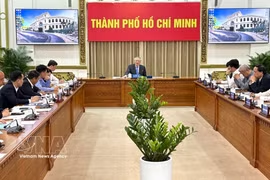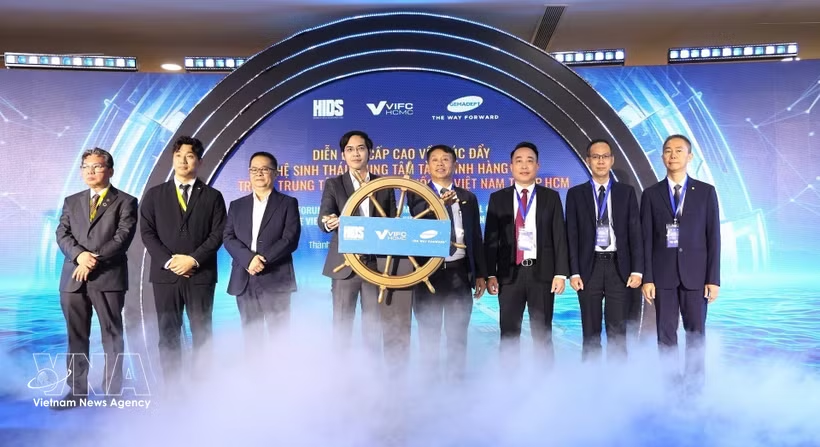
Ho Chi Minh City (VNA) – Ho Chi Minh City officially launched the International Maritime Finance Ecosystem (IMFE) on May 21 to develop the southern economic hub into a regional maritime finance centre and bring shipping and logistics-related financial transactions back to Vietnam.
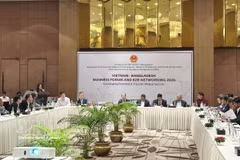
The initiative, one of the four strategic pillars of the Vietnam International Financial Centre in Ho Chi Minh City (VIFC-HCMC), was introduced at a high-level forum held in the city.
Speaking at the event, Nguyen Cong Vinh, Vice Chairman of the municipal People’s Committee, said Vietnam has so far participated mainly in global goods flows, while high-value-added maritime financial flows remain concentrated abroad.
To strengthen competitiveness and support sustainable marine economic development, Vietnam needs a comprehensive maritime finance ecosystem capable of integrating capital flows, logistics and financial services within the domestic economy, he stressed.
According to Vinh, Ho Chi Minh City is pursuing a development model that links seaport infrastructure and logistics with international financial services, transforming VIFC-HCMC into both a destination for global capital and a financial gateway for Vietnam’s marine economy.
He said IMFE is expected to connect banks, investment funds, insurers, shipping companies, logistics providers and international partners within a unified ecosystem.
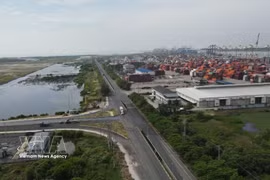
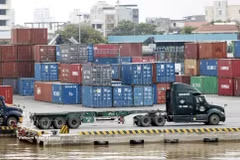
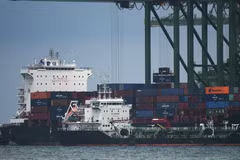
Southern Vietnam, particularly Ho Chi Minh City and the Cai Mep–Thi Vai Port Complex, has in recent years emerged as one of Southeast Asia’s major logistics and maritime hubs. Large-scale projects, including Gemalink Port, Cat Lai Port, and the planned Can Gio international transhipment port, are helping Vietnam deepen its integration into global supply chains.
Ho Chi Minh City’s port system handled more than 24 million TEUs in 2025, ranking eighth globally according to Lloyd’s List. The port network was linked to import-export turnover estimated at around 200 billion USD, accounting for roughly one-fifth of Vietnam’s total trade value.
At the same time, the city’s logistics ecosystem has expanded rapidly across cargo handling, warehousing, freight forwarding, customs services, supply chain transport and import-export support.
Consultancy firm Roland Berger reported that Vietnam’s container cargo throughput has grown by around 11% annually over the past 15 years. Total cargo volume in 2025 reached about 34 million TEUs, five times higher than in 2010, making Vietnam the fastest-growing cargo market in the Asia-Pacific region, surpassing India, China, Malaysia and Singapore.
Trade transactions generated through Vietnam’s port system, including logistics and related financial demand, are estimated to exceed 1 trillion USD per year.
However, high-value-added services such as trade finance, ship financing, marine insurance, reinsurance, international payments and logistics risk management are still largely handled by overseas financial centres.
Nguyen Hoang Anh, Senior Project Manager at Roland Berger, said Vietnam currently retains only 4–5% of the value generated in the maritime sector because many high-value services remain abroad.
He added that the value added per worker in Vietnam’s maritime industry stands at around 15,000–20,000 USD annually, significantly lower than Singapore’s 190,000–225,000 USD.
Vietnam’s maritime sector currently contributes around 1% of GDP, equivalent to 4–5 billion USD. Roland Berger estimated that increasing the share of transaction value retained domestically to around 15% by 2035 could generate an additional 9–10 billion USD in economic impact.
The consultancy also projected that IMFE could help develop around 16 specialised maritime finance service segments spanning finance, insurance, legal services, technology, data, consulting and international trade support.
If implemented effectively, the maritime finance ecosystem in Ho Chi Minh City could generate a cumulative economic impact of around 50 billion USD, according to Roland Berger.
Pham Quoc Long, Deputy General Director of Gemadept, said Vietnam and Ho Chi Minh City possess favourable conditions to emerge as a new maritime-financial hub in the region. However, he noted that the country still needs to address bottlenecks in infrastructure connectivity, specialised financial services, policy mechanisms, human resources and ecosystem coordination.
According to Long, the focus should now shift beyond port expansion and logistics capacity towards building a synchronised, internationally connected maritime finance ecosystem, an area IMFE is expected to address.
Assoc. Prof. Dr Nguyen Huu Huan, Vice Chairman of the executive board of VIFC-HCMC, said IMFE will initially prioritise ship-leasing finance, cross-border payments and fintech applications in maritime services.
VIFC-HCMC is also studying the establishment of a maritime financial exchange platform of port operators, logistics companies, banks, insurers and import-export firms within a shared ecosystem, to gradually redirect maritime financial transactions back to Ho Chi Minh City.
Under the proposed roadmap, IMFE will focus during its first one to two years on building foundational mechanisms, including a sandbox framework, a one-stop service centre and a maritime financial data platform. Over the next two to three years, the focus will be on growing the ecosystem through digitalisation, investment funds, and innovation, before shifting towards larger elements, like maritime arbitration, derivatives markets, and specialised risk-hedging products./.