Hanoi (VNA) – Faced with distortions that paint Vietnam’s tax policies as a “squeeze”, the actual governance record tells a sharply different story. From lightening the burden on small firms to overhauling tax administration and enhancing transparency, the reforms signal a development-first playbook rather than the “revenue extraction” script pushed by hostile voices. The Government’s commitment to reform and public service is itself the most convincing counter to the allegations now swirling around Vietnam’s tax regime.
The "excessive tax" fallacy
Taxation is a foundational pillar of state governance everywhere. It funds development investment and social welfare while acting as a lever for economic regulation, fairness and social stability. For Vietnam, extensive global integration and rapid digital transformation have made tax system reform an inevitable requirement, not an option.
Yet, that reform process has increasingly become a target for hostile actors, reactionary groups and political opportunists. They deliberately twist the nature of tax policy, framing tax administration with inflammatory rhetoric like “excessive collection,” “strangling small traders,” “controlling citizens’ assets” or “destroying the private sector".
These talking points exploit public concern over new rules to create a distorted image of state governance. When looking at Vietnam’s multi-year tax-reform trajectory, it becomes clear that its consistent goal is not to pile burdens onto citizens, but to build a modern, fair, transparent and growth-enabling tax system.
One of the most heavily distorted flashpoints has been the shift from the presumptive tax mechanism to a self-declaration, self-payment model, alongside the rollout of electronic invoicing. Government opponents deliberately portray these moves as a drive to “clamp down for maximum collection,” “push small traders into distress” or “target petty businesses”.
In fact, the old presumptive approach was riddled with flaws. Hand-estimated revenue lacked accuracy, routinely creating disparities and unfairness among firms of similar scale. In some cases, it also opened the door to budget losses and administrative misconduct.
Moving to self-declaration and digital platforms is therefore a natural step in modern governance, a model widely adopted globally to boost transparency, cut red tape and give taxpayers more autonomy.
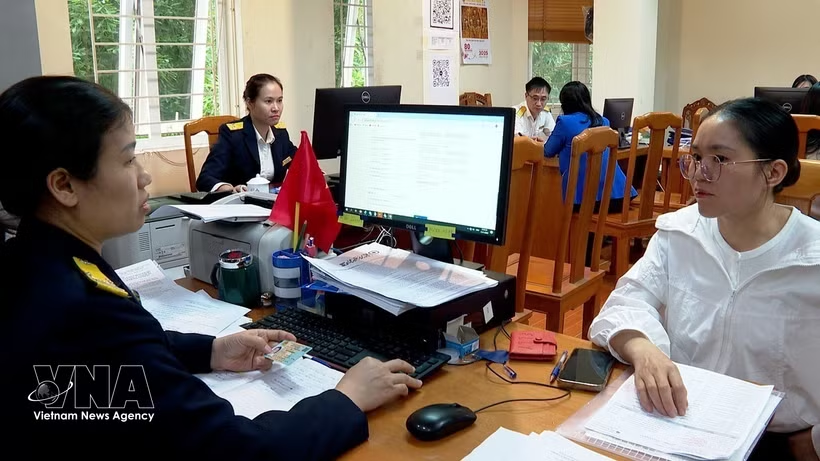
More to the point, Vietnam’s rollout has been anything but the rigid, coercive crackdown critics allege. Tax authorities have spent years providing free training, directly assisting business households with digital apps, guiding online filing and troubleshooting transition difficulties. The sight of tax officials walking traditional markets and shopfront streets to offer hands-on helps illustrate a clear spirit of partnership and citizen support.
Another recurring accusation claims that the State is “draining citizens’ pockets” to maximise budget revenue. That’s a simplistic, misleading line that ignores both the function and the essence of taxation in running a country.
Vietnam has repeatedly used fiscal tools to back households and businesses. Waves of tax deferrals, reductions and exemptions have been deployed to prop up production and trade, especially during the post-pandemic recovery. Most notably, lifting the tax-exempt revenue threshold for business households to 1 billion VND (38,400 USD) a year has created substantial headroom for small enterprises to stabilise operations and reinvest.
From a macro standpoint, taxes are never the “one-way outflow” that inflammatory rhetoric suggests. The White Book on Vietnam Taxation 2026 underscores a plain fact: taxation is among the most effective instruments for redistributing national income in support of development goals.
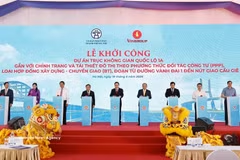
Tax revenues account for more than 80% of total state budget receipts and serve as the critical seed capital pumped back into society. Such has become North – South expressways, modern international airports, healthcare and education systems, and social welfare in remote and disadvantaged areas. It is the clearest evidence that the resources contributed by the general public are being reinvested for their benefit.
Exploiting tax policy to stoke opposition
As with household-business tax reforms, critics are now deliberately misrepresenting e-commerce and digital-platform tax rules.
The rapid expansion of e-commerce and digital trade activities has created governance headaches for countries worldwide, not just Vietnam.
Yet when authorities rolled out tax measures for livestream sales, e-commerce platforms and cross-border digital companies, hostile voices immediately framed them as a bid to “invade privacy” or “control citizens’ assets".
The arguments are baseless and intentionally misleading. In any economy, profit-making activity is subject to tax obligations. It makes no sense that salaried workers shoulder full tax compliance while online earners pulling in billions of Vietnamese dong in revenue escape fiscal responsibility.
E-commerce tax oversight is designed to level the playing field between brick-and-mortar and digital-platform businesses, and between compliant enterprises and those deliberately dodging obligations. Tracking financial flows in the digital economy also helps fight counterfeits, smuggling and commercial fraud that are proliferating online.
It must be stressed that data integration and coordinated management operate within legal frameworks, with clear information security and privacy protection, not the “privacy invasion” falsely alleged by distorted narratives.
Claims that new tax policies are “destroying” or “hindering” business households are entirely contradicted by real-world data. A fair and transparent tax policy doesn’t suffocate small traders; on the contrary, it launches them toward standardisation and sustainable growth.
The Ministry of Finance (MoF) reports that business households upgrading to enterprises have surged. After more than 3,200 conversions for all of 2025, January 2026 alone saw nearly 1,000, roughly 25% of the prior year’s total. The data show support policies are generating powerful momentum, giving small traders the confidence to scale.
Small traders and business households contribute nearly 30% of GDP and employ millions. The shift to e-invoicing and transparent revenue reporting has already given tens of thousands of them easier access to formal bank credit.
On the ground in major cities and e-commerce hubs, businesses that embraced the new tax rules and digital declaration tools have notched notable revenue gains by optimising operations and building consumer trust. Clearly, tax policy, far from a barrier, is becoming a benchmark for competitiveness, forging a more modern, professional and responsible generation of entrepreneurs that feeds national prosperity.
As part of the wider tax overhaul, the MoF’s “White Book on Vietnam Taxation 2026” demonstrates a deep commitment to transparency, accountability and public engagement. The document lays out a clear roadmap toward a modern, fair and transparent tax system built around serving citizens and businesses.
At a time when social media disinformation grows more sophisticated, transparency and public disclosure are the most potent counter to distortions. Facts, data and real-world results deliver the strongest rebuttal to attempts that twist reality and erode trust in tax administration reform.
Whatever slogans they wrap themselves in such as “protecting the poor” or “defending business freedom”, these hostile forces can’t hide their political agenda: sowing distrust, stoking citizen – government confrontation, and obstructing national modernisation. Yet truth cannot bend to extremist propaganda campaigns.
A sound policy must ultimately be judged by practical effectiveness, by economic growth, and by the tangible benefits that flow to the people./.