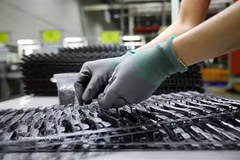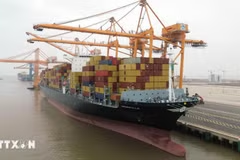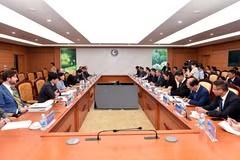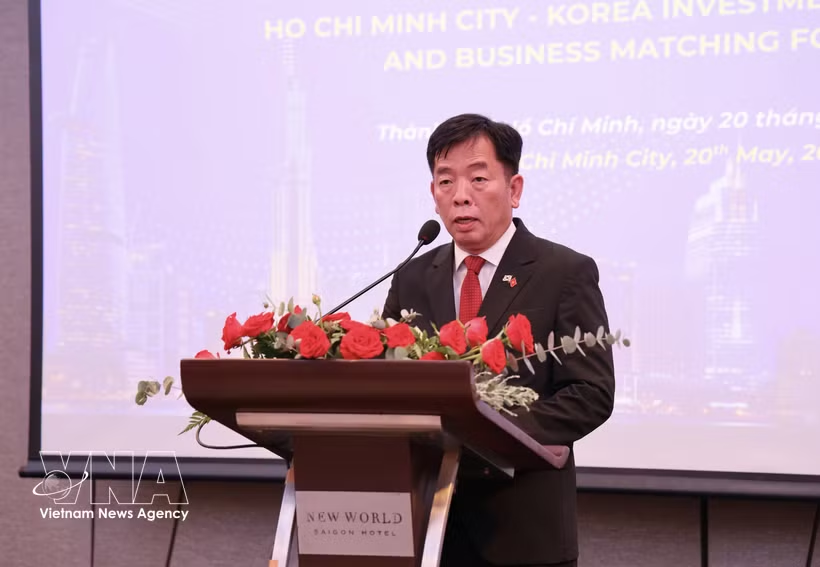
Ho Chi Minh City (VNA) – Vietnam and the Republic of Korea (RoK) still have ample room to strengthen supply chain connectivity in key industries such as electronics, semiconductors and food processing, experts said at the 2026 Ho Chi Minh City–RoK investment cooperation and business networking forum held in Ho Chi Minh City on May 20.
The event was jointly organised by the Ho Chi Minh City Investment and Trade Promotion Centre (ITPC), the ASEAN-Korea Centre (AKC), and the Vietnam Trade Office under the Vietnamese Embassy in the RoK.
Cao Thi Phi Van, Deputy Director of ITPC, said that after more than three decades of cooperation, Vietnam–RoK ties are shifting from traditional manufacturing cooperation towards mastering future-oriented technologies such as semiconductors, artificial intelligence (AI), digital finance, renewable energy and global supply chains.
Ho Chi Minh City’s economy expanded by 8.03% in 2025, while gross regional domestic product (GRDP) growth in the first quarter of 2026 reached 8.27%, the highest level recorded in recent years, she noted.
The southern city is currently home to 20,813 foreign-invested projects worth more than 142 billion USD from 152 countries and territories. The RoK ranks second in terms of project numbers with 3,349 projects, mainly in manufacturing and processing, technology, trade, services and logistics.
In the new development phase, Ho Chi Minh City is prioritising investment attraction from Korean businesses in four strategic areas, namely the development of an international financial centre focusing on digital banking and financial technology; AI and semiconductor ecosystems; startup ecosystems and venture capital funds; and smart urban development and green growth.
To meet new growth targets, local enterprises are seeking to expand partnerships with Korean counterparts in order to participate more deeply in supply chains, promote technology transfer, accelerate digital transformation and develop green production, Van added.
Jung Jung-tae, Consul General of the RoK in Ho Chi Minh City, said leaders of the two countries are aiming to raise bilateral trade turnover to 150 billion USD by 2030. He noted that Vietnam–RoK cooperation is shifting from an export-centred model towards a more balanced and sustainable approach through value chain integration.
Vietnam is emerging not only as a manufacturing base but also as an increasingly important partner in global supply chains, he said, expressing his hope that the forum would generate more substantive business connections and long-term cooperation opportunities for enterprises from both countries.
Kim Jae-shin, Secretary General of the ASEAN-Korea Centre, highlighted the strong development of cooperation between the two countries. Trade promotion and business networking activities would help realise cooperation potential while creating more opportunities for Vietnamese goods to penetrate deeper into the Korean market, he said.
Kim Dae-young, Vice Chairman of the Korea Importers Association (KOIMA), said Vietnam has strong competitiveness in electronics, information technology, textiles and garments, agriculture, fisheries and food industries. He suggested Vietnamese businesses participate more actively in trade promotion programmes in the RoK, such as the Korea Import Expo, to better understand market demand, import standards and international consumer trends, thereby expanding export markets more effectively.
Analysing Vietnam’s supply chain strategy, Bok Dug-Gyou, representative of the Korea Trade-Investment Promotion Agency (KOTRA), said foreign-invested enterprises currently account for 73% of Vietnam’s total export turnover, while the domestic value-added ratio in the manufacturing sector remains at only 12%, significantly lower than ASEAN’s average of 33%.
However, he noted that this also represents substantial room for domestic and foreign supporting industry enterprises to participate more deeply in the value chain.
According to Bok, investment and business efficiency could be enhanced if investors take advantage of the specialised strengths of each region, with northern Vietnam focusing on high technology and automobiles; central Vietnam on agro-fishery processing and chemicals; and southern Vietnam on textiles, footwear and food processing.
In addition, Vietnam’s expanding network of free trade agreements (FTAs) continues to provide competitive advantages for the country in the restructuring of global supply chains.
Within the framework of the forum, Vietnamese and Korean enterprises also engaged in direct business matching activities to seek partners, expand cooperation networks and promote future investment and trade projects./.