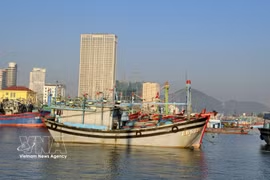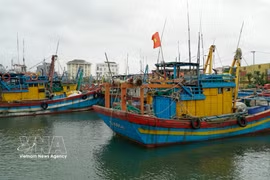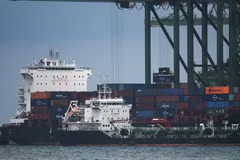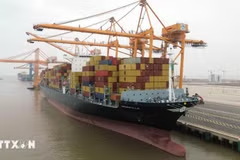
Gia Lai (VNA) – The central province of Gia Lai plans to build a smart fishing port at Tam Quan, as part of a broader push to modernise its seafood industry, improve export standards, and support long-term national growth targets.
The Tam Quan smart port, which includes a storm shelter for fishing vessels, will be instrumental in driving annual GDP growth above 10% from 2026-2030, matching goals set by the 14th National Party Congress, Vice Chairman of the provincial People’s Committee Nguyen Tuan Thanh said.
The port will deploy digital tools, automation, and data analytics to manage fleets, track catch volumes, enforce food safety, trace origins, and sharpen logistics services.
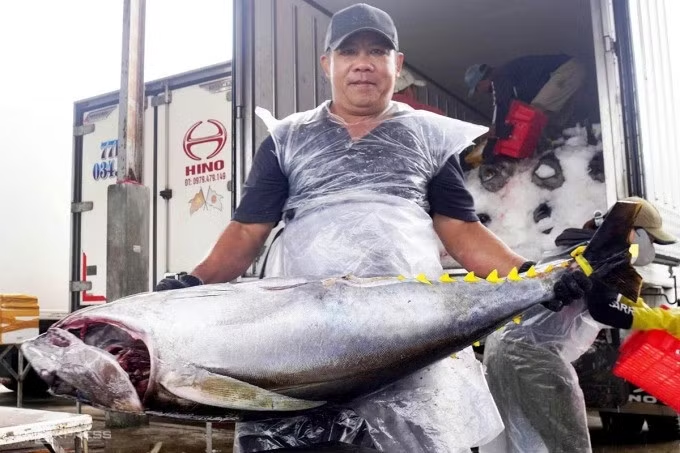
Authorities also plan an international-standard tuna auction centre and cold chain logistics hub at the smart port, while scaling vessel repair and fisheries engineering services in Hoai Nhon Bac ward. The province is courting private capital through public-private partnerships for ice and fuel supply networks serving major fishing ports.
The move falls under Gia Lai’s sustainable fisheries strategy for 2026–2030, with a longer-term vision extending to 2050, Thanh said.
Total estimated investment reaches 4.27 trillion VND (164 million USD), with 2.55 trillion VND from the central budget, 670 billion VND from provincial coffers, and 1.05 trillion VND from private and other sectors. Tam Quan will become a specialised regional tuna hub, with the share of export-grade tuna targeted at 30-35% by 2030 and 50-60% by 2050.
The port’s digital transformation agenda includes electronic catch traceability, e-logbooks, voyage monitoring systems, and the use of artificial intelligence, Internet of Things, and blockchain technology.
Data will be integrated with border guards, fisheries surveillance, and anti-IUU enforcement bodies to strengthen transparency, meet international standards, and back Vietnam’s push to have the European Commission’s “yellow card” warning over illegal, unreported, and unregulated (IUU) fishing lifted.
Plans also call for a digital seafood trading floor and tuna auction centre within the smart port to improve price transparency, tighten supply-demand matching, and lift the commercial value of seafood exports.
To shape Tam Quan’s design and operating model, study tours to ports in Japan, Spain, and Norway will zero in on tuna grading and auction systems.
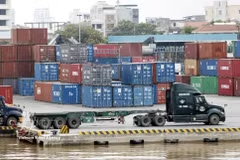
Gia Lai now operates Quy Nhon, De Gi, and Tam Quan fishing ports, with a combined cargo handling capacity of about 100,000 tonnes annually, alongside three storm shelters that can accommodate roughly 3,800 vessels./.
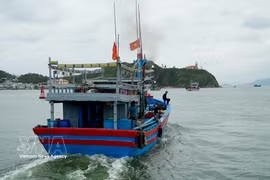
Gia Lai expands electronic fishing log coverage to combat IUU fishing
For many local fishermen, digitalisation is gradually replacing cumbersome paper-based procedures. By the end of April, 3,257 fishing vessels measuring at least 12 metres in length in Gia Lai had adopted electronic fishing logs, according to local authorities.