Banks shift to cash-flow lending to unlock capital for SMEs

Prof. Nguyen Trong Hoai from the University of Economics Ho Chi Minh City (UEH) suggested that Vietnam should study open finance models built on digital data adopted in several countries to improve credit access for SMEs lacking collateral.

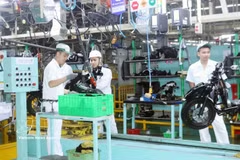
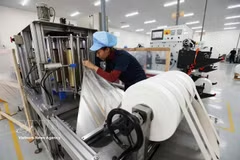
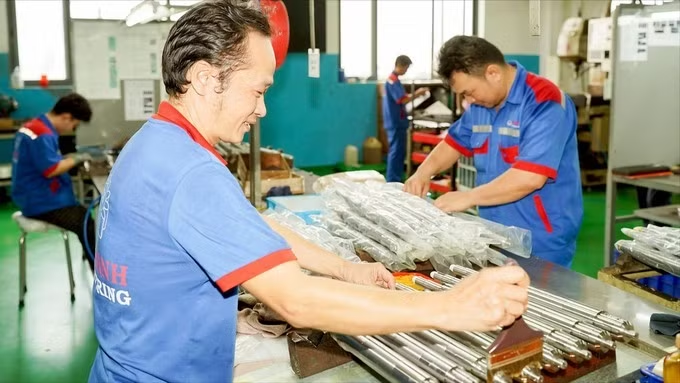
Workers of the Duy Khanh precision mechanical factory in Tang Nhon Phu ward, Ho Chi Minh City, manufacture support mechanical components. (Photo: sggp.org.vn)

Hanoi (VNA) – Access to finance remains a major bottleneck for small- and medium-sized enterprises (SMEs) in Vietnam, but a gradual shift by banks toward cash-flow-based lending and more flexible credit models is expected to help “unlock” capital flows for this critical sector.

Despite the Government’s push to strengthen the private sector, Vietnamese SMEs continue to face significant hurdles in accessing credit. According to the Vietnam Private Economic Report 2025 released by the Vietnam Chamber of Commerce and Industry (VCCI), 75.5% of businesses said they are unable to secure loans without collateral.

Beyond collateral requirements, borrowing conditions and capital costs remain misaligned with the demands of private firms. More than 56% of respondents said interest rates and lending conditions are less favourable than those offered to state-owned enterprises, while 46.1% reported being subject to disadvantageous terms imposed by credit institutions. Administrative procedures also remain burdensome, with 45% of firms describing them as cumbersome, alongside the persistence of informal costs.

These challenges highlight not only financial barriers but also institutional constraints that limit SMEs’ access to credit. The Vietnam Association of Small and Medium Enterprises attributes these difficulties to weak credit histories, insufficient collateral, and complex loan documentation, underscoring the need for a more innovative lending approach, particularly as the SME sector plays an increasingly important role in economic growth.

Prof. Nguyen Trong Hoai from the University of Economics Ho Chi Minh City (UEH) suggested that Vietnam should study open finance models built on digital data adopted in several countries to improve credit access for SMEs lacking collateral.

Meanwhile, Nguyen Ngoc Hoa, Chairman of the Ho Chi Minh City Business Association (HUBA), emphasised the need to develop capital markets, enabling large enterprises to diversify funding sources and free up bank credit for smaller firms.

Encouragingly, banks are beginning to adopt more flexible lending practices. In the plastics industry, which generates around 35 billion USD in revenue and grew by about 10% in 2025, most firms are SMEs with substantial working capital needs but limited financial capacity.

According to Hoang Trung Hieu from VPBank, the bank is shifting from collateral-based lending to a more comprehensive assessment of business plans, cash flows, and operational capacity. Tailored credit packages now allow loans backed by inventory, purchase orders, export contracts, or even unsecured lending based on viable business plans.

“Understanding the industry and the business is key to providing suitable financial solutions,” he said. In the first quarter of 2026, the Vietnam Prosperity Joint-Stock Commercial Bank (VPBank)’s outstanding loans exceeded 1 quadrillion VND (37.9 billion USD), up 10.2% from late 2025, with SME lending rising 8.4%.

Similarly, Southeast Asia Commercial Joint Stock Bank (SeABank) has introduced dedicated loan packages for micro-enterprises and newly formalised household businesses, which often struggle due to their short operating history. Firms with as little as three months of operation can now be considered for credit. Loan tenors extend up to 36 months for working capital, 120 months for equipment investment, and up to 300 months for property purchases serving business activities.

Major state-owned lenders are also expanding their role beyond financing. Vu Thi Hong Nhung from the Joint Stock Commercial Bank for Foreign Trade of Vietnam (Vietcombank) said the bank is increasingly offering financial advisory services and cash flow management support. By integrating into supply chains, banks can better monitor business performance and use real transaction data as a basis for lending decisions, rather than relying solely on collateral.

In agriculture, the Vietnam Bank for Agriculture and Rural Development (Agribank) is likewise transitioning toward cash-flow and production-based lending models./.

VNA
See more

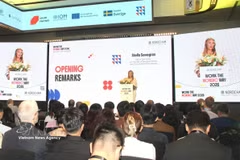
A view of Work the Nordic Way 2026 conference (Photo: VNA)

Conference offers insights into Nordic workplace culture

Speakers addressed a range of key issues, including managing organisations amid rapid economic shifts, effectively integrating artificial intelligence into the workplace, building high-performing teams and developing talent strategies in globally competitive industries.

Vietnam looks to stronger ties with Africa for sustainable development

Vietnam looks to stronger ties with Africa for sustainable development

Experts proposed a raft of coordinated solutions to create breakthroughs in bilateral and multilateral ties with African countries. Chief among them is the fact that Vietnam should step forward as a bridge, spearhead the expansion of knowledge-sharing forums, and roll out specialised skills training courses for African partners.

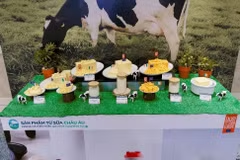
European dairy products from Ireland. (Photo: cafe.vn)

Ireland steps up dairy trade promotion in Vietnam

Data from IMARC Group showed that the Vietnamese dairy market was valued at 5.71 billion USD in 2024 and is projected to reach 13.37 billion USD by 2033, with a compound annual growth rate (CAGR) of 9.5% during the 2025–2033 period.

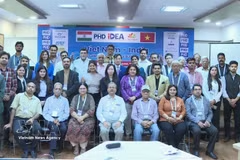
Organisers and speakers at the “Vietnam–India Cross-border E-commerce” forum pose for a group photo. (Photo: VNA)

Cross-border e-commerce drives Vietnam–India economic ties

Hang noted that cross-border e-commerce is creating fresh opportunities for bilateral cooperation. Indian products such as natural cosmetics, essential oil, herbal products, fashion items and household goods are seen as highly promising in the Vietnamese market. At the same time, Vietnamese businesses, especially small and medium-sized enterprises, are increasingly able to use digital platforms to access India’s market of more than 1.4 billion consumers.

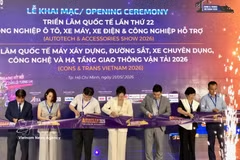
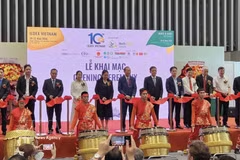
Delegates cut the ribbon to open the exhibition series on May 21, 2026 (Photo: VNA)

Industrial, transport infrastructure exhibitions open in Ho Chi Minh City

The events consist of the 22nd International Exhibition on Automobile, Motorcycle, Electric Vehicle and Supporting Industries (Autotech & Accessories 2026) and the International Exhibition on Construction Machinery, Rail Transit, Specialised Vehicles, Technology and Transportation Infrastructure (Cons & Trans 2026).

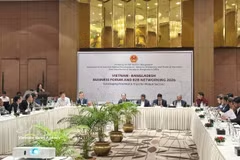
The Vietnam – Bangladesh business forum in Dhaka on May 19 (Photo: VNA)

Vietnam, Bangladesh eye to foster economic ties

Addressing the forum, Vietnamese Ambassador to Bangladesh Nguyen Manh Cuong highlighted the fruitful development of the bilateral ties over the past 53 years, noting that trade turnover has consistently exceeded 1.1 billion USD despite global disruptions. The two sides are now striving to raise the figure to 2 billion USD in the coming years.

The opening ceremony of the 10th International Livestock, Dairy, Meat Processing and Aquaculture Exposition on May 20 (Photo: VNA)

ILDEX Vietnam 2026 showcases livestock, agri-food innovation

The three-day event is jointly organised by VNU Asia Pacific and Thailand’s ITEC, serving as a platform for business networking, technology exchange and knowledge sharing in the livestock, aquaculture and food industries in Vietnam and Southeast Asia.

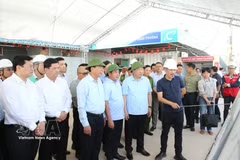
Permanent Deputy Prime Minister Pham Gia Tuc and officials inspect the Gia Binh International Airport project on May 20, 2026. (Photo: VNA)

Gia Binh international airport project accelerated ahead of APEC 2027

Tuc described Gia Binh International Airport as a national key project requiring strict adherence to construction timelines, particularly as it is expected to be put into operation in time for the 2027 APEC Economic Leaders' Meeting. Several associated projects are also being implemented under special mechanisms to serve major national tasks.

Vietnamese Ambassador to the Republic of Korea Vu Ho speaks at the forum.(Photo: VNA)

Forum promotes Vietnam–RoK supply chain connectivity

Cao Thi Phi Van, Deputy Director of ITPC, said that after more than three decades of cooperation, Vietnam–RoK ties are shifting from traditional manufacturing cooperation towards mastering future-oriented technologies such as semiconductors, artificial intelligence (AI), digital finance, renewable energy and global supply chains.

Fitch Ratings gives positive assessment of Vietnam’s economic fundamentals (Illustrative image. Source: VNA)

Fitch Ratings gives positive assessment of Vietnam’s economic fundamentals

Deputy Minister Tran Quoc Phuong stressed that Fitch’s credit assessments have enhanced Vietnam’s image and credibility in international financial markets, and provided additional motivation for the country to continue improving institutions, strengthening policy management efficiency and increasing economic transparency.