Top leader calls for strategic quantum technology development plan

Party General Secretary and State President To Lam emphasised that quantum technology is an entirely new, highly complex and rapidly evolving field closely linked to science and technology, national security, digital transformation, strategic industries and the country’s long-term competitiveness.

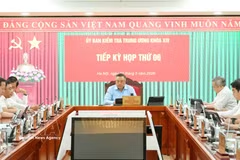
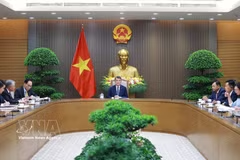
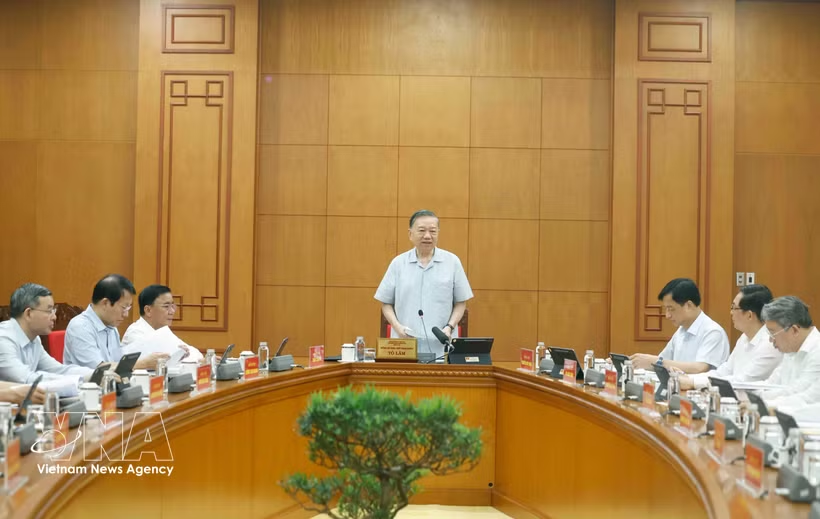
Party General Secretary and State President To Lam chairs the meeting of the standing board of the Central Steering Committee on Science, Technology, Innovation and Digital Transformation in Hanoi on May 21. (Photo: VNA)

Hanoi (VNA) – Party General Secretary and State President To Lam has stressed the need for deeper, more systematic and strategic research to finalise a comprehensive national quantum technology development plan that serves Vietnam’s development goals while ensuring strategic autonomy.

The top leader was chairing a meeting of the standing board of the Central Steering Committee on Science, Technology, Innovation and Digital Transformation to review a draft national project on quantum technology development in Hanoi on May 21.

The project on research, application and development of quantum technology serving socio-economic development and ensuring national defence and security aims to build Vietnam’s long-term capabilities in the emerging field.

The Party and State leader emphasised that quantum technology is an entirely new, highly complex and rapidly evolving field closely linked to science and technology, national security, digital transformation, strategic industries and the country’s long-term competitiveness.

He said that quantum technology should be recognised as a matter of national strategic importance rather than merely a scientific research issue. He underlined that development efforts must be integrated into the implementation of the Politburo’s Resolution 57 and aligned with broader national strategies related to national security, data governance, semiconductors, artificial intelligence and space technology.

General Secretary and President Lam underlined the need for a balanced approach, urging Vietnam to avoid both hesitation and unrealistic ambitions.

Vietnam may come later, but it must not move slowly, he said, warning against inferiority complexes, superficial movements, fragmented investment and goals that exceed the country’s actual capacity.

Instead, he called for selecting practical development directions suited to Vietnam’s conditions, focusing on building genuine national capabilities in areas where the country has the potential to participate and achieve mastery.

According to the leader, priority should be given to safeguarding national security and digital sovereignty to ensure Vietnam remains proactive and avoids strategic dependence.

He also stressed that international cooperation in quantum technology must be strong, selective and substantive, aimed at strengthening Vietnam’s self-reliance rather than creating new forms of dependency.
vnanet-tong-bi-thu-chu-tich-nuoc-to-lam-truong-ban-chi-dao-trung-uong-phat-bieu-anh-ttxvn-3675.jpg
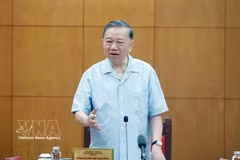
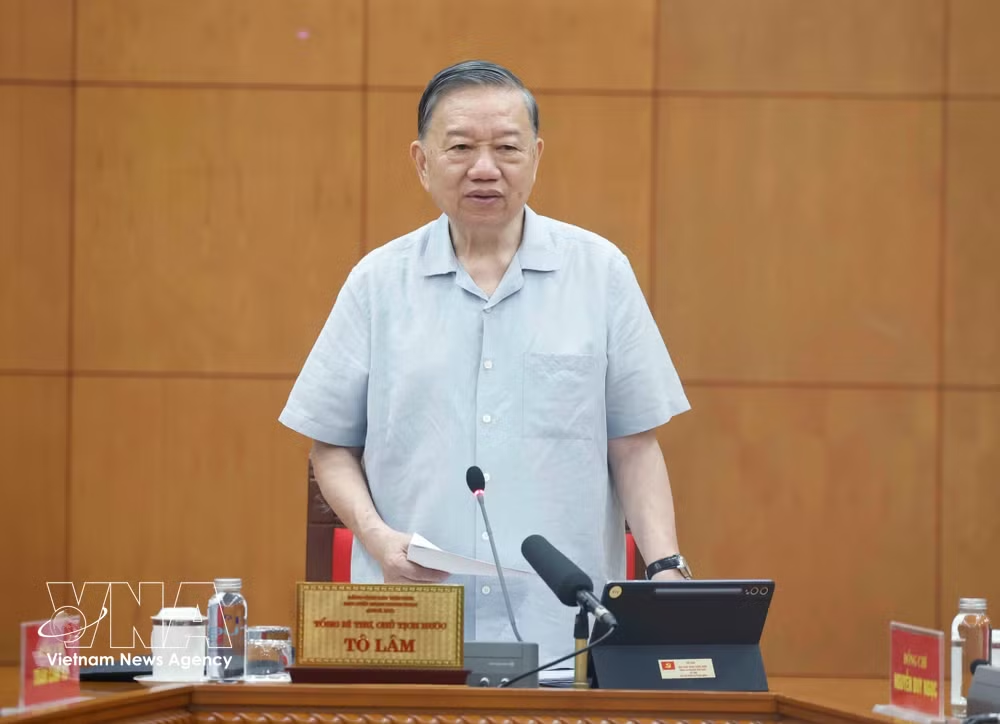
Party General Secretary and State President To Lam addresses the meeting. (Photo: VNA)

He stressed the need for focused investment instead of spreading resources thinly across multiple institutions and projects. He urged the establishment of strong research centres, key laboratories, leading research groups and effective coordination mechanisms linking research institutes, universities, businesses and defence-security agencies.

Alongside, it is crucial to reform the evaluation of scientific research outcomes, highlighting the importance of long-term capability building and acceptance of controlled risks in high-level scientific research. Management mechanisms, he said, must clearly distinguish between genuine scientific failure and wastefulness caused by formalism or irresponsibility.

The leader highlights the importance of human resources and innovation ecosystems, the leader added, calling for a national programme to train quantum technology, along with stronger international cooperation, including efforts to attract overseas Vietnamese scientists and foreign experts to contribute to Vietnam’s quantum technology capabilities.

Alongside basic research, he stressed the need to build a practical quantum innovation ecosystem involving the State, research institutes, universities, enterprises and defence-security units, with policies encouraging businesses to participate in research, application and commercialisation.

On workforce development, he noted that a successful national quantum programme must rest on a strong scientific culture marked by integrity and academic discipline.

He stressed the importance of inspiring younger generations to pursue frontier scientific knowledge and nurturing a new generation of scientists with professional expertise, academic integrity, global thinking, creativity and a strong sense of responsibility to the nation.

The Party and State leader also called for major reforms in implementation mechanisms, noting that quantum technology is an interdisciplinary field requiring highly coordinated governance.

He asked the Party Committee of the Vietnam Academy of Science and Technology to continue refining the project to ensure it is strategic, scientifically grounded and closely aligned with practical realities before submission to the Secretariat for consideration in accordance with regulations./.
VNA

See more

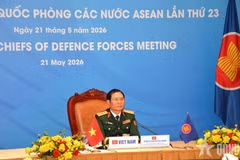
General Nguyen Tan Cuong attends the 23rd ASEAN Chiefs of Defence Forces Meeting (ACDFM-23) on May 21. (Photo: qdnd.vn)

Vietnam pledges to contribute more to adaptive, future-ready ASEAN

General Nguyen Tan Cuong highly valued the meeting’s theme – “Navigating Our Future, Together”, describing it as timely and reflective of ASEAN’s aspiration for solidarity, shared development and a prosperous community actively and effectively responding to present and future challenges.

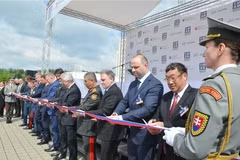
Deputy Minister of National Defence Sen. Lieut. Gen. Pham Hoai Nam (second from right) and delegates cut the ribbon to open IDEB 2026 (Photo: Vietnamese Embassy in Slovakia)

Vietnam attends international defence, security exhibition in Slovakia

A delegation from the Vietnam’s Ministry of National Defence led by its Deputy Minister Sen. Lieut. Gen. Pham Hoai Nam, has paid a working visit to Slovakia and attended the International Defence and Security Exhibition (IDEB 2026) at the invitation of the Slovak Ministry of Defence.

☀️ Morning digest on May 21

☀️ Morning digest on May 21

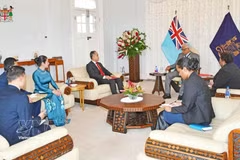
Party General Secretary and State President To Lam's meeting with the Party Committee of the Ministry of Health to look into traditional medicine, PM Le Minh Hung's phone talks with his New Zealand counterpart Christopher Luxon, and the 2026 Ho Chi Minh City – RoK investment cooperation and business networking forum are among news highlights on May 20 evening.

Prime Minister Le Minh Hung (R) hosts the UK's Ambassador to Vietnam Iain Frew in Hanoi on May 20 (Photo: VNA)

Vietnam attaches great importance to ties with UK: PM

Prime Minister Le Minh Hung suggested that the two countries work together towards raising bilateral trade turnover to 10 billion USD in 2026 and eventually 15 billion USD through expanded market access for each other’s goods.

Prime Minister Le Minh Hung (right) and Ambassador of the Democratic People’s Republic of Korea (DPRK) to Vietnam Ri Sung Guk at their meeting on May 20 (Photo: VNA)

Prime Minister receives DPRK Ambassador

Prime Minister Le Minh Hung affirmed that the Party, State and people of Vietnam always attach importance to and wish to continuously nurture and promote the Vietnam–DPRK relationship in a more substantive and effective manner in the new development era, in line with the common aspirations of the two peoples and contributing to peace, stability, cooperation and development in the region and the world.

Prime Minister Le Minh Hung (right) and Cuban Ambassador to Vietnam Rogelio Polanco Fuentes at their meeting on May 20 (Photo: VNA)

PM vows to deepen Vietnam-Cuba special ties

At a reception for Cuban Ambassador to Vietnam Rogelio Polanco Fuentes in Hanoi on May 20, Prime Minister Le Minh Hung stressed that the Party, Government and people of Vietnam always remember and treasure the solidarity and wholehearted support that the Party, Government and people of Cuba have extended to Vietnam during its past struggle for national liberation as well as the current cause of national construction and development.

Prime Minister Le Minh Hung has a phone conversation with New Zealand’s Prime Minister Christopher Luxon on May 20 (Photo: VNA)

PM holds phone talks with New Zealand counterpart

Prime Minister Le Minh Hung proposed six major orientations for future collaboration, including further strengthening political trust through increased delegation exchanges, high-level contacts and bilateral cooperation mechanisms, and promoting more substantive defence and security cooperation through enhanced exchanges and stronger naval and maritime security capabilities.

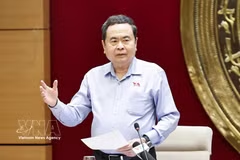
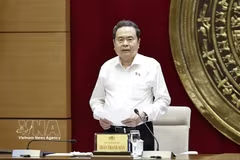
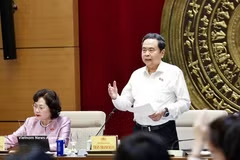
National Assembly Chairman Tran Thanh Man addresses the working session on May 20 (Photo: VNA)

NA leader urged more substantive, professional deputy affairs work

National Assembly Chairman Tran Thanh Man asked the NA Committee for Deputy Affairs to shift strongly from procedural consultation to strategic consultation, moving beyond the mindset of merely “following procedures correctly” towards policy design, process standardisation, quality control and forecasting.

General Secretary of the Communist Party of Vietnam Central Committee and State President To Lam speaks at the working session in Hanoi with the Party Central Committee’s Commission for Policies and Strategies and relevant agencies on assessing national development resources. (Photo: VNA)

Top leader orders decisive action to unlock idle resources for growth

Public resources must lead and activate private resources, while public investment should stimulate broader social investment. FDI, meanwhile, should move from quantity-based attraction toward quality-based absorption linked with technology transfer and stronger domestic linkages, said top leader To Lam.

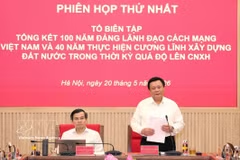
Prof. Dr. Nguyen Xuan Thang speaks at the event. (Photo: VNA)

Editorial team meets to begin review of 100-year Party leadership

Politburo member Prof. Dr. Nguyen Xuan Thang described the review as a major strategic political task, adding that the process must deliver historical depth, theoretical vision, and strategic foresight to guide Vietnam toward fast and sustainable development in the decades ahead.

NA Chairman Tran Thanh Man speaks at the working session with standing members of the NA's Committee for Economic and Financial Affairs in Hanoi on May 20. (Photo: VNA)

NA Chairman asks for enhanced policy advisory to support double-digit growth target

National Assembly (NA) Chairman Tran Thanh Man has demanded the NA's Committee for Economic and Financial Affairs to enhance its policy advisory capacity, stressing that robust and evidence-based policymaking is essential to achieving the country’s ambition of double-digit economic growth while safeguarding macroeconomic stability.

Prime Minister Le Minh Hung (R) and Ambassador Rick Switzer, Deputy US Trade Representative, in Hanoi on May 20, 2026. (Photo: VNA)

Prime Minister receives Deputy US Trade Representative

The Vietnamese Government will continue to work closely with the US side to soon finalise the agreement, thereby further deepening economic, trade, and investment cooperation as the main driving force for bilateral relations, said Prime Minister Le Minh Hung.

Minister of Foreign Affairs Le Hoai Trung (R) and Swedish State Secretary for Foreign Affairs Dag Hartelius in Hanoi on May 19, 2026. (Photo: VNA)

Vietnam sees Sweden one of leading European partners in innovation, green development

Discussing regional and international issues of mutual concern, both sides affirmed their support for multilateralism and free trade, as well as the peaceful settlement of disputes and conflicts in line with international law and the UN Charter. They also stressed the importance of maintaining peace, stability, security, safety, and freedom of navigation and overflight in accordance with international law, particularly the 1982 United Nations Convention on the Law of the Sea (UNCLOS).