Execution gap holds back Vietnam’s SMEs

Vietnamese small and medium-sized enterprises (SMEs) may not lack strategy or ambition, but many struggle to turn plans into results, business leaders and experts said at SME Forum 2026 in Ho Chi Minh City on March 20.

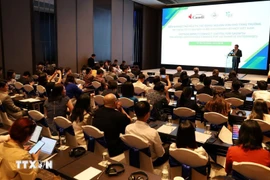
Rajesh Achanta, former vice president of Asia-Pacific supply chain operations at P&G, speaks at the SME Forum 2026 held in Ho Chi Minh City on March 20. (Photo courtesy of the organiser)

Ho Chi Minh City (VNS/VNA) - Vietnamese small and medium-sized enterprises (SMEs) may not lack strategy or ambition, but many struggle to turn plans into results, business leaders and experts said at the SME Forum 2026 held in Ho Chi Minh City on March 20.

Speakers warned that a widening gap between “knowing” and “doing” has become a major bottleneck for companies seeking to scale up and remain competitive in an increasingly volatile business environment.

The issue comes as Vietnamese firms face mounting pressure to balance growth with adaptability, as global economic uncertainty, geopolitical tensions and rapid technological change continue to reshape markets.

As businesses expand, structural weaknesses often emerge, particularly in organisational structures and operational systems. Rapid growth without strong foundations can quickly undermine efficiency when market conditions shift.

The challenge is especially acute for SMEs, which account for roughly 97–98% of all enterprises in Vietnam and contribute about half of the country’s gross domestic product.

Limited access to capital, management expertise and business networks often makes it harder for smaller companies to navigate market disruptions, prompting calls for stronger corporate governance and operational restructuring.

Strategy means little without execution

A central theme of the forum was the growing “execution gap” — the disconnect between strategy and implementation.

Dao Gia Hung, director of the SME division at VPBank, said the bank’s experience working with more than 200,000 enterprises shows that success often depends less on strategy itself than on the ability to execute it effectively.

“We have seen many Vietnamese companies grow from very small beginnings into businesses worth hundreds or even thousands of billions of đồng,” he said.

“But many others stall along the way. The difference is not opportunity, but the ability to execute and adapt,” he added.

Rajesh Achanta, former vice president of Asia-Pacific supply chain operations at Procter & Gamble (P&G), said the current business environment is, in some ways, even more complex than during the pandemic.

Geopolitical shifts, trade disruptions and technological change are continuously reshaping supply chains and operating models, requiring companies to rethink how they manage complexity.

He said supply chains should be viewed not merely as operational functions but as strategic drivers of value creation, contributing directly to profitability and cash flow.

At P&G, the implementation of a “Supply Chain 3.0” model helped achieve product availability levels of 98–99% while generating about 1.5 billion USD in annual savings, he added.

Turning strategy into action

Speakers said competitive advantage increasingly depends not on who has the best strategy, but on who can execute it most effectively.

That requires stronger management capabilities, clearer alignment between operations and business goals, and greater investment in workforce skills and cross-functional collaboration.

In a volatile global environment, participants said, the ability to act decisively and translate strategy into action will determine whether Vietnamese SMEs merely weather market turbulence or emerge stronger.

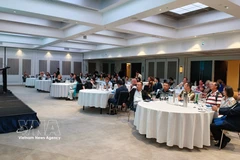
The event, co-organised by VPBank and Newing, gathered more than 1,000 founders and business executives under the theme “New Momentum for the Big Game.”/.
VNA

See more

Training sessions and dialogues have improved fishermen’s understanding of regulations and the risks associated with IUU fishing. (Photo: VNA)

Quang Tri strengthens fleet oversight to curb IUU fishing

Quang Tri province currently has about 4,600 fishing vessels measuring 6 metres or longer. All have met requirements on registration, inspection and licensing, and have installed vessel monitoring systems (VMS), a key tool to enhance oversight of offshore activities.

In Vietnam, silver bullion prices even touched 111 million VND (4,200 USD) per kilogramme, reflecting growing interest among individuals and investors. (Photo: vietnamnet.vn)

Vietnam considers listing silver bullion on commodity exchange

Under the proposal, the rollout would take place in two phases. The first would involve a pilot listing in the domestic market with physical transactions. In the second phase, after operations stabilise, the exchange could be linked with regional and international commodity exchanges.

Head of the Vietnam Trade Office in Australia Tran Thi Thanh My (Photo: VNA)

Vietnam rises as key market for Australian capital: official

Australian firms and investors are showing particularly strong interest in Vietnam, drawn by its large market, consistent high growth, youthful demographics, and rapidly expanding middle class, said a representative of the Vietnam Trade Office in Australia.

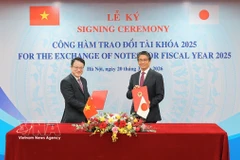
Deputy Minister of Finance Tran Quoc Phuong (left) and Japanese Ambassador to Vietnam Ito Naoki sign the exchange of notes on behalf of the governments of the two countries. (Photo: VNA)

Vietnam, Japan sign exchange of notes for ODA loans to support green transition

The funding, totaling approximately 90 billion JPY (around 609 million USD), will be allocated to three key projects, namely budget support for green growth and climate adaptation, disaster-resilient rural development, and climate-adaptive infrastructure to support production in northern mountainous regions, particularly for ethnic minority communities.

The third “Vietnamese Goods Vitality” programme themed “Vietnamese youth proud of Vietnamese goods”. (Photo: VNA)

Vitality of Vietnamese Goods programme opens

The event, organised by the Agency for Domestic Market Surveillance and Development in coordination with the Hoan Kiem ward People’s Committee, TikTok Shop and the National Payment Corporation of Vietnam, aims to support enterprises in promoting and selling products while expanding digital distribution channels. It also forms part of activities marking the 95th anniversary of the Ho Chi Minh Communist Youth Union (March 26, 1931–2026).

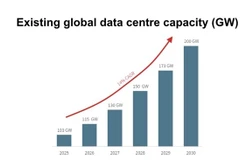
Global data centre capacity. (Photo Courtesy of JLL)

JLL: Vietnam data centres poised for growth

Hanoi and Ho Chi Minh City have a combined operational capacity of around 60 MW. While this is currently lower than regional hubs such as Jakarta, Kuala Lumpur, Bangkok, and Manila (74 MW), it demonstrates strong potential for future scaling.

Vietjet operates a modern, fuel-efficient fleet and continues to expand its international network, offering year-round promotions across destinations. (Photo: Vietjet)

Vietjet recognised among world’s best low-cost airlines with two international awards in 2026

The awards focus on in-flight product and passenger experience, using measurable onboard criteria. AirlineRatings experts highlighted Vietjet’s highly competitive fares, innovative approach, and products tailored to customer needs. The airline has maintained its title as the World’s Best Ultra Low-Cost Carrier since 2018 and has consistently ranked among the world’s leading low-cost airlines.

Noi Bai International Airport ranks 71st among the world’s 100 best airports. (Photo: VNA)

Noi Bai jumps to 71st in world’s top 100 airports: Skytrax

The airport climbed eight positions from 79th in 2025, marking one of its strongest performances to date. This is also the eighth consecutive year that Noi Bai, the capital’s main aviation gateway, has been named among the world’s top 100 airports.