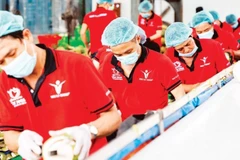
Banks offer diverse solutions to support SMEs

With an increasingly significant role in the economy, the small and medium-sized enterprise (SME) sector is becoming a key segment in the credit growth strategies of many banks and the banks have been taking diverse solutions to support the enterprises.

Vietnam is projected to have approximately 2.4 million SMEs, accounting for over 98% of the country’s total enterprises. (Photo: cafef.vn)

Hanoi (VNS/VNA) - With an increasingly significant role in the economy, the small and medium-sized enterprise (SME) sector is becoming a key focus in banks’ credit growth strategies, prompting lenders to roll out a range of solutions to support businesses that often run on tight cash flow.

According to the World Bank, by 2030 Vietnam is projected to have around 2.4 million SMEs, accounting for more than 98% of total enterprises nationwide.

In practice, SMEs typically have limited financial reserves, while their production and business activities depend heavily on short-term capital turnover and daily cash flow. Cash inflows and outflows are closely tied to order schedules, payment deadlines and the ability to rotate capital. Even minor timing disruptions, such as slow disbursement or delayed payments from partners, can upset business plans.

In response, many banks have adjusted their approach, shifting from appraisal models based mainly on collateral to assessments centred on cash flow and operational capacity.

Banks have also stepped up investment in digital platforms and specialised financial solutions for SMEs, expanding their services beyond lending to include cash flow management, corporate digital banking and electronic payments.

For example, MB’s MISA Lending platform provides an online overdraft facility for SMEs with a limit of up to 3 billion VND (116,000 USD). The process is fully digitised, enabling businesses to submit applications and receive preliminary approval quickly based on electronic invoice data, without requiring collateral. Many businesses have welcomed the speed and transparency of the solution.

Some banks approach SMEs from a cash flow management perspective. At ABBank, the ABBank Business platform is designed to address common challenges in corporate financial management, particularly cash flow control and transaction speed. By centralising core financial operations on a single platform, businesses can monitor income, expenses and balances in real time, reducing data fragmentation. A multi-level approval mechanism also supports appropriate internal control processes and helps mitigate operational risks.

Meanwhile, VPBankSME has adopted a broader approach to capital and management solutions, developing support packages based on actual cash flow and business cycles. Rather than offering standalone loans, the bank structures solutions around operational needs, from managing revenue and expenditure to payments and capital allocation at each stage. This enables businesses to use financial resources more proactively, especially when rapid capital turnover is required or during peak seasons.

At OCB, General Director Pham Hong Hai said the bank has implemented a separate credit policy focusing on evaluating business models, operational plans, founders’ management experience and the stability of cash flow for start-ups, a distinct segment within the SME sector.

According to Hai, these factors directly reflect a business’s ability to survive and grow when it has not yet accumulated sufficient collateral.

To broaden access to capital, OCB also collaborates with investment funds that include capital contributions from Japan’s Aozora Bank to provide financial solutions tailored to start-ups. Unsecured working capital loans are structured primarily on the basis of cash flow and business prospects, creating greater opportunities for enterprises with limited initial financial resources to obtain funding.

Dr Nguyen Huu Huan of Ho Chi Minh City University of Economics said the most common channel for SMEs to access international capital remains commercial banks, which act as intermediaries to mobilise and allocate funds from global impact investment and green finance funds.

According to Huan, the effective use of capital requires banks not only to disburse funds but also to support businesses in preparing documentation, demonstrating capacity and ensuring that capital is used for its intended purpose. These are mandatory requirements from international funds, which impose strict standards on transparency and risk control.

In practice, banks are moving towards becoming financial partners to businesses, providing timely capital while simplifying procedures and designing credit packages suited to the needs of each customer segment./.

VNA

See more

Industrial production surges in the first two months of 2026. (Photo: VNA)

Industrial production posts strong growth in first two months

According to the National Statistics Office (NSO) under the Ministry of Finance, the index of industrial production (IIP) in February was estimated to decrease 18.4% from the previous month but increase 1% year on year. Overall, in the January–February period, the IIP rose 10.4% compared with the same period last year.

A delegation from the Nghe An provincial People’s Committee inspects production and business activities at the VSIP Nghe An Industrial, Urban and Service Park. (Photo:nhandan.vn)

Nghe An steps up reforms to attract FDI

In 2025, the provincial People’s Committee licensed 25 new FDI projects and approved capital adjustments for 20 others, bringing the total newly registered and additional investment to more than 1 billion USD. Many large-scale projects in the Southeast Nghe An Economic Zone have already become operational, contributing to export growth, state budget revenues and job creation.

Nearly 35,500 enterprises are newly registered nationwide, with total registered capital reaching nearly 313.7 trillion VND and more than 167,500 registered workers. (Photo: VNA)

Nearly 35,500 new businesses set up in first two months

The enterprises registered combined capital of about 313.7 trillion VND and more than 167,500 employees. Compared with the same period last year, the number of new businesses surged by 70.7%, while registered capital rose by 36.1% and registered labour increased by 19.1%.

The yarn factory of Unitex Textile and Dyeing Company Limited applies new technology to optimise operations using an automated model. (Photo: VNA)

Resolution 68: International lessons for private sector development

A common feature in many successful economies is a fundamental shift in the perception of private enterprises. In countries such as Singapore, Germany, Republic of Korea (RoK) and China, private firms are viewed not mainly as entities requiring strict control but as development partners and key forces generating growth, jobs and innovation.

The production line of Regza Electronics Vietnam Co., Ltd. located in Dong Nai province. (Photo: VNA)

Vietnam’s overseas investment rises 2.3-fold in first two months

During the period, 36 new overseas projects were granted investment certificates with total registered capital from Vietnamese investors reaching 532.4 million USD, up 2.3 times compared to the same period last year. In addition, three projects adjusted their capital with an additional 7.8 million USD, 1.5 times higher than a year earlier.

Workers of PTSC Thanh Hoa check the system for crude oil imports. Vietnam saw strong increase in fuel imports in the first two months of this year. (Photo" VNA)

Vietnam records strong increase in fuel imports in two months

Statistics of Vietnam Customs showed that Vietnam spent more than 1.44 billion USD importing 2.18 million tonnes of petroleum products in the first two months of this year, representing a sharp increase of 31.4% and 43%, respectively, over the same period last year.

Prime Minister Pham Minh Chinh visits a macadamia cultivation model in Huoi Tao B village, Pu Nhi commune, Dien Bien province on March 8. (Photo: VNA)

PM requests boosting agricultural development in Northwestern region

PM Chinh encouraged local residents to explore additional crops and livestock suitable for intercropping in order to maximise land use efficiency. Farmers were also urged to strengthen cooperation with one another and with businesses by joining cooperatives, consolidating land resources and working together to expand production and improve incomes.

Farmers in the Mekong Delta province of An Giang harvest rice grown under the project 'Sustainable Development of One Million Hectares of High-Quality, Low-Emission Rice Associated with Green Growth in the Mekong Delta by 2030.' (Photo: VNA)

Promoting high-quality rice exports amid mounting challenges

According to the Ministry of Agriculture and Environment (MAE), an estimated 600,000 tonnes of rice worth 370 million USD was exported in January, up 12.4% in volume and 16.9% in value year-on-year. The average export price reached 616.6 USD per tonne, up 4%.