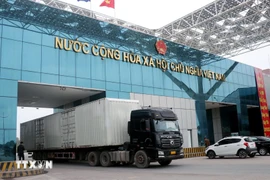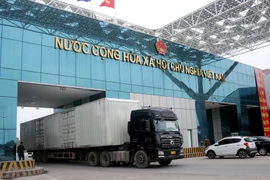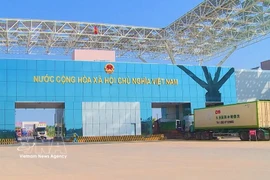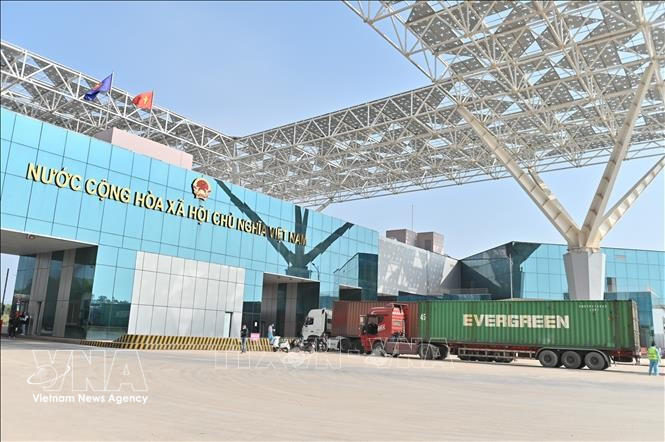
Quang Ninh (VNA) – The Government’s approval of a pilot scheme to develop a smart border gate at the Mong Cai (Vietnam) – Dongxing (China) international border gate pair marks not only a major technological step forward but also a clear demonstration of strong political resolve to translate strategic commitments between the two countries into reality, opening a new chapter for cross-border trade.
Strategic consensus
Deputy Prime Minister Bui Thanh Son, on January 26, signed a decision approving the pilot scheme. The decision establishes the legal foundation for the first smart border gate model in Quang Ninh province, and is the result of long-term strategic planning aligned with the “Two Corridors, One Belt” framework and China’s Belt and Road Initiative.
The smart border gate will be based on Industry 4.0 technologies, with cross-border data connectivity serving as its core. Beyond modernising a single customs checkpoint, the project aims to create a regional-scale “digital gateway” facilitating more efficient trade flows.
Once put into operation, customs clearance time is expected to be reduced to just four to six hours, compared with one to two days under traditional procedures.
Meanwhile, costs related to yards, transportation and ancillary logistics services are projected to fall by 30–40%.
A key technological highlight of the project is the deployment of unmanned intelligent guided vehicles (IGVs), operating on 5G networks and satellite positioning systems. Capable of operating around the clock, these vehicles will enable uninterrupted and contactless cargo flows, particularly for fresh agricultural products and electronic components. The system is designed to ensure safety and stability even in extreme conditions such as natural disasters or disease outbreaks.
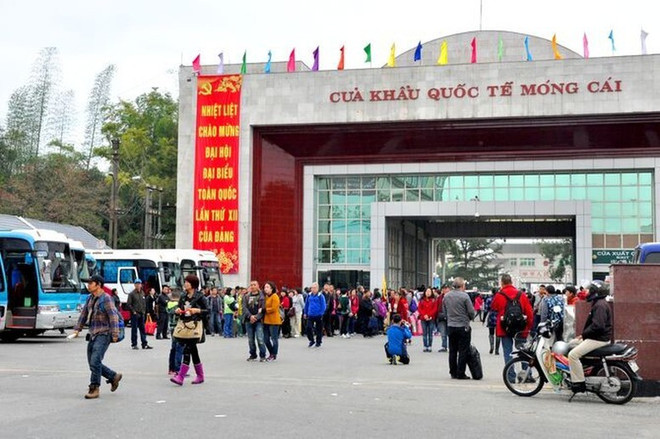
The Government’s consensus is reflected in the decision to grant Quang Ninh province a high degree of operational autonomy, while maintaining close coordination with ministries and central agencies. The Prime Minister’s decision clearly stipulates that implementation must ensure full synchronisation of infrastructure and planning with the Chinese side, sending a strong message about an open economy where borders are seen not as barriers but as dynamic buffer zones driving sustainable development.
Quang Ninh as the “conductor”
As the lead authority, Quang Ninh has drawn up an ambitious implementation roadmap with total projected investment exceeding 4.5 trillion VND (173.2 million USD). The plan is divided into two main phases, with phase one, scheduled for 2026, focusing on upgrading existing infrastructure at the Bac Luan I and II bridges. This includes the installation of IGV equipment and e-Gate systems using biometric facial and fingerprint recognition, along with the establishment of an Intelligent Operations Centre (IOC) to integrate data from all relevant functional forces.
Phase two, covering the 2027–2030 period, will see the expansion of the border-gate boundary and the establishment of specialised functional zones such as a high-tech logistics centre, a cross-border e-commerce zone, and internationally accredited testing laboratories located directly at the border. By 2030, Mong Cai’s customs clearance capacity is expected to triple compared with current levels.
The implementation of an unprecedented model is expected to face challenges related to legal frameworks, technical standards and capital mobilisation. To address these issues, the Government has instructed the Ministries of Public Security, National Defence, Finance, Industry and Trade, and Foreign Affairs to coordinate with local authorities.
In addition, Quang Ninh is working to diversify funding sources, with a strong emphasis on private-sector participation. Negotiations on customs data connectivity and mutual recognition of inspection results between Vietnam and China are also underway, to realise a “single window, single stop” mechanism and further facilitate cross-border trade./.