Finance ministry seeks public feedback on minimal tax on digital assets

Under the draft, the transfer and trading of crypto assets would not be subject to value-added tax. Individual investors, regardless of residency status, would be required to pay personal income tax at a rate of 0.1% on the gross value of each transfer. This approach mirrors the current tax method applied to securities transactions.

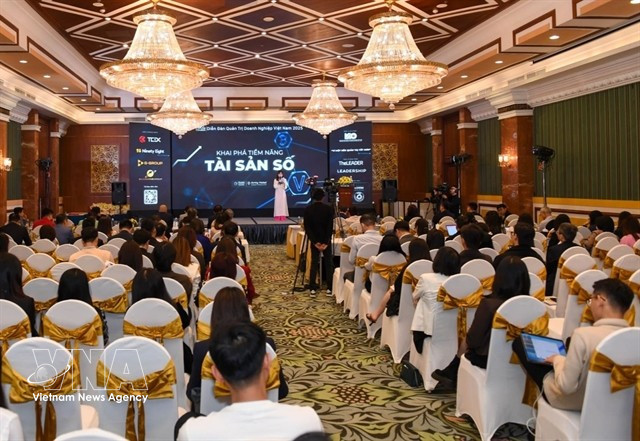
Participants at a conference on digital assets in Hanoi on December 10. (Photo: VNA)

Hanoi (VNS/VNA) - The Ministry of Finance has begun seeking public feedback on a draft circular regulating tax policies for transactions, transfers and business activities related to crypto assets.

Under the draft, the transfer and trading of crypto assets would not be subject to value-added tax. Individual investors, regardless of residency status, would be required to pay personal income tax at a rate of 0.1% on the gross value of each transfer. This approach mirrors the current tax method applied to securities transactions.

For organisations established in Vietnam that earn income from the transfer of crypto assets, corporate income tax would be levied at 20%. Taxable income would be calculated as the selling price minus the purchase price and expenses related to the transfer. The timing for determining revenue and taxable income would follow existing regulations on corporate and personal income tax applicable to securities transfers.

According to Phan Duc Trung, Chairman of the Vietnam Blockchain and Digital Assets Association, digital assets are inherently global in nature. A tax policy that lacks harmony, he said, could undermine the competitiveness of the domestic market. The key issue is not whether taxes are high or low but finding a balance of interests among the government, businesses and investors, while ensuring transparent and sustainable market development.

Trung said the proposed 0.1% rate is appropriate for the early stage of market formation. It provides a basis for management and budget revenue while maintaining incentives for businesses and investors to participate in the formal market.

He stressed that tax policies for digital assets should be designed to encourage market activity within a legal framework rather than creating barriers that push capital flows and transactions beyond regulatory oversight. As Vietnam seeks to attract international capital and professional investors, tax policy in this field should also contribute to building a competitive, transparent and reasonable investment environment, especially as licensed digital asset exchanges begin to take shape.

From a legal standpoint, lawyer Hoang Ha from the Ho Chi Minh City Bar Association described the 0.1% tax as a “prudent and practical step” by the Ministry of Finance during the pilot period from 2025 to 2030. The rate is not burdensome enough to drive investors out of the market, yet sufficient to establish a new regulatory order.

He noted that the rate is equivalent to that currently applied to securities transfers in Vietnam, reflecting an approach that places different types of financial investment assets on a more equal footing. For long-term investors, the tax burden is minimal, while for short-term or speculative traders it represents a more meaningful cost.

Importantly, the introduction of the tax sends a clear signal that the government recognises crypto assets as assets with value and lawful transactions protected under civil law, helping to remove a legal grey area that has persisted for years. By collecting tax at source through pilot exchanges, authorities would also be better positioned to monitor capital flows and support anti-money laundering and counter-terrorism financing efforts, while reducing compliance costs for individuals./.

source
See more

Steel products of Hoa Phat Group. (Photo: VNA)

Vietnam aims to meet 80–85% of domestic steel demand by 2030

Vietnam aims to meet 80–85% of domestic steel demand by 2030. Crude steel production is targeted at 25–26 million tonnes per year, with annual growth of 7–8%, while finished steel output is expected to reach 32–33 million tonnes per year, growing by 5.5–6.5% annually. Per capita steel consumption is projected at 270–280 kg per year.

One of the products granted Halal certification in 2026. (Photo: moit.gov.vn)

Spring Fair 2026 boosts momentum for Vietnam’s Halal sector

The fair’s greatest value for Halal products lies less in immediate revenue than in building trust and standardising business practices. In a market where certification determines entry, it highlights that expansion must begin with fundamentals, standards, raw materials, production processes and readiness.

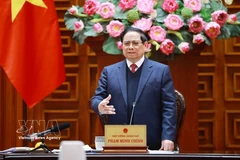
Prime Minister Pham Minh Chinh speaks at the fifth meeting of the Steering Committee for Nuclear Power Plant Construction. (Photo: VNA)

PM calls for more vigorous implementation of nuclear power projects

Describing nuclear power plants as nationally significant, strategic projects with a century-long vision, PM Chinh called for urgent and responsible implementation of tasks within assigned authority, with any outstanding issues promptly reported to higher authorities.

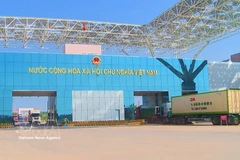
Vehicles transporting import and export goods at Bac Luan II Bridge border gate. (Photo: VNA)

Building smart border gates to enhance competitiveness, drive growth

With plans to build the Mong Cai–Ha Long–Hai Phong railway alongside the smart border gate and economic cooperation zone, Quang Ninh is positioning itself as a new growth pole in northern Vietnam and a key gateway for economic cooperation between Vietnam, ASEAN and China.

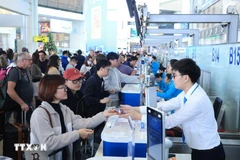
Noi Bai International Airport is expected to receive a record number of passengers (Photo: VNA)

Noi Bai, Tan Son Nhat airports expect record passenger volumes during Tet

Information from Noi Bai International Airport showed that during the peak Tet period, passenger traffic is forecast to reach a record high, posting double-digit growth year on year. Specifically, in the seven days before Tet (February 10–16), Noi Bai is expected to serve more than 725,000 passengers, up 16% from the same period in 2025, with 4,467 flights, an increase of 12.5%.

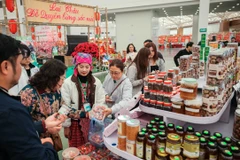
The booth of Lang Son province brings about distinctive local products to the fair, and also implemented various promotional programmes to stimulate consumer demand (Photo: VNA)

Spring Fair 2026 spreads cultural values, boost trade

From handwoven brocade textiles to traditional ethnic costumes, the fair presents vivid cultural colours and highlights how local producers are introducing heritage products to the modern market, expanding consumer reach, building brands, and strengthening trade links.

Hanoi markets come alive as Tet 2026 approaching (Photo: nhandan.vn)

Hanoi markets come alive as Tet 2026 approaching

A recent survey shows flower prices have seen only slight fluctuations this year thanks to favourable weather conditions. Peach blossoms are priced from 200,000 VND to several million VND, depending on size and shape.

Ho Chi Minh City’s public spending rose in 2025 but fell short of the amount it had targeted (Photo: dangcongsan.vn)

Ho Chi Minh City to tackle public spending bottlenecks

By the end of 2025, the city had disbursed 74% of the amount targeted by the Government – 89.07 trillion VND (3.7 billion USD) out of 120.32 trillion VND – well below the near-100 % rate typically required to maximise economic impact.

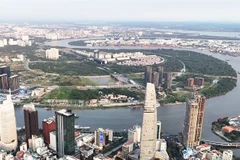
A view of Hanoi. The capital city will boost trade promotion and advertise the ‘Hanoi - A Green Destination’ programme to attract investment and international markets (Photo chinhphu.vn)

Hanoi aims to attract 4.5 billion USD in FDI in 2026

The plan was under Decision No. 53/KH-UBND on international economic integration in 2026, aiming to create momentum for rapid and sustainable growth, while simultaneously enhancing the competitiveness and position of the capital city in the context of deep integration.

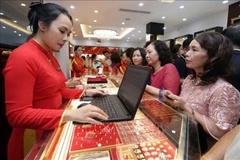
People buy gold at a shop in Hanoi (Photo: VNA)

Ministry of Finance clarifies new gold bar tax amid market concerns

Under the new Personal Income Tax Law No. 109/2025, adopted by the National Assembly, a 0.1% tax will be levied on each transfer of gold bars. The Government will set value thresholds to exempt individuals purchasing gold for savings rather than speculative purposes.

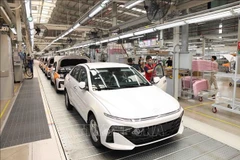
Hyundai Thanh Cong automobile manufacturing and assembly plant in Ninh Binh province. (Photo: VNA)

Vietnam reports 95% jump in January auto sales

Passenger cars accounted for the lion’s share of the gain, with 26,102 units sold. Commercial vehicles contributed 10,312 units, while special-purpose vehicles totaled 461 units.