Cross-border e-commerce drives Vietnam–India economic ties

Hang noted that cross-border e-commerce is creating fresh opportunities for bilateral cooperation. Indian products such as natural cosmetics, essential oil, herbal products, fashion items and household goods are seen as highly promising in the Vietnamese market. At the same time, Vietnamese businesses, especially small and medium-sized enterprises, are increasingly able to use digital platforms to access India’s market of more than 1.4 billion consumers.

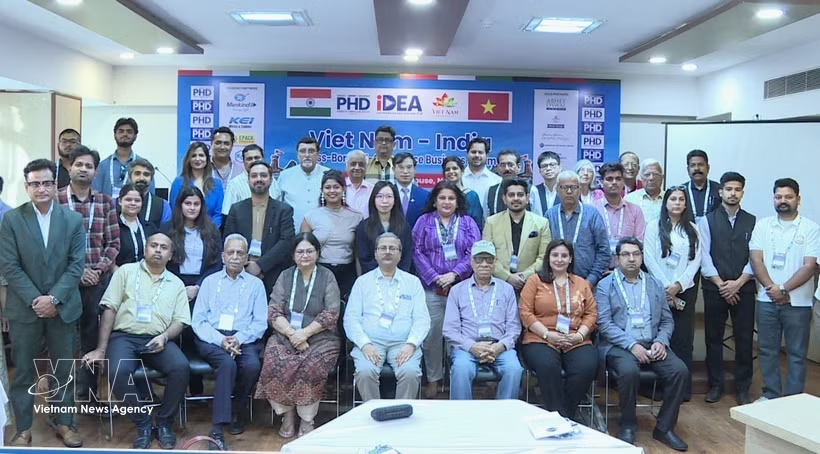
Organisers and speakers at the “Vietnam–India Cross-border E-commerce” forum pose for a group photo. (Photo: VNA)

​New Delhi (VNA) – Cross-border e-commerce, digital payments, artificial intelligence (AI), innovation and startup cooperation are expected to emerge as new growth engines for Vietnam–India economic relations as the two countries are striving to realise a bilateral trade target of 25 billion USD by 2030.

The outlook was highlighted by Bui Trung Thuong, Vietnam’s Trade Counsellor in India, at the recent forum “Vietnam–India Cross-border E-commerce” in New Delhi, which brought together more than 100 representatives from government agencies, industry associations, logistics providers, fintech firms, technology platforms and startups from both countries.

Bui Thi Thanh Hang, Head of the Department of International Cooperation at the Agency of E-commerce and Digital Economy (iDEA) under Vietnam’s Ministry of Industry and Trade, said the country’s B2C e-commerce market was estimated to generate 31 billion USD in revenue in 2025, with annual growth of 25.5%, placing Vietnam among the world’s fastest-growing digital markets. E-commerce currently contributes around 11% of the country’s total retail and service revenue, reinforcing its role as a major pillar of the digital economy.

Hang noted that cross-border e-commerce is creating fresh opportunities for bilateral cooperation. Indian products such as natural cosmetics, essential oil, herbal products, fashion items and household goods are seen as highly promising in the Vietnamese market. At the same time, Vietnamese businesses, especially small and medium-sized enterprises, are increasingly able to use digital platforms to access India’s market of more than 1.4 billion consumers.

She added that Vietnam is continuing to refine its legal framework, with the Law on E-commerce expected to take effect on July 1, 2026. Support programmes are also being rolled out to help businesses join international e-commerce platforms and develop “national pavilion” models, paving the way for stronger business connectivity and deeper participation in the digital economy.
vnanet-potal-thuong-mai-dien-tu-mo-rong-hop-tac-kinh-te-viet-nam-8093-an-do-8774870.jpg
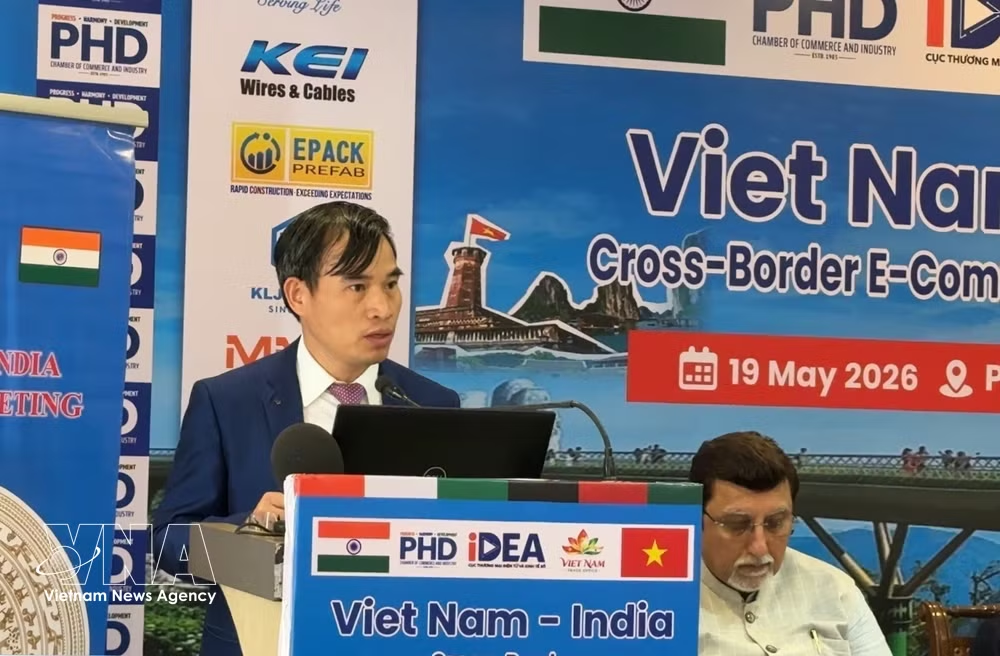
Bui Trung Thuong, Vietnam’s Trade Counsellor in India, speaks at the “Vietnam–India Cross-border E-commerce” forum in New Delhi. (Photo: VNA)

Representing the Indian side, Sanath Kumar, Chief Economist of the PHD Chamber of Commerce and Industry (PHDCCI), said India currently has over 80 million micro, small and medium-sized enterprises (MSMEs) and the world’s third-largest startup ecosystem, with around 150,000 startups. He described cross-border e-commerce as a vital tool for MSMEs to expand markets, generate jobs and improve access to global customers.

Ashok Gupta, Head of Asia-Pacific International Relations at PHDCCI, underscored the message “Made in India, Made in Vietnam – for the world”, saying the two countries could step up cooperation in green logistics, electric vehicles, AI and blockchain to optimise supply chains and lower logistics costs in cross-border trade.

Meanwhile, Sagar Sharma, Co-founder of Rainwater Labs, shared insights from India’s UPI digital payment system and suggested Vietnam and India prioritise cooperation in digital platforms for MSMEs, cross-border payments and AI/IoT applications in supply chain management.

Speaking to Vietnam News Agency correspondents in India, Naveen Seth, Deputy Secretary General of PHDCCI, described Vietnam and India as two dynamic Asian economies with strong cooperation potential in e-commerce, logistics and digital economy, driven by their young populations and rapid digital transformation.

According to Seth, cross-border e-commerce can directly connect MSMEs from both countries, helping them expand into new markets at competitive costs. He added that the Indian business community sees considerable potential in cooperation with Vietnam and hopes discussions at the forum will soon translate into concrete projects.

PHDCCI will continue coordinating with the Vietnam Trade Office in India and related partners to organise business networking activities, including plans to send Indian business delegations to Vietnam, contributing to more substantive cooperation and the shared goal of raising bilateral trade turnover to 25 billion USD by 2030, he said.

​During the discussion session, many Indian enterprises showed strong interest in support policies for foreign MSMEs, along with regulations on VAT, e-invoicing and procedures for entering Vietnam’s e-commerce market.​

The forum provided a practical platform for dialogue between policymakers and businesses from both countries, helping identify new cooperation opportunities in e-commerce, logistics, digital payments and innovation, while supporting efforts to further expand Vietnam–India trade relations./.

VNA

See more

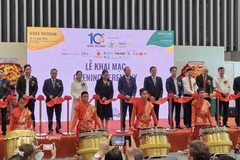
Delegates cut the ribbon to open the exhibition series on May 21, 2026 (Photo: VNA)

Industrial, transport infrastructure exhibitions open in Ho Chi Minh City

The events consist of the 22nd International Exhibition on Automobile, Motorcycle, Electric Vehicle and Supporting Industries (Autotech & Accessories 2026) and the International Exhibition on Construction Machinery, Rail Transit, Specialised Vehicles, Technology and Transportation Infrastructure (Cons & Trans 2026).

Workers of the Duy Khanh precision mechanical factory in Tang Nhon Phu ward, Ho Chi Minh City, manufacture support mechanical components. (Photo: sggp.org.vn)

Banks shift to cash-flow lending to unlock capital for SMEs

Prof. Nguyen Trong Hoai from the University of Economics Ho Chi Minh City (UEH) suggested that Vietnam should study open finance models built on digital data adopted in several countries to improve credit access for SMEs lacking collateral.

The Vietnam – Bangladesh business forum in Dhaka on May 19 (Photo: VNA)

Vietnam, Bangladesh eye to foster economic ties

Addressing the forum, Vietnamese Ambassador to Bangladesh Nguyen Manh Cuong highlighted the fruitful development of the bilateral ties over the past 53 years, noting that trade turnover has consistently exceeded 1.1 billion USD despite global disruptions. The two sides are now striving to raise the figure to 2 billion USD in the coming years.

The opening ceremony of the 10th International Livestock, Dairy, Meat Processing and Aquaculture Exposition on May 20 (Photo: VNA)

ILDEX Vietnam 2026 showcases livestock, agri-food innovation

The three-day event is jointly organised by VNU Asia Pacific and Thailand’s ITEC, serving as a platform for business networking, technology exchange and knowledge sharing in the livestock, aquaculture and food industries in Vietnam and Southeast Asia.

Permanent Deputy Prime Minister Pham Gia Tuc and officials inspect the Gia Binh International Airport project on May 20, 2026. (Photo: VNA)

Gia Binh international airport project accelerated ahead of APEC 2027

Tuc described Gia Binh International Airport as a national key project requiring strict adherence to construction timelines, particularly as it is expected to be put into operation in time for the 2027 APEC Economic Leaders' Meeting. Several associated projects are also being implemented under special mechanisms to serve major national tasks.

Vietnamese Ambassador to the Republic of Korea Vu Ho speaks at the forum.(Photo: VNA)

Forum promotes Vietnam–RoK supply chain connectivity

Cao Thi Phi Van, Deputy Director of ITPC, said that after more than three decades of cooperation, Vietnam–RoK ties are shifting from traditional manufacturing cooperation towards mastering future-oriented technologies such as semiconductors, artificial intelligence (AI), digital finance, renewable energy and global supply chains.

Fitch Ratings gives positive assessment of Vietnam’s economic fundamentals (Illustrative image. Source: VNA)

Fitch Ratings gives positive assessment of Vietnam’s economic fundamentals

Deputy Minister Tran Quoc Phuong stressed that Fitch’s credit assessments have enhanced Vietnam’s image and credibility in international financial markets, and provided additional motivation for the country to continue improving institutions, strengthening policy management efficiency and increasing economic transparency.

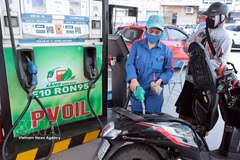
Consumer purchases E10 biofuel at a PVOIL petrol station on Thai Thinh street in Hanoi. (Photo: VNA)

Hanoi strengthens oversight of transition to E10 biofuel

To ensure compliance with the transition roadmap, the Hanoi Market Surveillance Sub-Department has requested petrol traders to proactively review and upgrade storage tanks, fuel pumps and other technical conditions necessary for E10 distribution, thereby preventing disruptions to fuel supply serving consumption and production demands across the capital.

A Phu Tho civil servant guides a local how to switch from presumptive tax mechanism to tax sef-declaration. (Photo: VNA)

📝OP-ED: Vietnam’s tax reform: Fair play, not revenue squeeze

At a time when social media disinformation grows more sophisticated, transparency and public disclosure are the most potent counter to distortions. Facts, data and real-world results deliver the strongest rebuttal to attempts that twist reality and erode trust in tax administration reform.