Vietnamese travellers enjoy planning for trips

The Booking.com’s Travel Trends 2026 data revealed that a growing number of Vietnamese travellers, about 74% of respondents, are channelling “Main Character Planning Energy”, where planning and booking is just as enjoyable as the trip itself.

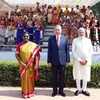
Many Vietnamese travellers love to plan the trip by themselves even when it requires a lot of time. (Photo courtesy of Booking.com)

Ho Chi Minh City (VNS/VNA) – Vietnamese travellers prefer planning the trip themselves even when it requires a lot of time and work, signalling a clear shift of how travel planning is viewed from being stressful to generating excitement, a travel agency said.

The Booking.com’s Travel Trends 2026 data revealed that a growing number of Vietnamese travellers, about 74% of respondents, are channelling “Main Character Planning Energy”, where planning and booking is just as enjoyable as the trip itself.

This trend is attributed to the joy of planning, which is matched with easy, intuitive booking experiences, ensuring travellers can focus on what truly matters: making memories.

According to Booking.com, Vietnamese travellers are entering 2026 with positivity around travel and a desire for discovery.

A majority of them feel optimistic about their upcoming trips, while many plan on visiting a new destination, suggesting a year defined by first-time experiences and meaningful travel moments.

This persona enjoys making plans and happily takes the lead, even if it requires a lot of time and work. More than 60% of Vietnamese travellers are proudly willing to take charge of planning and reservations, and this persona emerges as the majority of travellers across age cohorts.

Other travellers like being a main planner and organiser but frequently wishes others would offer more help or share the responsibility.

In addition, there is a group of travellers who are happy to help with specific tasks (like research or booking one part) but prefer not to be the main leader.

About 5% of travellers often prefer not to plan but end up taking the lead because no one else will. And the last are travellers who prefer others to take the lead on planning and are grateful to simply enjoy the itinerary they create.

Travel companions continue to play a defining role in shaping trips, with familial relationships anchoring travel decisions.

Family travel remains dominant, with 45% of Vietnamese travellers planning to travel with their spouse and children this year.

This is followed by getaways with a friend or their significant other, while one-third plan on travelling with extended family and with colleagues from work.

These dynamics underscore a key shift: while travel companions may vary, the intent remains consistent, travellers are prioritising deeper, more meaningful connections./.

VNA

See more

Hai Tac Island in An Giang province is increasingly attractive to visitors. (Photo: VNA)

Slow travel increases connections, reshapes tourism trends

Rather than rushing to “check in” at as many attractions as possible, slow travel allows visitors to immerse themselves in local life. Travellers may spend time wandering through a highland market, learning to cook a traditional dish, cycling around a coastal fishing village, or simply enjoying the tranquil rhythm of life in the countryside.

The Dien Bien Phu campaign headquarters has become a popular tourist attraction in Dien Bien province. (Photo: VNA)

Dien Bien Phu tourism cable car project receives in-principle approval

The project aims to effectively tap the area’s natural landscapes, geographical advantages and distinctive historical value, while creating a high-quality tourism product with strong competitiveness. It is also intended to preserve, honour and promote the value of the Dien Bien Phu Victory special national historical relic site.

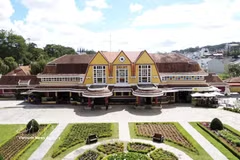
Da Lat station is the hub of the roughly 84-km Phan Rang–Da Lat railway (Photo: VNA)

Da Lat city's century-old railway station doubles as tourist draw

It now functions as both a transport hub and a sought-after photo spot. In the early morning, with mist still threaded through the pines, the station radiates an old-world calm. Visitors arrive at dawn to breathe the mountain air and capture iconic images of the highland city.

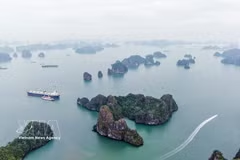
Ha Long Bay in Quang Ninh province. (Photo: VNA)

Quang Ninh - magnet for affluent Indian travellers

Alongside wedding tourism, Quang Ninh is also seeing robust growth in arrivals of Indian MICE travellers. Delegations of hundreds, and sometimes thousands, of visitors have been coming to the province for conferences, seminars and incentive travel programmes combined with leisure stays.

Visitors explore the Tra Su cajuput forest in An Giang province. (Photo: Tra Su Tourism Area)

Mekong Delta eyes stronger foothold in global tourism

Enriched by the alluvial deposits of the Mekong River, the region stands out for its dense canal network, year-round fruit orchards, biodiversity-rich national parks, and vibrant folk festivals – invaluable assets for developing diverse tourism offerings, from orchard-based eco-tourism and river experiences to cultural, festival, resort and nature conservation tourism.

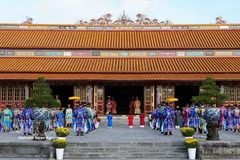
A Lunar New Year court ceremony of Nguyen Dynasty is reenacted at Thai Hoa Palace in the Imperial Citadel of Hue (Photo: VNA)

Culinary, heritage passports reshape cultural tourism

The central city of Hue is among the first to forge new paths. Its “Hue Tourism Passport” began as a destination brochure in 2018 and has since evolved into the “Hue City Passport” app, with a heritage-passport feature that strings monuments into a structured journey.

Phu Quoc International Airport in Phu Quoc special zone of An Giang province. (Photo: VNA)

Air travel surges to 1.68 million passengers during holiday periods

Domestic air travel accounted for 675,140 passengers and 3,400 tonnes of cargo, marking declines of 7.5% and 11.6%, respectively. In contrast, international transport showed robust growth, surpassing 1 million passengers and reaching 24,050 tonnes of cargo, up 10% in passenger numbers and 10.6% in cargo volume.