Hue maps out four tourism zones for sustainable growth

The plan sets out concrete steps to promote eco-tourism and community-based tourism, aligned with a green, sustainable approach closely linked to local communities.

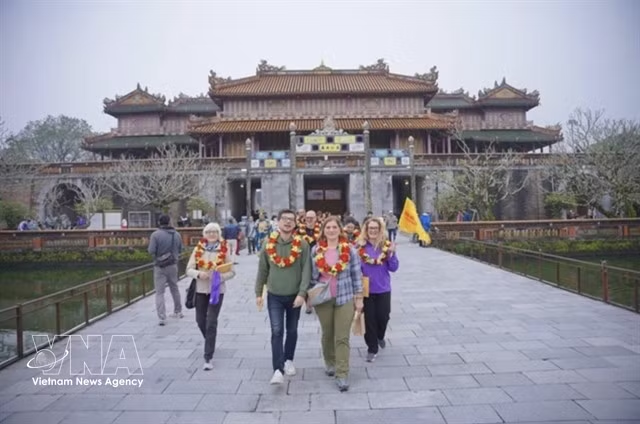
Foreigners visit Hue Imperial Citadel. The ancient capital is reshaping its tourism landscape by mapping out four distinctive zones. (Photo: VNA)

Hue (VNS/VNA) – The ancient capital of Hue is reshaping its tourism landscape by mapping out four distinctive zones, aiming to build a diverse ecosystem of experiences rooted in local identity and sustainable development.

The move follows the issuance of Plan No. 188/KH-UBND for 2026–27, recently signed by Vice Chairman of the municipal People’s Committee Tran Huu Thuy Giang.

The plan sets out concrete steps to promote eco-tourism and community-based tourism, aligned with a green, sustainable approach closely linked to local communities.

Under the plan, the city will establish four tourism clusters based on characteristic spaces: riverside and peri-urban areas, lagoon and coastal zones, mountainous and forest ecosystems, and agricultural and rural landscapes.

The zoning is expected to optimise tourism resources while creating distinctive products and enhancing competitiveness.

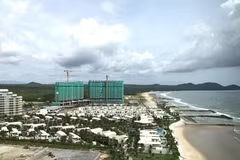
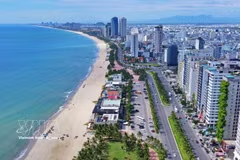
Specifically, the Heritage – Huong River – craft villages and garden houses zone will highlight traditional cultural values combined with urban landscapes. The Tam Giang lagoon and coastal area will focus on fishing village culture and livelihoods.

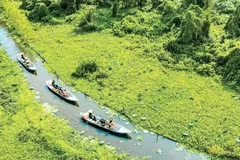
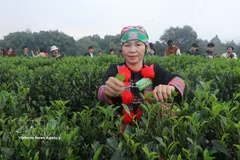
Mountainous area will leverage natural streams, waterfalls and indigenous culture, while agricultural zones will centre on rural experiences and OCOP products.

At the same time, the city plans to review and select around 10 to 12 communes and wards with strong potential for implementation during 2026-27.

It aims to develop and put into operation at least eight to 10 pilot models that meet criteria on infrastructure, environmental standards, safety and visitor capacity.

A notable feature of the plan is the emphasis on building “product stories”, increasingly seen as key to enhancing tourism value.

Interpretation content at destinations will be standardised to help visitors better understand local culture, history and community life.

In parallel, the city targets training and upskilling around 50% of households directly involved in tourism activities.

Improving service quality and hospitality skills is expected not only to enhance visitor experience but also to raise public awareness of environmental protection and sustainable tourism practices.

As of the end of the first quarter of 2026, Hue had 887 accommodation establishments with 14,075 rooms and 22,644 beds.

Hotels account for 22.4% of total facilities but hold 60.5% of rooms. Notably, the three- to five-star segment comprises 24 establishments with 3,430 rooms, representing 91.4% of rooms in the star-rated category.

The travel sector has also continued to expand, with 91 companies in operation, including 65 international tour operators, 19 domestic firms and seven travel offices and agencies. This provides a solid foundation for market expansion, product diversification and stronger tour connectivity./.

VNA

See more

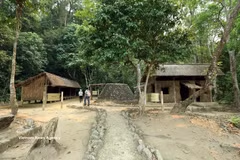
The Dien Bien Phu campaign headquarters has become a popular tourist attraction in Dien Bien province. (Photo: VNA)

Dien Bien Phu tourism cable car project receives in-principle approval

The project aims to effectively tap the area’s natural landscapes, geographical advantages and distinctive historical value, while creating a high-quality tourism product with strong competitiveness. It is also intended to preserve, honour and promote the value of the Dien Bien Phu Victory special national historical relic site.

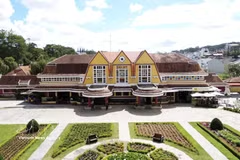
Da Lat station is the hub of the roughly 84-km Phan Rang–Da Lat railway (Photo: VNA)

Da Lat city's century-old railway station doubles as tourist draw

It now functions as both a transport hub and a sought-after photo spot. In the early morning, with mist still threaded through the pines, the station radiates an old-world calm. Visitors arrive at dawn to breathe the mountain air and capture iconic images of the highland city.

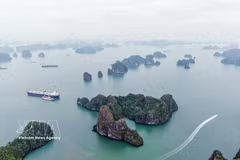
Ha Long Bay in Quang Ninh province. (Photo: VNA)

Quang Ninh - magnet for affluent Indian travellers

Alongside wedding tourism, Quang Ninh is also seeing robust growth in arrivals of Indian MICE travellers. Delegations of hundreds, and sometimes thousands, of visitors have been coming to the province for conferences, seminars and incentive travel programmes combined with leisure stays.

Visitors explore the Tra Su cajuput forest in An Giang province. (Photo: Tra Su Tourism Area)

Mekong Delta eyes stronger foothold in global tourism

Enriched by the alluvial deposits of the Mekong River, the region stands out for its dense canal network, year-round fruit orchards, biodiversity-rich national parks, and vibrant folk festivals – invaluable assets for developing diverse tourism offerings, from orchard-based eco-tourism and river experiences to cultural, festival, resort and nature conservation tourism.

A Lunar New Year court ceremony of Nguyen Dynasty is reenacted at Thai Hoa Palace in the Imperial Citadel of Hue (Photo: VNA)

Culinary, heritage passports reshape cultural tourism

The central city of Hue is among the first to forge new paths. Its “Hue Tourism Passport” began as a destination brochure in 2018 and has since evolved into the “Hue City Passport” app, with a heritage-passport feature that strings monuments into a structured journey.

Phu Quoc International Airport in Phu Quoc special zone of An Giang province. (Photo: VNA)

Air travel surges to 1.68 million passengers during holiday periods

Domestic air travel accounted for 675,140 passengers and 3,400 tonnes of cargo, marking declines of 7.5% and 11.6%, respectively. In contrast, international transport showed robust growth, surpassing 1 million passengers and reaching 24,050 tonnes of cargo, up 10% in passenger numbers and 10.6% in cargo volume.

International visitors admire the beauty of the My Son Cham sanctuary in Duy Xuyen, Da Nang. (Photo: VNA)

Vietnam records 2 million foreign arrivals in April

The Vietnam National Authority of Tourism (VNAT) said the figures highlight the country’s rising profile as a safe, stable and increasingly compelling destination. It is the first time Vietnam has surpassed 2 million foreign arrivals for four straight months, and the first time the January – April tally has reached 8.8 million.

The Cau Vang (Golden Bridge) in the central city of Da Nang. (Photo: VNA)

Ho Chi Minh City, Da Nang lead Thai tourists’ searches

Data from the online booking platform Agoda shows that Ho Chi Minh City recorded the highest growth in searches from Thailand, reaching 134%, followed by Da Nang with a 58% increase. Other destinations such as Hong Kong (China) saw more modest growth.