Da Lat city's century-old railway station doubles as tourist draw

It now functions as both a transport hub and a sought-after photo spot. In the early morning, with mist still threaded through the pines, the station radiates an old-world calm. Visitors arrive at dawn to breathe the mountain air and capture iconic images of the highland city.

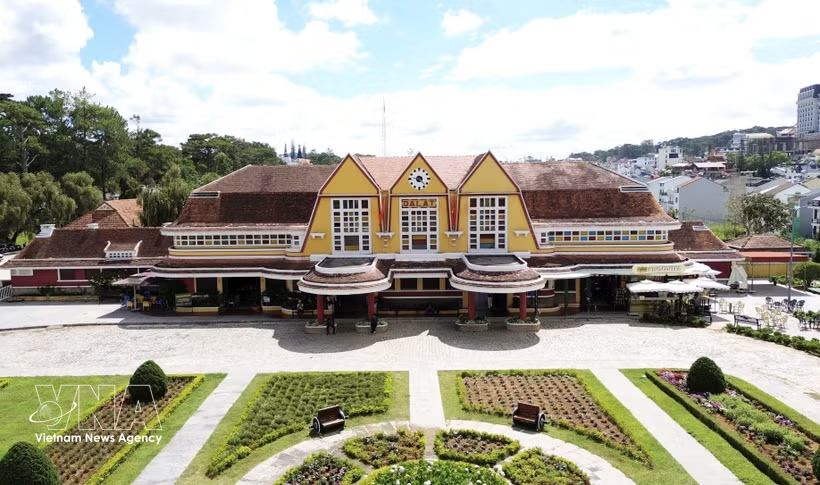
Da Lat station is the hub of the roughly 84-km Phan Rang–Da Lat railway (Photo: VNA)

Lam Dong (VNA) – Perched at over 1,500 metres above sea level in Lam Dong province, Da Lat Railway Station is seen as one of the oldest and most beautiful stations in Vietnam and former Indochina. Beyond its architectural pedigree, the station now doubles as a tourist draw, pulling visitors eager to ride the Da Lat–Trai Mat tourist train through the Central Highlands.

Heritage preservation in combination with tourism development

Built by the French from 1932 and completed in 1938, the station was the hub of the roughly 84-km Phan Rang–Da Lat railway. Some 16km of the line used a rack system to climb the steep Ngoan Muc Pass, averaging a 12% gradient. At that time, rack railway technology existed only in Switzerland and Vietnam, an engineering rarity in global rail history.

The station fuses western architecture with indigenous Central Highlands motifs. Its signature feature is a trio of pointed roofs soaring above the structure, evoking Langbiang Mountain or communal houses of regional ethnic groups. It spans 66.5m long, 11.4m wide and 11m high, with stained glass windows and vaulted ceilings shaping its distinctive look.

After decades of historical upheaval, the railways sector revived the roughly 7-km Da Lat–Trai Mat section in 1991 for tourism purpose. In 2001, the station was designated a national historical relic for its historical, architectural and cultural value.

It now functions as both a transport hub and a sought-after photo spot. In the early morning, with mist still threaded through the pines, the station radiates an old-world calm. Visitors arrive at dawn to breathe the mountain air and capture iconic images of the highland city.

Adding services, adding stops

Phan Thi Xuan Thao, Vice Chairwoman of the People’s Committee of Xuan Huong - Da Lat ward, said the locality is one of Lam Dong’s main tourism zones, home to four and five-star hotels and well-known sites, including the station and Datanla Waterfall. Local authorities are working with the railway sector to keep the station’s architecture and heritage values intact.

Its architecture and open setting have also made it a venue for cultural and tourism events. The Da Lat Railway Station runs promotions for visitors, especially tour groups and children. Officials plan to host more cultural and tourism activities there to spread Da Lat’s image and enrich visitors' experiences.

vnanet-t.jpg
Music performances on the train (Photo: VNA)

Ho Sy Thai, who manages the Da Lat Railway Transport Station under the Saigon Railway Transport branch, said passengers' demand for the Da Lat–Trai Mat route holds steady and rises sharply on weekends and during peak tourism seasons. Advance bookings allow operators to plan schedules more efficiently and sustain service quality.

Beyond the historic architecture, passengers get onboard live music, artichoke tea and free Wi-Fi. A renovation of the Da Lat–Trai Mat line began in April, covering rail replacement and infrastructure repairs. The six-month project aims to improve technical conditions, safety and services.

To capture tourism demand this year, the branch has rolled out promotions and specialty services on the route. It offers private carriage and train rentals for birthdays, weddings and product showcases, while continuing to operate seven daily round trips with distinct tourism experiences.

Highlights include the “Da Lat Coffee Train” departing at 7:05 and the “Da Lat Night Journey” at 18:15 and 20:20, letting visitors take in the highlands at different hours. The operator has also introduced a range of ticket discounts.

A broader restoration of the entire line is under study, with expectations that it will foster regional links and spur tourism and economic growth across the south-central coast and Central Highlands./.

VNA

See more

The Dien Bien Phu campaign headquarters has become a popular tourist attraction in Dien Bien province. (Photo: VNA)

Dien Bien Phu tourism cable car project receives in-principle approval

The project aims to effectively tap the area’s natural landscapes, geographical advantages and distinctive historical value, while creating a high-quality tourism product with strong competitiveness. It is also intended to preserve, honour and promote the value of the Dien Bien Phu Victory special national historical relic site.

Ha Long Bay in Quang Ninh province. (Photo: VNA)

Quang Ninh - magnet for affluent Indian travellers

Alongside wedding tourism, Quang Ninh is also seeing robust growth in arrivals of Indian MICE travellers. Delegations of hundreds, and sometimes thousands, of visitors have been coming to the province for conferences, seminars and incentive travel programmes combined with leisure stays.

Visitors explore the Tra Su cajuput forest in An Giang province. (Photo: Tra Su Tourism Area)

Mekong Delta eyes stronger foothold in global tourism

Enriched by the alluvial deposits of the Mekong River, the region stands out for its dense canal network, year-round fruit orchards, biodiversity-rich national parks, and vibrant folk festivals – invaluable assets for developing diverse tourism offerings, from orchard-based eco-tourism and river experiences to cultural, festival, resort and nature conservation tourism.

A Lunar New Year court ceremony of Nguyen Dynasty is reenacted at Thai Hoa Palace in the Imperial Citadel of Hue (Photo: VNA)

Culinary, heritage passports reshape cultural tourism

The central city of Hue is among the first to forge new paths. Its “Hue Tourism Passport” began as a destination brochure in 2018 and has since evolved into the “Hue City Passport” app, with a heritage-passport feature that strings monuments into a structured journey.

Phu Quoc International Airport in Phu Quoc special zone of An Giang province. (Photo: VNA)

Air travel surges to 1.68 million passengers during holiday periods

Domestic air travel accounted for 675,140 passengers and 3,400 tonnes of cargo, marking declines of 7.5% and 11.6%, respectively. In contrast, international transport showed robust growth, surpassing 1 million passengers and reaching 24,050 tonnes of cargo, up 10% in passenger numbers and 10.6% in cargo volume.

International visitors admire the beauty of the My Son Cham sanctuary in Duy Xuyen, Da Nang. (Photo: VNA)

Vietnam records 2 million foreign arrivals in April

The Vietnam National Authority of Tourism (VNAT) said the figures highlight the country’s rising profile as a safe, stable and increasingly compelling destination. It is the first time Vietnam has surpassed 2 million foreign arrivals for four straight months, and the first time the January – April tally has reached 8.8 million.

The Cau Vang (Golden Bridge) in the central city of Da Nang. (Photo: VNA)

Ho Chi Minh City, Da Nang lead Thai tourists’ searches

Data from the online booking platform Agoda shows that Ho Chi Minh City recorded the highest growth in searches from Thailand, reaching 134%, followed by Da Nang with a 58% increase. Other destinations such as Hong Kong (China) saw more modest growth.

A corner of Phu Quoc island (Photo: VNA)

Phu Quoc becomes new hotspot for Korean tourists

Korean media reported on May 2 that Phu Quoc, once a hidden gem two decades ago, has undergone one of Vietnam’s most dramatic makeovers thanks to massive infrastructure upgrades and a proliferation of luxury resorts.