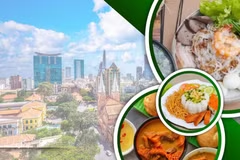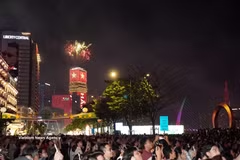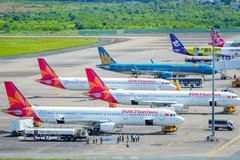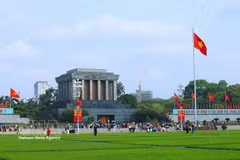
Ho Chi Minh City aims to become a “touchpoint” of international tourism

Surveys conducted in the first months of this year showed a growing trend toward integrated tourism packages combining accommodation, cuisine and entertainment services, enabling visitors to enjoy short itineraries that blend urban tourism with coastal resort experiences.

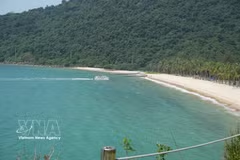
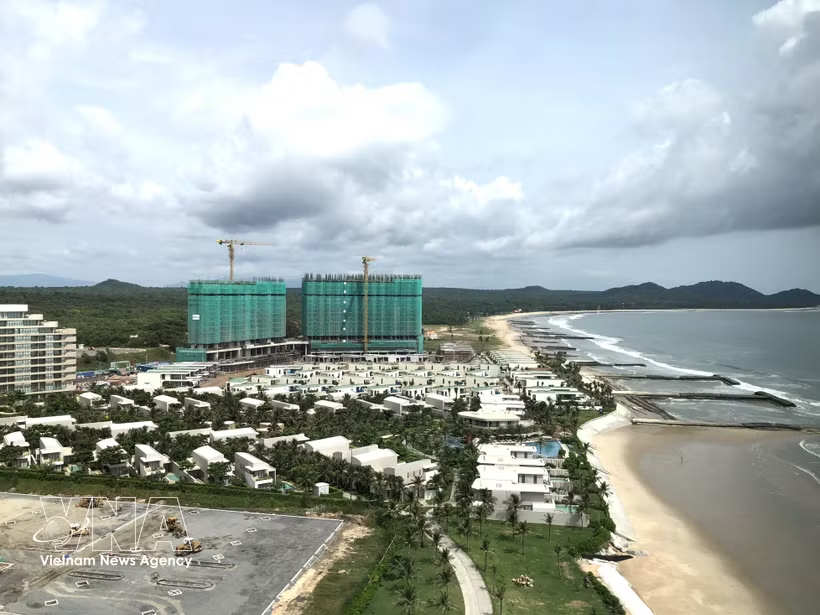
A series of tourism projects in the Ho Tram area in Ho Chi Minh City are contributing to shaping a "world-class tourism hub" (Photo: VNA)

Ho Chi Minh City (VNA) - Ho Chi Minh City has set a target of welcoming 11 million international visitors and 50 million domestic tourists in 2026 as the southern economic hub moves towards developing tourism as a comprehensive experiential ecosystem rather than a standalone economic sector.

Surveys conducted in the first months of this year showed a growing trend toward integrated tourism packages combining accommodation, cuisine and entertainment services, enabling visitors to enjoy short itineraries that blend urban tourism with coastal resort experiences. The southern metropolis is also strengthening its role not only as a major destination but also as a transit hub connecting tourists with neighbouring localities.

Experts said the city’s tourism industry is shifting from fragmented services to a more systematic and highly personalised approach based on analysis of tourists’ experiences and travel touchpoints. Technological solutions, including digital maps and smart applications, are helping transform heritage and cultural data into engaging tourism experiences while enabling international visitors to better access the city’s cultural and culinary offerings.

Dr. Khoa Tang, senior lecturer at RMIT University Vietnam, said digital transformation is becoming an important tool in tourism management and organisation, helping expand tourism development in depth instead of relying solely on infrastructure expansion. Digital maps now provide not only navigation but also integrated information on destinations, services and cultural contexts, helping visitors better plan their journeys while supporting sustainable tourism development.

Chairwoman of the Ho Chi Minh City Tourism Association Nguyen Thi Khanh said the association has worked closely with businesses to develop smart service chains linking transport, accommodation, cuisine and sightseeing services. She stressed that integrated and real-time personalised solutions are key to enhancing visitor experiences and increasing tourism value.

Following the adoption of Resolution No. 62/2025/NQ-HDND on policies to attract MICE (Meetings, Incentives, Conferences, and Exhibitions) tourism delegations, the city has begun receiving large international groups. From May 1-9, the city welcomed a delegation of 890 visitors from Indonesia’s Allianz insurance company organised by Viking Tourism JSC. The visitors joined various activities across the city, while local tourism authorities coordinated airport reception and tourism promotion programmes.

Le Truong Hien Hoa, Deputy Director of the municipal Department of Tourism said that the city has outlined a MICE tourism development roadmap through 2030 focusing on four pillars: market promotion, specialised tourism products, digital transformation and workforce standardisation, and the development of a synchronised tourism ecosystem.

Alongside MICE tourism, the city is leveraging regional connectivity to develop diversified tourism chains combining urban, coastal, ecological and cultural destinations, contributing to strong growth in domestic tourism.

Tourism enterprises have also diversified products through thematic tours combining cultural and historical experiences with high-quality services. New offerings include helicopter city tours, five-star cruise experiences, Can Gio mangrove forest tours by speedboat, Saigon nightlife and culinary discovery tours by motorbike, and metro-linked tourism experiences.

The city’s accommodation system has sufficient capacity to meet visitor demand even during peak seasons, while many localities are encouraging community participation in tourism activities, environmental protection and destination promotion.

Hoa said these achievements reaffirm the city’s sustainable appeal as a tourism destination, with MICE tourism serving as a key driver for recovery, growth and stronger positioning of Ho Chi Minh City on the global tourism map./.

VNA

See more

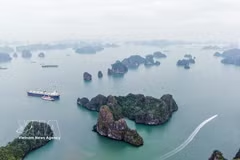
Ha Long Bay in Quang Ninh province. (Photo: VNA)

Quang Ninh - magnet for affluent Indian travellers

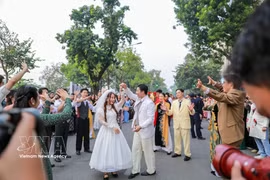
Alongside wedding tourism, Quang Ninh is also seeing robust growth in arrivals of Indian MICE travellers. Delegations of hundreds, and sometimes thousands, of visitors have been coming to the province for conferences, seminars and incentive travel programmes combined with leisure stays.

Visitors explore the Tra Su cajuput forest in An Giang province. (Photo: Tra Su Tourism Area)

Mekong Delta eyes stronger foothold in global tourism

Enriched by the alluvial deposits of the Mekong River, the region stands out for its dense canal network, year-round fruit orchards, biodiversity-rich national parks, and vibrant folk festivals – invaluable assets for developing diverse tourism offerings, from orchard-based eco-tourism and river experiences to cultural, festival, resort and nature conservation tourism.

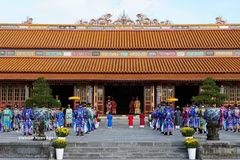
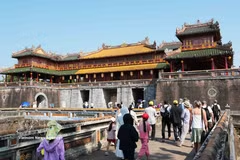
A Lunar New Year court ceremony of Nguyen Dynasty is reenacted at Thai Hoa Palace in the Imperial Citadel of Hue (Photo: VNA)

Culinary, heritage passports reshape cultural tourism

The central city of Hue is among the first to forge new paths. Its “Hue Tourism Passport” began as a destination brochure in 2018 and has since evolved into the “Hue City Passport” app, with a heritage-passport feature that strings monuments into a structured journey.

Phu Quoc International Airport in Phu Quoc special zone of An Giang province. (Photo: VNA)

Air travel surges to 1.68 million passengers during holiday periods

Domestic air travel accounted for 675,140 passengers and 3,400 tonnes of cargo, marking declines of 7.5% and 11.6%, respectively. In contrast, international transport showed robust growth, surpassing 1 million passengers and reaching 24,050 tonnes of cargo, up 10% in passenger numbers and 10.6% in cargo volume.

International visitors admire the beauty of the My Son Cham sanctuary in Duy Xuyen, Da Nang. (Photo: VNA)

Vietnam records 2 million foreign arrivals in April

The Vietnam National Authority of Tourism (VNAT) said the figures highlight the country’s rising profile as a safe, stable and increasingly compelling destination. It is the first time Vietnam has surpassed 2 million foreign arrivals for four straight months, and the first time the January – April tally has reached 8.8 million.

The Cau Vang (Golden Bridge) in the central city of Da Nang. (Photo: VNA)

Ho Chi Minh City, Da Nang lead Thai tourists’ searches

Data from the online booking platform Agoda shows that Ho Chi Minh City recorded the highest growth in searches from Thailand, reaching 134%, followed by Da Nang with a 58% increase. Other destinations such as Hong Kong (China) saw more modest growth.

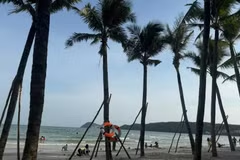
A corner of Phu Quoc island (Photo: VNA)

Phu Quoc becomes new hotspot for Korean tourists

Korean media reported on May 2 that Phu Quoc, once a hidden gem two decades ago, has undergone one of Vietnam’s most dramatic makeovers thanks to massive infrastructure upgrades and a proliferation of luxury resorts.

Participants in Trang An Marathon 2025 (Photo: VNA)

Ninh Binh turns sporting events into tourism engine

In 2025 and early 2026, Ninh Binh hosted a lineup of high-profile international sports events, including the World Triathlon Development Regional Cup & National Championships 2025, AFC Champions League Two, the ASEAN Club Championship, the SEA V.League, and the Li-Ning Vietnam International Series 2025 badminton tournament.