Localities aim for higher growth through science, technology

Experiences from localities nationwide show that Resolution 57 is fostering a marked transformation in development mindset. Science and technology, innovation and digital transformation are increasingly becoming foundational drivers of economic growth and opening new development space for localities in the years ahead.

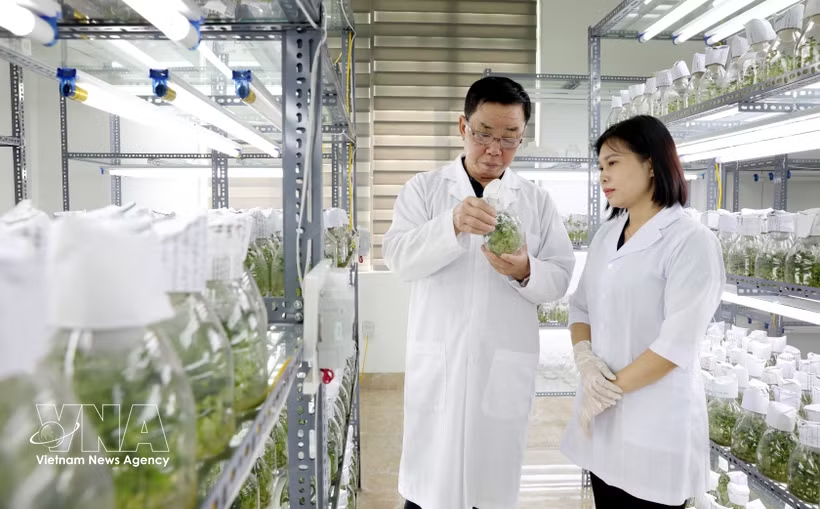
Thai Binh Seed Group Joint Stock Company has applied science and technology in research and production to develop numerous high-yield, high-quality crop varieties. (Photo: VNA)

Hanoi (VNA) - As science and technology, innovation and digital transformation have increasingly become intertwined with growth objectives, many localities across Vietnam are moving beyond policy declarations to concrete actions, viewing these areas as strategic tools to restructure the economy, improve labour productivity and create new drivers of growth.

Shifting development mindset under Resolution 57

Among the localities taking proactive steps, Quang Ninh province has emerged as a notable example of determination to make science and technology, innovation and digital transformation central pillars of economic development. The province has set a target of achieving double-digit growth during the 2026–2030 period, with a goal of 13% growth in 2026 alone.

To support these ambitions, Quang Ninh has allocated nearly 1.19 trillion VND (45 million USD) for science and technology, innovation and digital transformation in 2026. The province is also implementing 51 ongoing science and technology projects with clear commitments to practical application.

Notably, it has publicly announced nine major science and technology challenges, inviting research institutions and businesses to jointly develop solutions. The approach reflects a significant shift in development mindset.

Secretary of the provincial Party Committee Quan Minh Cuong stressed that digital transformation should not merely involve the application of technology in governance, but must become a new development model and a key growth engine for the province in the coming years.

A similar transition is underway in Khanh Hoa province. Under its development orientation to 2030 with a vision towards 2045, the province aims to become a smart urban area, an international marine tourism and services hub, and a growth pole for the south central coastal and Central Highlands regions.

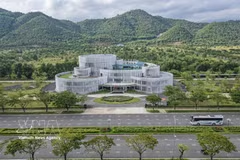
vnanet-potal-pho-thu-tuong-nguyen-chi-dung-du-khai-truong-bao-tang-vu-tru-viet-nam-8225228.jpg
A display area at the Vietnam Space Museum. (Photo: VNA)

To achieve this, Khanh Hoa has identified the need to shift towards a development model based on knowledge, data, technology and innovation. The provincial People’s Committee is implementing plans to assess industrial technological capacity and develop a technology roadmap through 2035.

Strengthening state-university-enterprise partnership

Another notable trend in the implementation of the Politburo’s Resolution No. 57 on breakthroughs in science and technology development, innovation and national digital transformation is the growing focus on data infrastructure, artificial intelligence and the cooperation model involving the State, research institutes/universities and businesses.

In Hanoi, the model is being promoted through the Hanoi Innovation Centre, where government agencies, universities and technology enterprises are jointly developing an innovation ecosystem. Participants include the Ministry of Public Security’s Department for Administrative Management of Social Order (C06), the Hanoi Department of Science and Technology, Hanoi University of Science and Technology, FPT Corporation and MK Group.

The partners are cooperating in operating innovation spaces, organising incubation and training programmes, exhibitions and the commercialisation of scientific and technological products. Hanoi is also expanding cooperation with universities, research institutes and international partners to modernise its innovation ecosystem and strengthen the connection between research, market demand and technology transfer.

At the “Tech Cafe Quang Ninh 2026” event, four memoranda of understanding on research, technology transfer and commercialisation were signed between the Institute of Chemistry under the Vietnam Academy of Science and Technology and local enterprises. The province also launched techhub.quangninh.gov.vn platform to connect businesses with the innovation ecosystem.

In Dak Lak province, authorities have piloted the model to support the development of key local products. Collaborative projects include diversifying products derived from Dak Lak durian and researching medicinal products from avocado leaves to support treatment of stomach ulcers caused by Helicobacter pylori bacteria.

Experiences from localities nationwide show that Resolution 57 is fostering a marked transformation in development mindset. Science and technology, innovation and digital transformation are increasingly becoming foundational drivers of economic growth and opening new development space for localities in the years ahead./.

VNA

See more

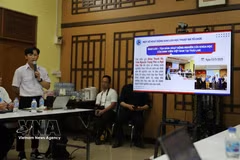
Lieutenant Colonel Nguyen Dinh Do Thi of the Department of Cybersecurity and High-Tech Crime Prevention under the Ministry of Public Security speaks at a discussion session. (Photo: VNA)

Experts recommend ‘five don’ts’ to protect personal data

Vietnamese authorities handled more than 30 cases involving the illegal sale and theft of personal data between 2023 and 2025, affecting over 160 million data records across sectors including health, education, finance, banking and telecommunications.

Major General Nguyen Tung Hung, deputy commander of the Cyber Warfare Command under the Ministry of National Defence, addresses the event (Photo: VNA)

Protecting digital future in post-quantum, AI era

Participants highlighted the importance of building a proactive, synchronised and sustainable national cybersecurity ecosystem through closer cooperation among regulators, technology firms, research institutions and cybersecurity experts.

An engineer from the Digital Transformation Centre under the Khanh Hoa provincial Department of Science and Technology carry out equipment maintenance work. (Photo: VNA)

Vietnam pushes ahead with AI-powered legal infrastructure

Research by the Ministry of Justice (MoJ) shows that AI adoption in the legal sector remains constrained by fragmented, unstandardised and weakly connected legal databases. A unified national legal data ecosystem has yet to be established, while big data and AI applications are still largely confined to pilot programmes and have not been integrated across the full legislative process, including drafting, appraisal, review and inspection of legal documents.

Deputy Prime Minister Ho Quoc Dung speaks at the meeting. (Photo: VNA)

Deputy PM demands full disbursement for sci-tech in 2026

As of May 12, total disbursed capital reached 7.95 trillion VND, equivalent to 14.78% of the Prime Minister’s plan. Of this, central budget disbursement hit 4.06 trillion VND, or 14.8% of the target, while local budget disbursement exceeded 3.88 trillion VND, or 14.75%.

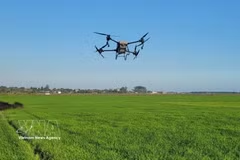
Using drones to spray pesticides in the An Nhut rice fields in Long Dien commune of Ho Chi Minh City. (Photo: VNA)

Solving technology challenge through the “three-party linkage”

According to Pham Duc Nghiem, Deputy Director of the Department of Startups and Technology Enterprises under the Ministry of Science and Technology, the “three party” linkage model involving the State, research institutes/universities and enterprises is becoming essential for developing strategic technologies. Enterprises provide practical problems, universities and research institutes develop technological solutions, while the State creates support mechanisms and policies to accelerate commercialisation.

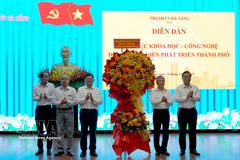
Da Nang city's leaders present flowers to congratulate the Union of Science and Technology Associations in Da Nang on Vietnam Science and Technology Day (May 18). (Photo: VNA)

Human capital key to Da Nang’s digital economy ambitions: experts

Vo Cong Tri, Chairman of the Union of Science and Technology Associations (VUSTA) in Da Nang, described high-quality human resources as a “key driver” in the city’s transformation. Da Nang is already regarded as one of Vietnam’s leading “university cities,” with 19 higher education institutions and a high concentration of students and skilled workers. The city is also home to a growing network of science and technology organisations that are helping to foster an innovation ecosystem.

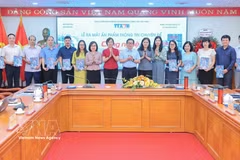
Delegates at the publication launching ceremony. (Photo: VNA)

Vietnam News Agency debuts monthly technology publication

Each 40-page issue is expected to pack 3-5 chapters, delivering a panoramic view of the global sci-tech landscape alongside in-depth analyses of emerging technology trends. The publication aims to explain strategic shifts that will shape the country’s development and examine the sci-tech, innovation and digital transformation policies of other nations.

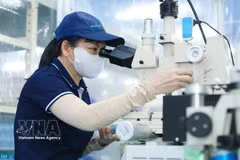
A worker assembles ultra-precision micro-components used in semiconductor chip production. (Photo: VNA)

Vietnam prioritises 70 high technologies for strategic development

Issued under Decision No. 23/2026/QD-TTg dated May 15, 2026, the list covers a wide range of technologies, including artificial intelligence (AI), big data and data analytics, cloud and edge computing, distributed and high-performance computing, Internet of Things (IoT), blockchain, quantum technology, renewable and clean energy, advanced energy storage, AI-powered real-time disaster forecasting and warning systems, and next-generation microbiology technologies.

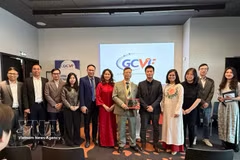
Vietnamese Ambassador to France Trinh Duc Hai (sixth from the right) and the leadership of Global Connect Vietnam France. (Photo: VNA)

Vietnamese association launched in France to foster technology, AI cooperation

In the context of the growing Comprehensive Strategic Partnership between Vietnam and France, Hai said GCVF should position itself as a bridge for knowledge and technology transfer, bringing scientific and technological achievements from France and Europe to support Vietnam’s practical development needs.

Party General Secretary and State President To Lam presents a statute of President Ho Chi Minh to VNU-Hanoi. (Photo: VNA)

Top Vietnamese leader’s vision puts scientists at core of growth drive

As the country enters a new era, the Party and State have designated sci-tech and and innovation as central priorities, Kiem said, adding that VNU-Hanoi, alongside other higher education establishments, must not only produce high-caliber talents but also function as a hub for knowledge transfer and groundbreaking innovation.

Illustrative image (Photo: VNA)

Korean robotics, AI firms interested in Vietnam

KOTRA said it is teaming up with the Korea Institute for Robot Industry Advancement to run the “K-Robot Pavilion"” at the 23rd Vietnam International Exhibition on Machinery, Equipment, Technology and Industrial Products (VINAMAC EXPO 2026) in Hanoi from May 14-16.