Hanoi (VNA) – Artificial intelligence (AI), cloud computing and emerging quantum technologies are reshaping the global digital economy while creating unprecedented cybersecurity risks, experts warned at the Vietnam Security Summit 2026 held in Hanoi on May 22.
Participants noted that AI is creating a “dual impact” on information security. While the technology helps organisations accelerate threat detection, automate operations and optimise data analysis, cybercriminals are increasingly exploiting AI to launch sophisticated phishing campaigns, ransomware attacks and identity fraud schemes.
At the same time, the rapid rise of quantum computing is raising concerns over the future viability of traditional encryption standards, prompting governments and businesses to accelerate preparations for the post-quantum cryptography era.
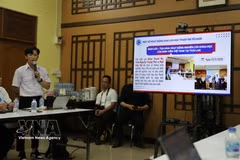
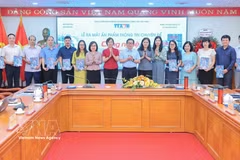
Against this backdrop, the summit aimed to provide a platform for government agencies, businesses and experts to discuss strategies for protecting data, securing digital infrastructure and strengthening resilience against cyber threats in the AI and post-quantum era. The event also sought to promote cooperation, knowledge-sharing and advanced cybersecurity solutions to support the digital economy and strengthen digital trust.
Speaking at the summit, Colonel Nguyen Hong Quan, deputy director of the Department of Cybersecurity and High-Tech Crime Prevention, said cyberattacks are growing in scale, sophistication and cross-border nature as digital transformation becomes the foundation of modern society.
He warned that cybercriminals are increasingly using AI for fraud, impersonation, malware distribution and targeted attacks against agencies, businesses and individuals. Emerging threats such as deepfakes, voice impersonation, data theft, account hijacking and online financial scams are causing serious consequences for assets, business operations and public trust in the digital environment.
Quan also noted that rapid advances in quantum technology are creating new challenges for traditional cybersecurity systems, as many current encryption methods may no longer remain secure against quantum computing capabilities. He stressed the need for agencies, organisations and businesses to strengthen cybersecurity awareness, invest in technology and human resources, and improve coordination with authorities to detect and respond to threats early.
Participants highlighted the importance of building a proactive, synchronised and sustainable national cybersecurity ecosystem through closer cooperation among regulators, technology firms, research institutions and cybersecurity experts.
Major General Nguyen Tung Hung, deputy commander of the Cyber Warfare Command under the Ministry of National Defence, said cyberattacks have changed dramatically in both scale and sophistication, including risks linked to “harvest now, decrypt later” strategies associated with advanced quantum technologies.
According to Hung, cybercriminal groups are increasingly using AI, exploiting zero-day vulnerabilities, targeting supply chains and deploying dormant malware. Many attacks now aim not only to steal data but also to disrupt essential services, seize control of systems, sabotage infrastructure and undermine public trust.
He stressed the importance of strengthening cooperation between enterprises and state agencies, expanding early warning mechanisms, sharing threat intelligence and organising regular cyber defence exercises.
Hung emphasised that cyberspace has become inseparable from national sovereignty, making cybersecurity protection for critical infrastructure essential to safeguarding political stability, economic development and national security in the digital era.
The summit also featured presentations from regulatory agencies and international technology firms on cybersecurity priorities for 2026 and beyond, AI-driven cyber defence, cloud-based AI security, trusted AI governance and protecting AI agents in enterprise environments.
Vietnam Security Summit 2026 included a plenary session on the event’s main theme and three thematic sessions focusing on data protection and digital identity, critical infrastructure security, and cyber risk governance.
A cybersecurity technology exhibition featuring more than 40 domestic and international solution providers was also held on the sidelines of the event./.
See more
Vietnam pushes ahead with AI-powered legal infrastructure
Research by the Ministry of Justice (MoJ) shows that AI adoption in the legal sector remains constrained by fragmented, unstandardised and weakly connected legal databases. A unified national legal data ecosystem has yet to be established, while big data and AI applications are still largely confined to pilot programmes and have not been integrated across the full legislative process, including drafting, appraisal, review and inspection of legal documents.
Vietnam approves human resources development plan for atomic energy sector
The scheme aims to build a workforce with sufficient quantity, balanced structure and high-quality expertise to meet the country’s growing demand for atomic energy development and applications, while ensuring radiation safety, nuclear safety and nuclear security.
Vietnam’s startup ecosystem gains momentum on global stage
According to the Global Startup Ecosystem Index 2026 released by StartupBlink, Vietnam climbed five places to rank 50th globally, marking its highest position ever in the annual rankings.
Vietnam needs groundbreaking policies to develop major tech firms: Experts
The country is now home to around 80,000 technology firms, 1.4 times higher than the figure in 2020. Total revenue of the sector in 2025 was estimated at 198 billion USD, up nearly 26% from 2024.
Vietnam moves to build standards framework for strategic technologies, products
The strategy is designed to promote the adoption of international, regional and Vietnamese standards to serve the development of strategic technologies, strategic products and key economic sectors.
Deputy PM demands full disbursement for sci-tech in 2026
As of May 12, total disbursed capital reached 7.95 trillion VND, equivalent to 14.78% of the Prime Minister’s plan. Of this, central budget disbursement hit 4.06 trillion VND, or 14.8% of the target, while local budget disbursement exceeded 3.88 trillion VND, or 14.75%.
VinFuture 2026: Global partner network expands 14-fold after six seasons
With 17,154 nominating partners from 117 countries and territories across all five continents, the scale of the prize has grown by around 16% compared with the 2025 season and more than 14-fold compared with its inaugural year in 2021.
Da Nang exhibition showcases advanced German scientific research
The exhibition reflects the important role of science within German culture while also showcasing Germany’s broad international scientific cooperation network for students and young researchers worldwide.
Solving technology challenge through the “three-party linkage”
According to Pham Duc Nghiem, Deputy Director of the Department of Startups and Technology Enterprises under the Ministry of Science and Technology, the “three party” linkage model involving the State, research institutes/universities and enterprises is becoming essential for developing strategic technologies. Enterprises provide practical problems, universities and research institutes develop technological solutions, while the State creates support mechanisms and policies to accelerate commercialisation.
Young Vietnamese intellectuals in Thailand promote innovation cooperation
Vietnamese students and intellectuals in Thailand could contribute to promoting Vietnam’s image internationally by actively organising and participating in Vietnamese cultural festivals and exchange activities.
Human capital key to Da Nang’s digital economy ambitions: experts
Vo Cong Tri, Chairman of the Union of Science and Technology Associations (VUSTA) in Da Nang, described high-quality human resources as a “key driver” in the city’s transformation. Da Nang is already regarded as one of Vietnam’s leading “university cities,” with 19 higher education institutions and a high concentration of students and skilled workers. The city is also home to a growing network of science and technology organisations that are helping to foster an innovation ecosystem.
Vietnam News Agency debuts monthly technology publication
Each 40-page issue is expected to pack 3-5 chapters, delivering a panoramic view of the global sci-tech landscape alongside in-depth analyses of emerging technology trends. The publication aims to explain strategic shifts that will shape the country’s development and examine the sci-tech, innovation and digital transformation policies of other nations.
Vietnam prioritises 70 high technologies for strategic development
Issued under Decision No. 23/2026/QD-TTg dated May 15, 2026, the list covers a wide range of technologies, including artificial intelligence (AI), big data and data analytics, cloud and edge computing, distributed and high-performance computing, Internet of Things (IoT), blockchain, quantum technology, renewable and clean energy, advanced energy storage, AI-powered real-time disaster forecasting and warning systems, and next-generation microbiology technologies.
Vietnamese association launched in France to foster technology, AI cooperation
In the context of the growing Comprehensive Strategic Partnership between Vietnam and France, Hai said GCVF should position itself as a bridge for knowledge and technology transfer, bringing scientific and technological achievements from France and Europe to support Vietnam’s practical development needs.
Top Vietnamese leader’s vision puts scientists at core of growth drive
As the country enters a new era, the Party and State have designated sci-tech and and innovation as central priorities, Kiem said, adding that VNU-Hanoi, alongside other higher education establishments, must not only produce high-caliber talents but also function as a hub for knowledge transfer and groundbreaking innovation.
Korean robotics, AI firms interested in Vietnam
KOTRA said it is teaming up with the Korea Institute for Robot Industry Advancement to run the “K-Robot Pavilion"” at the 23rd Vietnam International Exhibition on Machinery, Equipment, Technology and Industrial Products (VINAMAC EXPO 2026) in Hanoi from May 14-16.
Party official calls on Samsung Vietnam to expand R&D cooperation
The Party official highlighted Samsung’s important role in Vietnam’s economy as the country’s largest foreign investor, noting that the Samsung R&D Centre in Hanoi is the firm’s largest in Southeast Asia.
Vietnam approves digital tech blueprint through 2030, targets 55 bln USD in exports
The scheme defines digital technology as a foundational industry, positioning it as a key growth driver to lift productivity, quality, and national competitiveness.
Sri Lanka eyes breakthrough sci-tech cooperation with Vietnam
A Sri Lankan official has expressed confidence that science, technology and digital transformation will become a key driver in shifting bilateral ties from traditional friendship to a partnership grounded in innovation and inclusive economic growth.
Ho Chi Minh City eyes to attract high-tech capital with improved digital infrastructure
According to Deputy Director of the municipal Department of Science and Technology Nguyen Huu Yen, Ho Chi Minh City will continue investing in digital infrastructure and smart governance in 2026, with a target of expanding 5G coverage to 70-80% of the population.