Eco-industrial parks seen as catalyst for higher-quality FDI

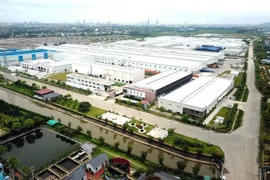
The eco-industrial park model will help Vietnam meet international environmental standards while creating opportunities to improve growth quality and economic competitiveness. Many multinational corporations now view green standards, emissions reduction and energy efficiency as key conditions when selecting investment destinations.

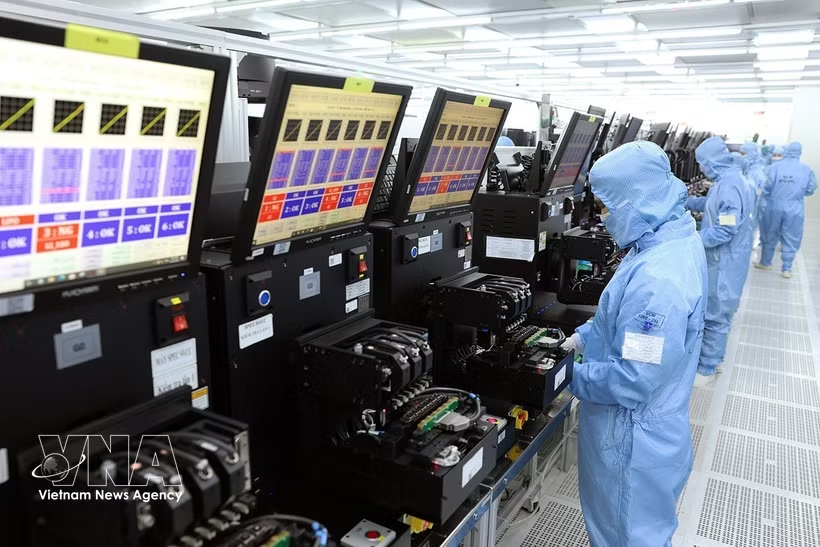
A production line for camera modules and export-oriented electronic components at the factory of MCNEX VINA Co., Ltd. in Phuc Son Industrial Park, Ninh Binh province. (Photo: VNA)

Hanoi (VNA) – Vietnam is accelerating the shift toward green and eco-industrial parks as part of efforts to improve the quality of foreign direct investment (FDI), enhance competitiveness and strengthen its position in global supply chains.

According to the Ministry of Finance (MoF), the country currently has 478 industrial parks, including 324 already operational and 153 under development. Vietnam has also attracted more than 45,000 FDI projects with combined registered capital surpassing 530 billion USD.

Do Van Su, Director General of the MoF’s Foreign Investment Agency, said FDI inflows into industrial and export processing zones have remained on a positive trajectory, contributing significantly to industrial growth, exports and economic restructuring.

He noted that Vietnam is increasingly prioritising quality over quantity in attracting FDI, with rising additional investment flowing into existing projects, reflecting investors’ long-term confidence. Investment trends are also shifting toward high-tech industries, advanced manufacturing and smart production.

Despite these gains, Su said challenges remain, including uneven project quality, limited spillover effects and weak linkages between foreign-invested enterprises and domestic firms. Infrastructure constraints, shortages of high-quality labour and imbalanced industrial park planning also continue to hinder development.

​Against the backdrop of global supply chain restructuring, Vietnam faces mounting pressure to improve investment quality. Investors are paying greater attention to innovation, technology, workforce skills and the business environment, while ESG standards, green transition, energy efficiency and digital transformation are becoming increasingly important in investment decisions.

In this context, industrial parks are being redefined not only as manufacturing hubs but also as integrated ecosystems capable of generating higher added value and strengthening supply chain connectivity. Developing green, smart and eco-industrial parks is therefore becoming essential for Vietnam to integrate more deeply into next-generation global supply chains.

However, awareness of eco-industrial park models remains relatively low. A survey conducted by the Vietnam Chamber of Commerce and Industry (VCCI) across 118 industrial parks found that nearly half of businesses had little or no understanding of sustainable industrial park concepts. Only around 30% were familiar with eco-industrial parks, while just 20% fully understood the need to balance economic, environmental, social and governance objectives.

To support the transition, Decree No. 35/2022/ND-CP dated May 28, 2022 established a legal framework for eco-industrial parks, followed by Circular No. 05/2025/TT-BKHDT issued in early 2025 by the former Ministry of Planning and Investment (now the MoF), providing further implementation guidelines.

As more countries tighten carbon reduction commitments and strengthen environmental standards on imports, the transition from traditional industrial parks to eco-industrial models is becoming increasingly urgent.

Hanoi currently operates nine industrial parks covering approximately 1,348 ha, most of which were established around 20 years ago, including three converted from smaller industrial clusters.

​Many of these parks are now facing ageing infrastructure, deteriorating facilities and shortcomings in meeting updated fire safety and environmental standards, highlighting the need for comprehensive transformation.

​Le Thanh Son, deputy head of the Hanoi High-Tech and Industrial Parks, warned that without timely reform, industrial land risks becoming locked into outdated growth models or serving as a destination for obsolete technologies, weakening the capital’s competitiveness and attractiveness to investors.

​The authority is drafting a roadmap to transform existing industrial parks into green, smart and eco-industrial zones, alongside a comprehensive evaluation framework covering planning, digital and technical infrastructure, environment, energy, industrial structure, circular economy, social infrastructure and governance.

​According to Son, the criteria are intended not only to assess industrial parks but also to screen investment projects, improve land-use efficiency, raise production value and promote sustainable growth.

​Economic experts said the eco-industrial park model would help Vietnam meet international environmental standards while creating opportunities to improve growth quality and economic competitiveness. Many multinational corporations now view green standards, emissions reduction and energy efficiency as key conditions when selecting investment destinations.

​For Vietnam, eco-industrial parks could also enhance resource efficiency, reduce production costs through circular economy models and improve working conditions for employees. The transition is aligned with the country’s net-zero emissions commitment by 2050 announced at COP26./.
VNA

See more

The Vietnam Agriculture Reputation Index (VARI), a new programme to rate the credibility of agricultural businesses, and its portal are launched in Hanoi on May 22 (Photo: VNA)

Agriculture reputation index launched to improve market trust, funding access

The VARI initiative is designed to research, survey and assess the credibility of enterprises and entrepreneurs in the agricultural sector in a scientific, objective and transparent manner. It aims to create a reliable reference system that helps consumers, farmers, partners and investors identify responsible businesses that uphold commitments and pursue sustainable development.

The proposal is currently posted for public comment on the ministry's news portal. (Photo: VNA)

Finance Ministry proposes abolishing 26 legal documents in tax sector

The documents under review include circulars covering resource tax, income tax, agricultural land use tax, value-added tax and corporate income tax for public health facilities and personal income tax, tax debt cancellation, tax incentives for software enterprises and incentives for developing raw material zones and processing industries for agricultural, forestry, aquaculture and salt production.

A view of a stall at the second Jade Dragon Snow Mountain coffee festival in Baisha ancient town, Yunnan’s Lijiang city. (Photo: VNA)

Vietnam, China strengthen coffee cooperation, opening new opportunities in Yunnan

Vietnam is the world’s second-largest coffee producer, while China’s coffee consumption market now ranks among the largest globally,” Liu Haifeng, vice chairman of the pu'er coffee association. The two sides can promote cooperation across many areas, from trade and human resources training to professional activities such as competitions and seminars, as well as the development of distinctive coffee products.

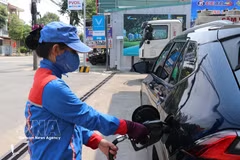
A worker pumps E10 petrol into a vehicle at Tran Phu filling station in Nghia Lo ward, Quang Ngai province. (Photo: VNA)

E10 biofuel deemed compatible with over 90% of vehicles

Technically, E100 ethanol contains around 34.7% oxygen and has a high octane rating of about 108 RON, enabling more efficient combustion. Studies also show that E10 can reduce carbon monoxide (CO) emissions by 20–30% and hydrocarbon (HC) emissions by 10–20% compared to conventional petrol.

A view of Work the Nordic Way 2026 conference (Photo: VNA)

Conference offers insights into Nordic workplace culture

Speakers addressed a range of key issues, including managing organisations amid rapid economic shifts, effectively integrating artificial intelligence into the workplace, building high-performing teams and developing talent strategies in globally competitive industries.

Vietnam looks to stronger ties with Africa for sustainable development

Vietnam looks to stronger ties with Africa for sustainable development

Experts proposed a raft of coordinated solutions to create breakthroughs in bilateral and multilateral ties with African countries. Chief among them is the fact that Vietnam should step forward as a bridge, spearhead the expansion of knowledge-sharing forums, and roll out specialised skills training courses for African partners.

European dairy products from Ireland. (Photo: cafe.vn)

Ireland steps up dairy trade promotion in Vietnam

Data from IMARC Group showed that the Vietnamese dairy market was valued at 5.71 billion USD in 2024 and is projected to reach 13.37 billion USD by 2033, with a compound annual growth rate (CAGR) of 9.5% during the 2025–2033 period.

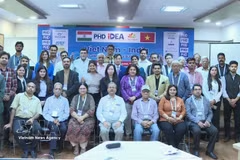
Organisers and speakers at the “Vietnam–India Cross-border E-commerce” forum pose for a group photo. (Photo: VNA)

Cross-border e-commerce drives Vietnam–India economic ties

Hang noted that cross-border e-commerce is creating fresh opportunities for bilateral cooperation. Indian products such as natural cosmetics, essential oil, herbal products, fashion items and household goods are seen as highly promising in the Vietnamese market. At the same time, Vietnamese businesses, especially small and medium-sized enterprises, are increasingly able to use digital platforms to access India’s market of more than 1.4 billion consumers.

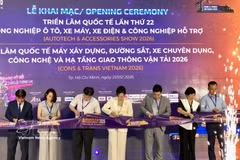
Delegates cut the ribbon to open the exhibition series on May 21, 2026 (Photo: VNA)

Industrial, transport infrastructure exhibitions open in Ho Chi Minh City

The events consist of the 22nd International Exhibition on Automobile, Motorcycle, Electric Vehicle and Supporting Industries (Autotech & Accessories 2026) and the International Exhibition on Construction Machinery, Rail Transit, Specialised Vehicles, Technology and Transportation Infrastructure (Cons & Trans 2026).

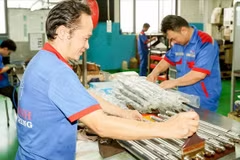
Workers of the Duy Khanh precision mechanical factory in Tang Nhon Phu ward, Ho Chi Minh City, manufacture support mechanical components. (Photo: sggp.org.vn)

Banks shift to cash-flow lending to unlock capital for SMEs

Prof. Nguyen Trong Hoai from the University of Economics Ho Chi Minh City (UEH) suggested that Vietnam should study open finance models built on digital data adopted in several countries to improve credit access for SMEs lacking collateral.

The Vietnam – Bangladesh business forum in Dhaka on May 19 (Photo: VNA)

Vietnam, Bangladesh eye to foster economic ties

Addressing the forum, Vietnamese Ambassador to Bangladesh Nguyen Manh Cuong highlighted the fruitful development of the bilateral ties over the past 53 years, noting that trade turnover has consistently exceeded 1.1 billion USD despite global disruptions. The two sides are now striving to raise the figure to 2 billion USD in the coming years.