E10 biofuel deemed compatible with over 90% of vehicles

Technically, E100 ethanol contains around 34.7% oxygen and has a high octane rating of about 108 RON, enabling more efficient combustion. Studies also show that E10 can reduce carbon monoxide (CO) emissions by 20–30% and hydrocarbon (HC) emissions by 10–20% compared to conventional petrol.

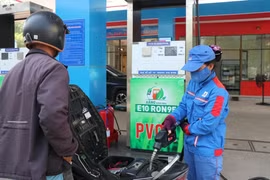
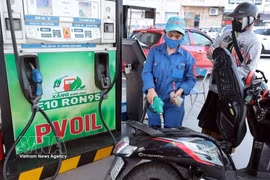
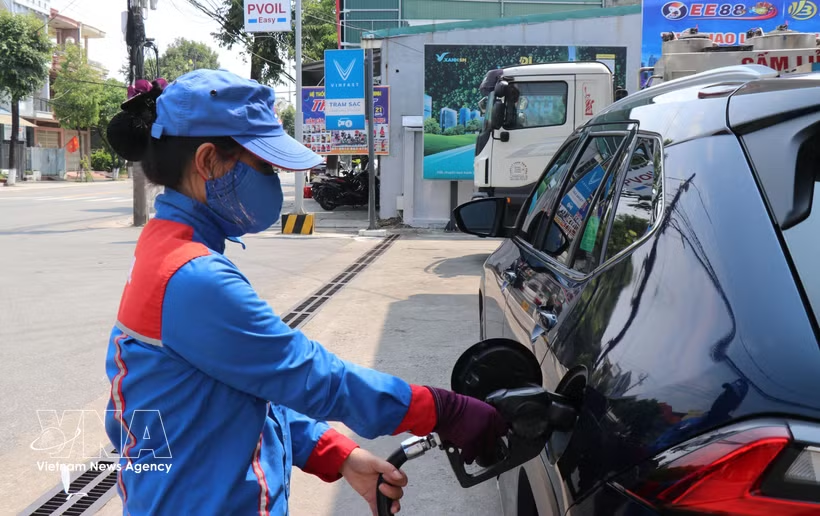
A worker pumps E10 petrol into a vehicle at Tran Phu filling station in Nghia Lo ward, Quang Ngai province. (Photo: VNA)

Hanoi (VNA) – E10 petrol is compatible with more than 90% of vehicles currently in circulation, requires no engine modifications and can significantly reduce polluting emissions, according to a draft Government resolution aimed at removing bottlenecks and accelerating the rollout of the biofuel.

Under the draft, built by the Ministry of Industry and Trade (MoIT) and now open for feedback, E5 petrol once accounted for around 40% of the market but has since fallen to 15–20% due to the narrow price gap with mineral petrol and lingering consumer concerns. The ministry said stronger policies, clearer price incentives and expanded public communications campaigns are needed to boost biofuel consumption.

Technically, E100 ethanol contains around 34.7% oxygen and has a high octane rating of about 108 RON, enabling more efficient combustion. Studies also show that E10 can reduce carbon monoxide (CO) emissions by 20–30% and hydrocarbon (HC) emissions by 10–20% compared to conventional petrol.

The MoIT estimated that monthly demand for E100 ethanol used in blending E5 and E10 petrol currently stands at 92,000–100,000 cubic metres, while domestic output is only about 25,000 cubic metres per month. If existing plants expand capacity and several suspended projects resume operations, total supply could rise to around 44,000 cubic metres monthly, still insufficient to meet demand.

Vietnam is currently home to six E100 ethanol plants with a combined designed capacity of 500,000–600,000 cubic metres per year, but actual utilisation rates remain at just 30–40%. As a result, the country is expected to continue importing about 75,000 cubic metres of E100 ethanol per month for at least another year to support biofuel blending.

Regarding infrastructure, as of late March, 12 out of 26 major fuel distributors had invested in biofuel blending stations. Another nine companies are awaiting licences for projects with a combined capacity of more than 260,000 cubic metres per month. Once approved, total nationwide E10 blending capacity is expected to exceed 1.15 million cubic metres monthly.

The draft also noted that switching from RON95 mineral petrol to E10 RON95 will not require additional storage tanks though businesses will need to upgrade existing systems to suit the characteristics of biofuels.

During the transition, companies may either fully drain and clean storage systems before introducing E10 to ensure compliance with fuel standards, or directly blend E10 into tanks containing around 20% mineral petrol to save time and costs. However, the latter option could result in ethanol content falling below standards during the first 15 days.

According to the MoIT, Vietnam already has a foundation for E10 deployment, including a nationwide E5 distribution network, existing blending systems invested in by several fuel distributors, and pilot E10 sales launched in a number of localities since August 2025. However, broader implementation will still require further efforts to address bottlenecks related to infrastructure, ethanol supply, pricing and support policies./.

VNA
See more

A view of Work the Nordic Way 2026 conference (Photo: VNA)

Conference offers insights into Nordic workplace culture

Speakers addressed a range of key issues, including managing organisations amid rapid economic shifts, effectively integrating artificial intelligence into the workplace, building high-performing teams and developing talent strategies in globally competitive industries.

Vietnam looks to stronger ties with Africa for sustainable development

Vietnam looks to stronger ties with Africa for sustainable development

Experts proposed a raft of coordinated solutions to create breakthroughs in bilateral and multilateral ties with African countries. Chief among them is the fact that Vietnam should step forward as a bridge, spearhead the expansion of knowledge-sharing forums, and roll out specialised skills training courses for African partners.

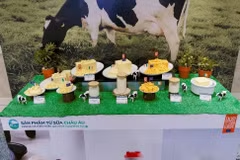
European dairy products from Ireland. (Photo: cafe.vn)

Ireland steps up dairy trade promotion in Vietnam

Data from IMARC Group showed that the Vietnamese dairy market was valued at 5.71 billion USD in 2024 and is projected to reach 13.37 billion USD by 2033, with a compound annual growth rate (CAGR) of 9.5% during the 2025–2033 period.

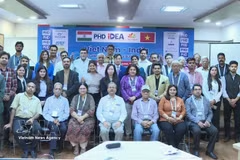
Organisers and speakers at the “Vietnam–India Cross-border E-commerce” forum pose for a group photo. (Photo: VNA)

Cross-border e-commerce drives Vietnam–India economic ties

Hang noted that cross-border e-commerce is creating fresh opportunities for bilateral cooperation. Indian products such as natural cosmetics, essential oil, herbal products, fashion items and household goods are seen as highly promising in the Vietnamese market. At the same time, Vietnamese businesses, especially small and medium-sized enterprises, are increasingly able to use digital platforms to access India’s market of more than 1.4 billion consumers.

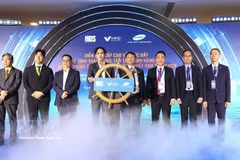
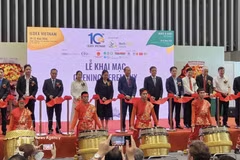
Delegates cut the ribbon to open the exhibition series on May 21, 2026 (Photo: VNA)

Industrial, transport infrastructure exhibitions open in Ho Chi Minh City

The events consist of the 22nd International Exhibition on Automobile, Motorcycle, Electric Vehicle and Supporting Industries (Autotech & Accessories 2026) and the International Exhibition on Construction Machinery, Rail Transit, Specialised Vehicles, Technology and Transportation Infrastructure (Cons & Trans 2026).

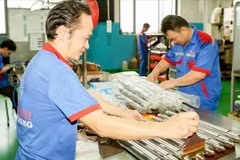
Workers of the Duy Khanh precision mechanical factory in Tang Nhon Phu ward, Ho Chi Minh City, manufacture support mechanical components. (Photo: sggp.org.vn)

Banks shift to cash-flow lending to unlock capital for SMEs

Prof. Nguyen Trong Hoai from the University of Economics Ho Chi Minh City (UEH) suggested that Vietnam should study open finance models built on digital data adopted in several countries to improve credit access for SMEs lacking collateral.

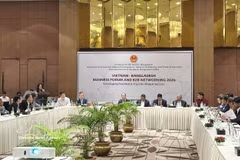
The Vietnam – Bangladesh business forum in Dhaka on May 19 (Photo: VNA)

Vietnam, Bangladesh eye to foster economic ties

Addressing the forum, Vietnamese Ambassador to Bangladesh Nguyen Manh Cuong highlighted the fruitful development of the bilateral ties over the past 53 years, noting that trade turnover has consistently exceeded 1.1 billion USD despite global disruptions. The two sides are now striving to raise the figure to 2 billion USD in the coming years.

The opening ceremony of the 10th International Livestock, Dairy, Meat Processing and Aquaculture Exposition on May 20 (Photo: VNA)

ILDEX Vietnam 2026 showcases livestock, agri-food innovation

The three-day event is jointly organised by VNU Asia Pacific and Thailand’s ITEC, serving as a platform for business networking, technology exchange and knowledge sharing in the livestock, aquaculture and food industries in Vietnam and Southeast Asia.

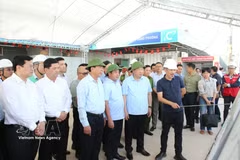
Permanent Deputy Prime Minister Pham Gia Tuc and officials inspect the Gia Binh International Airport project on May 20, 2026. (Photo: VNA)

Gia Binh international airport project accelerated ahead of APEC 2027

Tuc described Gia Binh International Airport as a national key project requiring strict adherence to construction timelines, particularly as it is expected to be put into operation in time for the 2027 APEC Economic Leaders' Meeting. Several associated projects are also being implemented under special mechanisms to serve major national tasks.

Vietnamese Ambassador to the Republic of Korea Vu Ho speaks at the forum.(Photo: VNA)

Forum promotes Vietnam–RoK supply chain connectivity

Cao Thi Phi Van, Deputy Director of ITPC, said that after more than three decades of cooperation, Vietnam–RoK ties are shifting from traditional manufacturing cooperation towards mastering future-oriented technologies such as semiconductors, artificial intelligence (AI), digital finance, renewable energy and global supply chains.

Fitch Ratings gives positive assessment of Vietnam’s economic fundamentals (Illustrative image. Source: VNA)

Fitch Ratings gives positive assessment of Vietnam’s economic fundamentals

Deputy Minister Tran Quoc Phuong stressed that Fitch’s credit assessments have enhanced Vietnam’s image and credibility in international financial markets, and provided additional motivation for the country to continue improving institutions, strengthening policy management efficiency and increasing economic transparency.