Vietnam, China strengthen coffee cooperation, opening new opportunities in Yunnan

Vietnam is the world’s second-largest coffee producer, while China’s coffee consumption market now ranks among the largest globally,” Liu Haifeng, vice chairman of the pu'er coffee association. The two sides can promote cooperation across many areas, from trade and human resources training to professional activities such as competitions and seminars, as well as the development of distinctive coffee products.

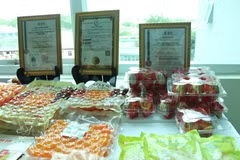
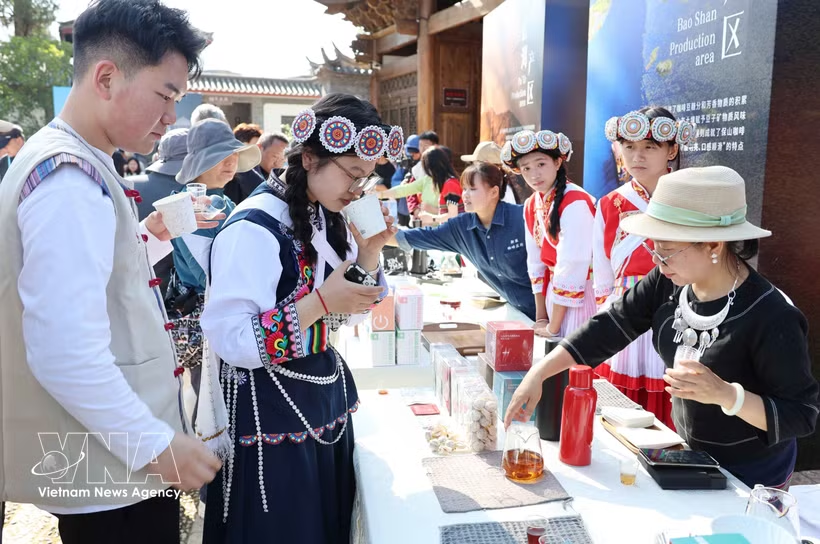
A view of a stall at the second Jade Dragon Snow Mountain coffee festival in Baisha ancient town, Yunnan’s Lijiang city. (Photo: VNA)

Hanoi (VNA) – Amid growing agricultural and trade cooperation, the coffee industries of Vietnam and China, particularly in Yunnan province, are witnessing notable developments.

The opening of the second Jade Dragon Snow Mountain coffee festival in Baisha ancient town, Yunnan’s Lijiang city, has emerged as a key highlight, bringing together businesses, experts and consumers while creating prospects for deeper cooperation in coffee culture, technology and markets.

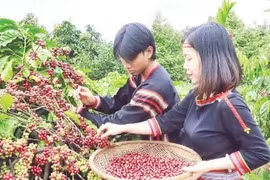
Coffee cooperation between the two countries stems from their geographical proximity and similar natural conditions. Vietnam’s Central Highlands are renowned for Robusta coffee, while Yunnan mainly cultivates Arabica beans, creating a complementary supply structure and opening opportunities for exchanges in production techniques and expertise.

Speaking to Vietnam News Agency correspondents in China, Liu Haifeng, vice chairman of the pu'er coffee association, stressed that coffee serves as a cultural bridge connecting communities around the world.

Vietnam is the world’s second-largest coffee producer, while China’s coffee consumption market now ranks among the largest globally, he said. The two sides can promote cooperation across many areas, from trade and human resources training to professional activities such as competitions and seminars, as well as the development of distinctive coffee products.

According to Liu, coffee exchange and tasting activities between the two sides are also highly meaningful. While Vietnam mainly produces Robusta beans, Yunnan grows Arabica varieties. At present, many Yunnan coffee products still rely on Vietnamese coffee supplies, creating opportunities for joint development and cooperation.

vnanet-chinese-youth.jpg
Young people from China and Vietnam exchange views on coffee at the second Jade Dragon Snow Mountain coffee festival in Baisha ancient town, Yunnan’s Lijiang city. (Photo: VNA)

Sharing the same view, Nguyen Bao Huy, representing Acom Vietnam, a subsidiary of Switzerland-based Ecom Group, spoke highly of the cooperation potential between the two countries.

He noted that bilateral cooperation in the coffee sector has developed positively, adding that China is currently one of Vietnam’s largest coffee import markets, with import volumes increasing annually.

In the coming period, the two sides could expand cooperation in areas such as coffee culture, coffee tourism, and linkages between Yunnan coffee and coffee from Vietnam’s Central Highlands, particularly Da Lat, Huy said. He also suggested promoting knowledge exchange for farmers on brewing techniques, quality improvement and brand positioning for both Yunnan and Vietnamese coffee on the global coffee map.

Huy also pointed to several challenges that still need to be addressed, noting that the promotion of Vietnamese coffee in China remains limited, with relatively few authentically Vietnamese-style cafés or Vietnamese roasting companies operating in the market./.

VNA

See more

Vice Chairman of the National Assembly (NA) Nguyen Hong Dien receives a delegation from the European Chamber of Commerce in Vietnam (EuroCham) in Hanoi on May 22. (Photo: VNA)

Vietnam, EU promote substantive, effective economic cooperation

The NA always attaches importance to improving institutional frameworks and building a comprehensive, transparent and development-enabling legal environment to support both domestic and foreign businesses, including European enterprises operating in Vietnam, said NA Vice Chairman Nguyen Hong Dien.

Exports and imports are handled at Hai Phong International Container Terminal. (Photo: VNA)

Vietnam seen as attractive investment destination for 2026–2035

The article described Vietnam as strategically positioned along major regional maritime routes, including the East – West corridor linking the Americas, the Middle East, India and Europe, and the North – South corridor connecting China and Southeast Asia, helping make the country a gateway for international trade.

The working session between Deputy Minister of Finance Nguyen Duc Tam and a delegation of foreign investors led by venture capital fund Argor Capital (Photo: tapchikinhtetaichinh.vn)

Vietnam taps venture capital for innovation: Deputy Finance Minister

To secure double-digit growth over the next two decades, the official said the Vietnamese Government will maintain political and macroeconomic stability while building a transparent legal environment that treats domestic and foreign investors equally and cuts red tape to attract quality private and foreign capital.

The Vietnam Agriculture Reputation Index (VARI), a new programme to rate the credibility of agricultural businesses, and its portal are launched in Hanoi on May 22 (Photo: VNA)

Agriculture reputation index launched to improve market trust, funding access

The VARI initiative is designed to research, survey and assess the credibility of enterprises and entrepreneurs in the agricultural sector in a scientific, objective and transparent manner. It aims to create a reliable reference system that helps consumers, farmers, partners and investors identify responsible businesses that uphold commitments and pursue sustainable development.

A production line for camera modules and export-oriented electronic components at the factory of MCNEX VINA Co., Ltd. in Phuc Son Industrial Park, Ninh Binh province. (Photo: VNA)

Eco-industrial parks seen as catalyst for higher-quality FDI

The eco-industrial park model will help Vietnam meet international environmental standards while creating opportunities to improve growth quality and economic competitiveness. Many multinational corporations now view green standards, emissions reduction and energy efficiency as key conditions when selecting investment destinations.

The proposal is currently posted for public comment on the ministry's news portal. (Photo: VNA)

Finance Ministry proposes abolishing 26 legal documents in tax sector

The documents under review include circulars covering resource tax, income tax, agricultural land use tax, value-added tax and corporate income tax for public health facilities and personal income tax, tax debt cancellation, tax incentives for software enterprises and incentives for developing raw material zones and processing industries for agricultural, forestry, aquaculture and salt production.

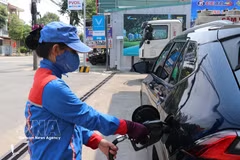
A worker pumps E10 petrol into a vehicle at Tran Phu filling station in Nghia Lo ward, Quang Ngai province. (Photo: VNA)

E10 biofuel deemed compatible with over 90% of vehicles

Technically, E100 ethanol contains around 34.7% oxygen and has a high octane rating of about 108 RON, enabling more efficient combustion. Studies also show that E10 can reduce carbon monoxide (CO) emissions by 20–30% and hydrocarbon (HC) emissions by 10–20% compared to conventional petrol.

A view of Work the Nordic Way 2026 conference (Photo: VNA)

Conference offers insights into Nordic workplace culture

Speakers addressed a range of key issues, including managing organisations amid rapid economic shifts, effectively integrating artificial intelligence into the workplace, building high-performing teams and developing talent strategies in globally competitive industries.

Vietnam looks to stronger ties with Africa for sustainable development

Vietnam looks to stronger ties with Africa for sustainable development

Experts proposed a raft of coordinated solutions to create breakthroughs in bilateral and multilateral ties with African countries. Chief among them is the fact that Vietnam should step forward as a bridge, spearhead the expansion of knowledge-sharing forums, and roll out specialised skills training courses for African partners.

European dairy products from Ireland. (Photo: cafe.vn)

Ireland steps up dairy trade promotion in Vietnam

Data from IMARC Group showed that the Vietnamese dairy market was valued at 5.71 billion USD in 2024 and is projected to reach 13.37 billion USD by 2033, with a compound annual growth rate (CAGR) of 9.5% during the 2025–2033 period.

Organisers and speakers at the “Vietnam–India Cross-border E-commerce” forum pose for a group photo. (Photo: VNA)

Cross-border e-commerce drives Vietnam–India economic ties

Hang noted that cross-border e-commerce is creating fresh opportunities for bilateral cooperation. Indian products such as natural cosmetics, essential oil, herbal products, fashion items and household goods are seen as highly promising in the Vietnamese market. At the same time, Vietnamese businesses, especially small and medium-sized enterprises, are increasingly able to use digital platforms to access India’s market of more than 1.4 billion consumers.

Delegates cut the ribbon to open the exhibition series on May 21, 2026 (Photo: VNA)

Industrial, transport infrastructure exhibitions open in Ho Chi Minh City

The events consist of the 22nd International Exhibition on Automobile, Motorcycle, Electric Vehicle and Supporting Industries (Autotech & Accessories 2026) and the International Exhibition on Construction Machinery, Rail Transit, Specialised Vehicles, Technology and Transportation Infrastructure (Cons & Trans 2026).