Dak Lak forum spotlights Vietnam’s coffee heritage ambitions

Nearly 40 research papers and presentations from Vietnamese and international scholars and experts were featured at the event, covering topics ranging from economics, culture, and heritage to processing technology, global value chains, and sustainability

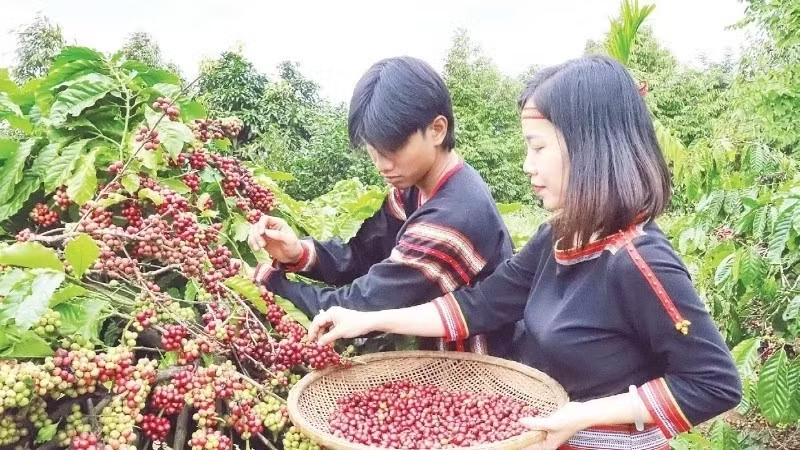
In March 2025, the Ministry of Culture, Sports and Tourism recognises “the knowledge of coffee cultivation and processing in Dak Lak” as a national intangible cultural heritage. (Photo: nhandan.vn)

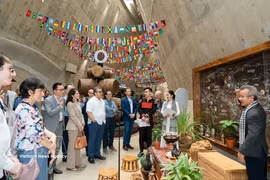
Dak Lak (VNA) – The 2026 World Coffee Heritage Forum, held in late April in Dak Lak, provided a global platform for the province to showcase its coffee cultivation and processing expertise, promote the image of Vietnam’s Central Highlands and its people, foster multicultural exchange, and elevate the profile of Vietnam’s coffee industry on the world stage.

Held under the theme “From Diverse Traditions to a Living Global Heritage”, the forum served as a high-level international dialogue on coffee as a “living heritage” capable of connecting people, communities, and civilisations while becoming a shared symbol of harmony, creativity, and sustainable development.

Nearly 40 research papers and presentations from Vietnamese and international scholars and experts were featured at the event, covering topics ranging from economics, culture, and heritage to processing technology, global value chains, and sustainability. Discussions were organised around four key themes: the history of global coffee, coffee cultivation and production, global coffee consumption culture and the evolution of coffee heritage, and best practices in conservation and sustainable development.

During sessions on cultivation and production, delegates highlighted the coffee ecosystem as a combination of indigenous knowledge, cultural landscapes, and community livelihoods. Discussions also focused on the global coffee value chain, the social responsibility of the coffee sector, and strategies to position Dak Lak as a global coffee hub while advancing efforts to have Vietnam’s coffee cultural landscape recognised by UNESCO and support green transition goals.

At discussions on coffee consumption culture and heritage development, speakers emphasised that coffee goes beyond being a consumer product, serving instead as a cultural space for interaction, dialogue, and creativity. Digital technology, they noted, is helping redefine coffee as a “living heritage” with growing influence in modern life.

The forum also shared successful conservation and sustainable development models from Thailand, alongside approaches by the Food and Agriculture Organisation of the United Nations (FAO) to building sustainable coffee systems that balance livelihoods and environmental protection. Delegates clarified UNESCO standards for “good safeguarding practices”, stressing the central role of communities in preserving, passing on, and promoting heritage while creating sustainable livelihoods.

Participants agreed that coffee should be regarded not only as an agricultural commodity or economic sector, but also as a “living heritage” and cultural space that embodies knowledge, customs, lifestyles, and spiritual values passed down through generations.

​Beyond the story of a crop, coffee’s history is also one of trade, cultural exchange, creativity, and aspirations for development. Vietnam holds a distinctive position as one of the world’s leading coffee producers and exporters, with favourable conditions for nurturing a rich and unique coffee culture. In Buon Ma Thuot, coffee is deeply rooted in indigenous knowledge systems covering cultivation, harvesting, processing, enjoyment, cultural practices, and community life, values that continue to shape a vibrant living heritage.

In March 2025, the Ministry of Culture, Sports and Tourism recognised “the knowledge of coffee cultivation and processing in Dak Lak” as a national intangible cultural heritage. The recognition affirmed the heritage’s historical depth, cultural vitality, and community significance.

Standing Deputy Minister of Foreign Affairs Nguyen Minh Vu said introducing Dak Lak’s coffee cultivation and processing heritage to the international community will help promote the image of the Central Highlands and its people, strengthen multicultural dialogue, and enhance the added value of Vietnam’s coffee industry, gradually reinforcing the country’s standing on the global coffee map./.

VNA

See more

An Ao Dai show held in Prague, the Czech Republic, in May 2026 (Photo: VNA)

Vietnam culture, cuisine showcased in Czech Republic

The festival featured more than 20 booths offering traditional Vietnamese dishes, including "pho" and spring rolls, alongside activities promoting Ao Dai (Vietnamese traditonal long dress). One of the highlights was the presentation of complimentary Ao Dai to Czech residents and international visitors.

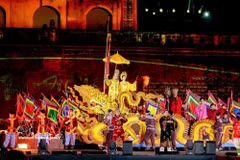
The Nguyen Dynasty (1802-1945) imperial throne, a recognised national treasure of Vietnam, officially returns to public display at Thai Hoa Palace in Hue Imperial Citadel on June 4 (Photo: VNA)

Nguyen Dynasty throne returns to Hue Imperial Citadel after restoration

The throne has been reinstated at its original central position inside Thai Hoa Palace, the ceremonial heart of the former imperial court. Its return has attracted significant interest from visitors and heritage enthusiasts eager to see one of Vietnam’s most important royal artefacts back on display.

People join the “Ho Van Lantern Festival Night” programme at the special national relic site of the Van Mieu–Quoc Tu Giam (Temple of Literature) in Hanoi. (Photo: VNA)

Night-time economy drives growth of Hanoi’s cultural industries

Under the Politburo’s Resolution No. 80-NQ/TW on the development of Vietnamese culture, Hanoi has been given fresh opportunities to leverage its cultural, historical, tourism and creative assets. The city’s recently approved project on developing the night-time economy for 2026–2030, with a vision to 2045, is expected to create momentum for cultural industry growth while enhancing Hanoi’s standing as a creative and modern city with a distinctive identity.

Efforts made to preserve, promote values of Non Nuoc Cao Bang Global Geopark

Efforts made to preserve, promote values of Non Nuoc Cao Bang Global Geopark

First recognised by UNESCO on April 12, 2018, the Non Nuoc Cao Bang Global Geopark in the northern province of Cao Bang is a land shaped by more than 500 million years of geological history. Covering over 3,683 sq.km and encompassing all or part of 36 communes and wards, the geopark is home to numerous scenic landscapes, as well as historical and cultural sites of exceptional value.

Scenic views of Da Nang featured in the film "Love in Vietnam" (Photo: VNA)

Da Nang Asian Film Festival 2026 set to launch with expanded international focus

Through this coordinated effort, Da Nang aims to establish DANAFF not only as an annual film event but also as a distinctive cultural landmark, helping position the city as a reputable destination for regional film and cultural events and enhancing its international profile, Vice Chairwoman of the municipal People’s Committee Nguyen Thi Anh Thi, said.

Co Bo Temple in Thanh Hoa province (Photo: nhandan.vn)

Thanh Hoa taps spiritual heritage to boost cultural tourism

Experts have called for stronger implementation of heritage management regulations under the Cultural Heritage Law, clearer responsibilities for site management boards and stricter action against activities that distort cultural traditions.

Ambassador Do Hung Viet, Vietnam's Permanent Representative to the United Nations, and his spouse introduce Vietnamese dishes to visitors at the 2026 UN International Bazaar in New York on June 3. (Photo: VNA)

Vietnam leaves strong impression at 2026 UN International Bazaar

A wide range of traditional handicrafts reflecting Vietnam’s rich cultural heritage, including ceramics, lacquerware, silk products, brocade textiles and other items, attracted considerable attention from visitors. Many products sold out early in the day.

Former political prisoner Le Tu Cam is moved as she views a portrait of herself, digitally restored from archival photographs and crafted from lotus leaves, on display at the Con Dao Museum. (Photo: VNA)

Digital innovation breathes new life into Vietnam’s museums

Technology is similarly enriching exhibitions at the Vietnam Women’s Museum in Hanoi. Wartime letters, a typewriter and other artefacts linked to former Vice President Nguyen Thi Binh have been digitally integrated with collections held at the War Remnants Museum in Ho Chi Minh City. Through projection mapping, 3D displays and a virtual reality recreation of the Paris Peace Agreement, visitors can engage more deeply with the life and achievements of one of Vietnam’s most prominent diplomats.

At the award ceremony of the Da Nang Asian Film Festival 2025. (Photo: VNA)

Da Nang Asian Film Festival 2026: Bridging Asia and the world

The festival is expected to bring together around 900 artists, producers and film professionals from Vietnam and abroad, including more than 200 international guests. This marks the largest edition since DANAFF was first launched in 2023, highlighting its growing appeal within the film industry.

Performance showcasing excerpts from the Pon Poong festival of the Muong ethnic community in Thanh Hoa province. (Photo: VNA)

Vietnam’s culture development in digital era

Under the Politburo's Resolution No. 80-NQ/TW, issued on January 7, 2026, culture is defined as the spiritual foundation of society, an important endogenous resource, a driver of socio-economic development and a source of national soft power. In the new era, cultural values are expected to permeate all aspects of life, serving as a foundation, resource, catalyst and regulatory force for the country’s rapid and sustainable development.

Students experience virtual reality games. (Photo: VNA)

Vietnamese team crowned FFWS SEA esports champion

The triumph marked a breakthrough moment for Vietnamese Free Fire esports, with SECRET WAG becoming the first Vietnamese squad to lift an FFWS SEA trophy on home soil. The result underscored the rising stature and growing competitiveness of Vietnam’s esports scene in Southeast Asia.