Hanoi seeks to turn cultural assets into stronger tourism driver

The challenge ahead is not only to preserve cultural values but also to organise and utilise them more effectively so that culture can become a genuine engine of tourism growth and sustainable urban development.

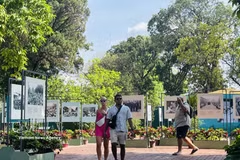
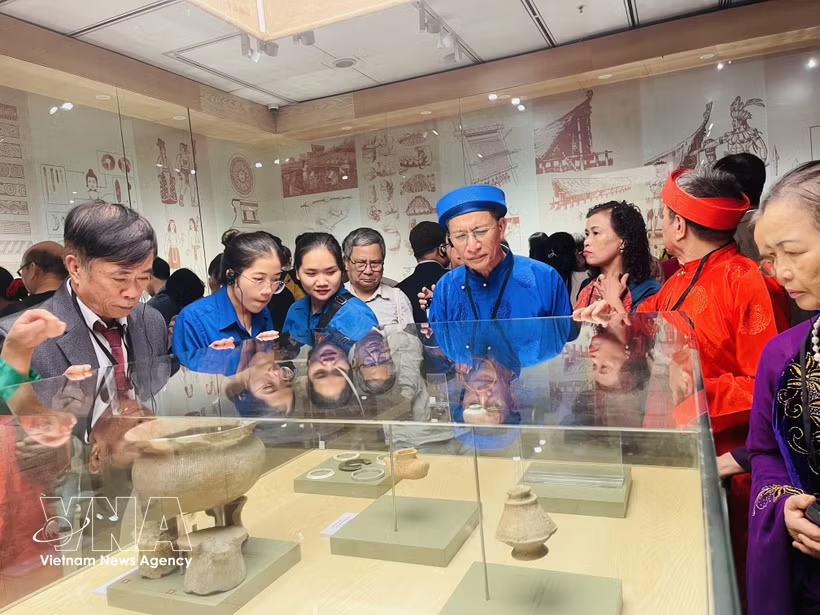
Visitors look at artefacts displayed at the Hanoi Museum. (Photo: VNA)

Hanoi (VNA) – Since the Politburo's issuance of Resolution No. 80-NQ/TW on the development of Vietnamese culture in January 2026, Hanoi has been moving to translate cultural development goals into practical action, with tourism emerging as one of the key areas expected to benefit.

Hanoi possesses rich cultural resources. It is home to 6,489 relic sites, 1,793 items of intangible cultural heritage, six UNESCO-recognised heritage elements, 351 national treasures, and 1,350 traditional craft villages and craft-based communities. The capital also preserves the Old Quarter, pre-1954 French architectural works, monuments and reliefs of significant historical and artistic value.

Hanoi also benefits from a concentration of universities, research institutes, diplomatic missions, international organisations and major cultural institutions. A relatively extensive grassroots network of cultural facilities, with 4,374 community houses of culture, further strengthens its foundation.

Yet despite this abundance, much of Hanoi’s cultural wealth has yet to be converted into a strong economic resource.

Tourist arrivals have risen sharply in recent years, but many heritage-based tourism products remain fragmented and lack distinctive identity. High-value destinations such as Huong Pagoda and Thay Pagoda are still largely dependent on seasonal festivals while many other periods of the year remain underutilised.

Even in central areas, heritage spaces such as the Old Quarter, West Lake and the wider urban core have not yet been developed through integrated visitor experiences or linked product chains. Craft village tourism, agricultural tourism and cultural industries also remain scattered, with no clearly defined ecosystem.

Local authorities say the main constraints include the lack of distinctive product strategies, limited integration between preservation and commercial use, and insufficient application of technology and social resources.

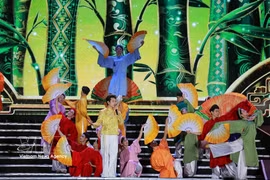
"Cheo Tau" singing – a unique cultural practice of O Dien commune, Hanoi. (Photo: VNA)

"Cheo Tau" singing – a unique cultural practice of O Dien commune, Hanoi. (Photo: VNA)

Hanoi’s action plan sets concrete targets for 2030. These include ensuring that 95% of grassroots cultural institutions operate effectively, 100% of students have access to arts and heritage education, all national and special national relics are digitised and available on digital platforms, and cultural industries contribute around 9% of the city’s gross regional domestic product.

Digital transformation has been identified as a breakthrough area. The city plans to develop shared digital cultural databases, virtual tours, digital exhibitions and automatic interpretation systems at key heritage sites. Pilot projects are under way at the Temple of Literature, Hoa Lo Prison Relic, Hanoi Museum, Hanoi Library and Thang Long Water Puppet Theatre. Digitalisation is also being expanded at Thang Long Imperial Citadel and Co Loa Citadel through GIS, 3D, virtual reality and augmented reality technologies.

Notably, Hanoi has set a target for open digital cultural data to reach 70%, while revenue from the digital cultural sector is expected to account for 30% of the city’s cultural economy. This signals a shift from digital archiving towards using data as a development resource.

The city is also promoting a broader creative ecosystem in which businesses serve as a driving force while residents remain both participants and beneficiaries.

Besides, traditional arts such as cheo, cai luong, puppetry and drama are being revived and linked with tourism products.

As a member of the UNESCO Creative Cities Network, Hanoi welcomed nearly 30 million visitors in 2025 and more than 12 million in the first four months of 2026. Night-time economy activities, culinary tourism and creative spaces are increasingly becoming urban highlights.

Recent pilot models combining tourism, culture and craft villages in Bat Trang, Son Tay, Soc Son and Ba Vi have shown encouraging results, shifting activities from simple sightseeing to deeper experiences.

Experts say unlocking Hanoi’s full potential will require stronger planning, better destination management, investment in heritage restoration, more innovative tour design and wider digital promotion.

Taken together, Hanoi’s implementation of Resolution 80 is gradually moving from policy direction to concrete action. The challenge ahead is not only to preserve cultural values but also to organise and utilise them more effectively so that culture can become a genuine engine of tourism growth and sustainable urban development./.
VNA

See more

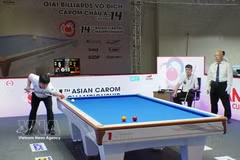
Men’s three-cushion carom defending champion Cho Myung Woo of the Republic of Korea (left) competes against Yoneyama Satoru of Japan in Group A at the 14th Asian Carom Championship. (Photo: VNA)

14th Asian Carom Championship kicks off in Ho Chi Minh City

Organised by the Ho Chi Minh City Billiards & Snooker Federation, the tournament features four events: men’s three-cushion carom, women’s three-cushion carom, men’s one-cushion carom, and the men’s U22 three-cushion category.

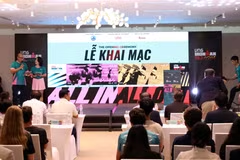
The opening ceremony of the VNG IRONMAN Vietnam 2026 and the VNG IRONMAN 70.3 Da Nang 2026. (Photo: VNA)

Da Nang launches Southeast Asia’s largest IRONMAN week

Speaking at the ceremony, Deputy Director of the municipal Department of Culture, Sports and Tourism Tao Viet Hai described the event as a major milestone in Da Nang’s sports and tourism development. For the first time, the city will host the full-distance IRONMAN Vietnam while also staging the 10th edition of IRONMAN 70.3 Da Nang.

Players at the Vietnam (in white) – Yemen match on May 7. (Photo: VFF)

Vietnam edge Yemen in AFC U17 Asian Cup opener

At the 2026 AFC U-17 Asian Cup, Vietnam are drawn in Group C alongside the Republic of Korea (RoK), the UAE and Yemen. Under the fixture schedule, Vietnam will face Yemen on May 7, the RoK on May 10 and the UAE on May 14.

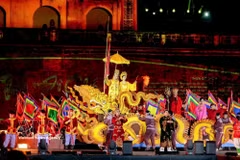
A performance at the Thang Long - Hanoi Festival 2025 (Photo: VNA)

Thang Long - Hanoi Festival 2026 to return in September

Co-hosted by the municipal People’s Committee, the Department of Culture and Sports, and domestic and foreign agencies, the whole spectacle is meant to honour the city’s millennia-old heritage while reafffirming its strategy of establishing culture as a development engine.

An installation by Le Huu Hieu at the 61st Venice Art Biennale in Italy (Photo courtesy of Venice Art Biennale)

Vietnam lacquer artists debut at Venice Biennale

Vietnam's appearance at the Venice Art Biennale 2026 is not only a symbolic milestone for the country's fine arts scene but also a new chapter in the integration of Vietnamese art into the global landscape.

Hanoi’s New Opera House takes center stage for the global travel elite, drawing comparisons to the world’s most legendary architectural icons. (Photo: travelandleisureasia)

Asia’s leading luxury travel magazine hails Hanoi's new opera house: "Move aside, Sydney"

The magazine opened its feature with a bold declaration: "Move aside, Sydney. There’s a new iconic opera house on the water." The fact that Hanoi’s architectural masterpiece is being showcased by a platform that shapes the trends of the global travel elite is a clear testament to the project's worldwide appeal. International experts have already begun to place the Hanoi Opera House on the same scale as the most legendary icons on the planet.

The display space of the archival photo exhibition “Echoes of a New Era” at the Imperial Citadel of Thang Long. (Photo: VNA)

Exhibition traces Vietnam’s post-reunification journey

Showcasing more than 70 documentary images, the exhibition highlights Vietnam’s journey from the 1975 Spring Victory through the early years of recovery and reconstruction, with a spotlight on the nationwide general election on April 25, 1976.

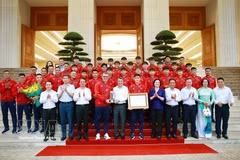
Prime Minister Le Minh Hung and members of Vietnam’s national U17 men’s football team pose for a group photo. (Photo: VNA)

PM hails U17 football team’s ASEAN triumph, sets sights higher

Presenting a certificate of merit to the team, the PM praised their championship run as a compelling and remarkable journey marked by resilience, determination, and a strong competitive spirit. The team remained unbeaten throughout the tournament, recording four wins and one draw while scoring 19 goals.

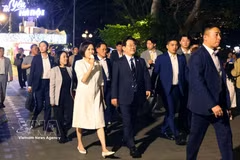
President of the Republic of Korea Lee Jae Myung and his spouse take a stroll around Hoan Kiem Lake in Hanoi during a visit to Vietnam in April 2026. (Photo: VNA)

Vietnamese cuisine gains global spotlight through leaders’ street food moments

In recent years, Vietnamese dishes have gained wider global recognition through travellers and international rankings. A social media group named “Vietnam Banh Mi Appreciation Society,” with nearly 200,000 foreign members, is dedicated to reviewing banh mi from street stalls to established shops, reflecting growing international enthusiasm for the dish.

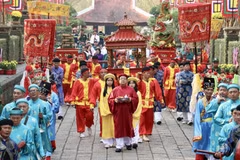
Offering of cylindrical glutinous rice cakes to Hung Kings at Thuong Temple in Ho Chi Minh City (Photo: VNA)

Vietnam Culture Day: Rendezvous of identity, internal strength

Culture has long been described as the spiritual foundation of society, an internal strength, and a driver of development; yet for that idea to truly take root in everyday life, it must be translated into concrete, visible, and tangible policies.

Visitors explore blooming plum orchards in Hom hamlet, Chieng Coi ward, Son La province. (Photo: VNA)

Northwest cultural showcase to open in Son La in May

Conceived as an integrated cultural space, the Huong sac vung cao (Highland Hues) exhibition will bring together archival and artistic images alongside artefacts to depict the cultural and social life of ethnic communities, underscore the Party and State’s focus on upland areas, and reflect local development progress.