Hai Phong temple recognised for Asia-record stone walls engraved with Buddhist swastika symbol

The swastika motifs above represent auspiciousness and form part of the 32 auspicious marks associated with Gautama Buddha, signifying wisdom, virtue and compassion attained through enlightenment.

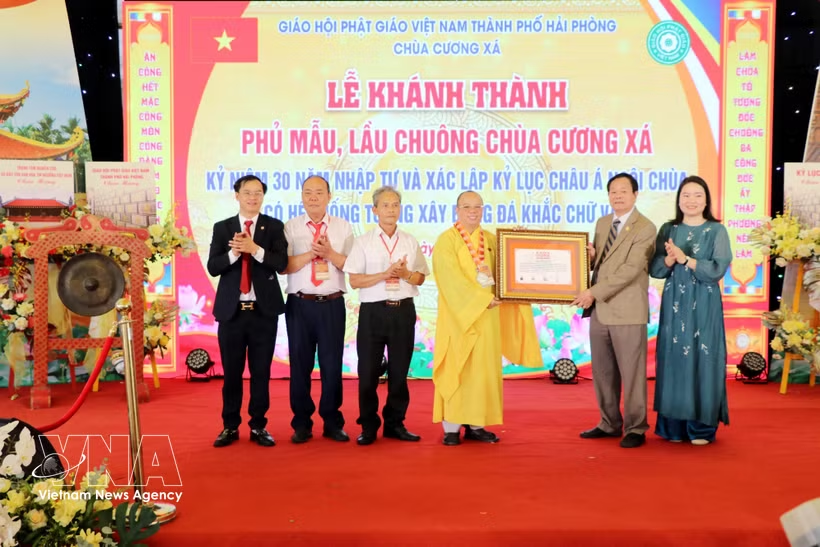
The certificate recognising Cuong Xa Pagoda as the temple with the largest system of stone walls engraved with the Buddhist swastika symbol is handed over to the pagoda's representatives at a ceremony held on May 3. (Photo: VNA)

Hai Phong (VNA) – Cuong Xa Pagoda in Tan Hung ward of northern Hai Phong city has been recognised as the temple with the largest system of stone walls engraved with the Buddhist swastika symbol in Asia by the Asia Book of Records.

Authorities, Buddhist dignitaries, followers, visitors and residents gathered at a ceremony held on May 3 to receive the certificate.

Also known as Quynh Khau Tu (Jade Mound Pagoda), the site stands on elevated ground to the southwest of former Cuong Xa village, now part of Tan Hung ward.

According to stone inscriptions, the pagoda underwent its first major restoration during the reign of King Le Than Tong (1607–1662). Ravaged by wars and prolonged neglect, it fell into severe disrepair before being restored again in 1946, though without a resident abbot.
vnanet-potal-hai-phong-chua-cuong-xa-xac-lap-ky-luc-chau-a-ve-tuong-da-khac-chu-van-8738302.jpg
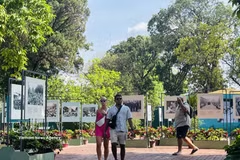
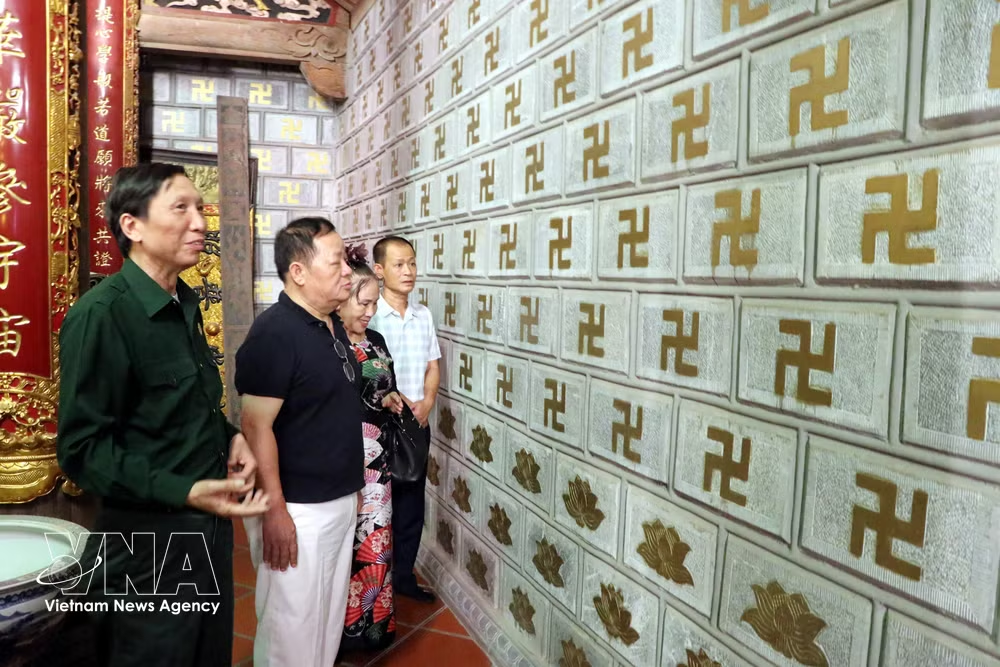
Locals and tourists visit a stone wall engraved with the Buddhist swastika symbol at Cuong Xa Pagoda.
(Photo: VNA)

A turning point came in 1996 when Venerable Thich Thanh Cuong was appointed abbot. At the time, the pagoda consisted of only a modest front hall and a small rear sanctuary in deteriorated condition. Despite this, it preserved a number of valuable artefacts, including nine wooden statues, a grand bell dating back to the Le Dynasty, ancient inscriptions, ancient couplets and a centuries-old tree.

Driven by a vision to fully revive the pagoda, the abbot initiated a comprehensive restoration project in 2009, with approval from local authorities. Excavation revealed ancient structural foundations and bricks dating back to the Eastern Han dynasty in China, approximately 2,000 years ago, affirming the site’s long-standing historical significance.

Following nearly seven years of reconstruction, the pagoda complex now spans 7,385 square metres. Notably, its distinctive stone wall system is built from green stone sourced from Nhoi Mountain in central Thanh Hoa province. Each horizontal row comprises 108 blocks, each measuring 40cm in length, 30cm in width and 35cm in thickness, with an average weight of around 80kg.

The first three rows are intricately carved with lotus motifs while from the fourth row upward to the roofline, each stone is engraved with a gilded swastika symbol. In total, nearly 3,000 such symbols adorn the structure, creating a striking synthesis of architectural scale, sculptural craftsmanship and Buddhist symbolism.
vnanet-potal-hai-phong-chua-cuong-xa-xac-lap-ky-luc-chau-a-ve-tuong-da-khac-chu-van-8738297.jpg
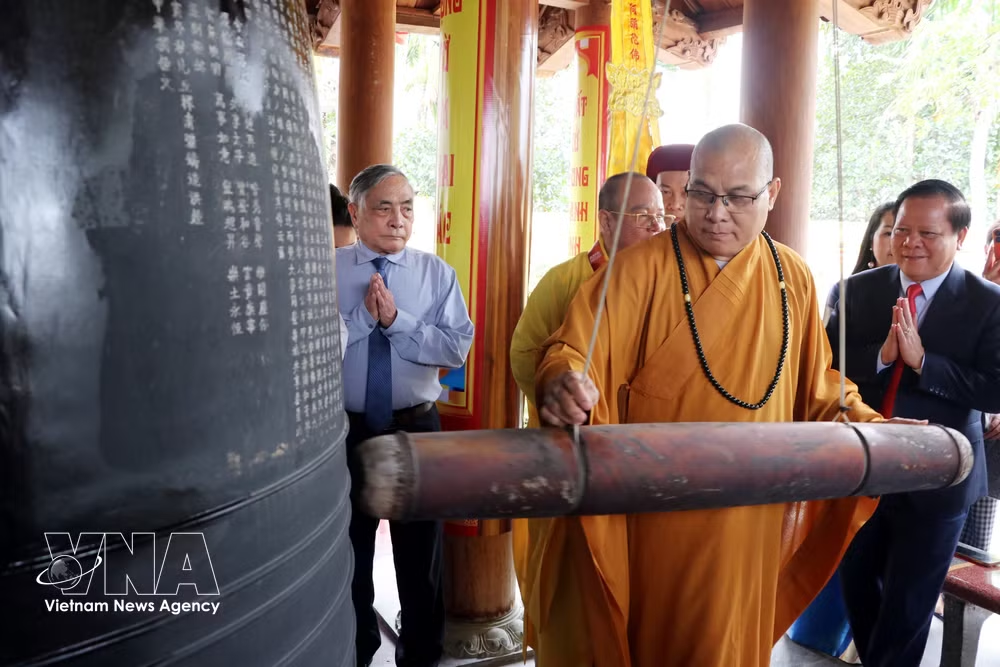
Most Venerable Thich Thanh Van, Permanent Vice Chairman of the Vietnam Buddhist Sangha's chapter in Hai Phong city, rings the bell to symbolically awaken the true nature of enlightenment, and pray for national prosperity and peace for the people at the ceremony. (Photo: VNA)

Venerable Thich Thanh Cuong said the original design envisioned a wooden structure. However, after visiting Angkor Wat in Cambodia, he drew inspiration from its monumental stone construction and decided to adopt a similar approach using smaller carved stone blocks. The construction process proved highly labour-intensive, with artisans hand-carving each stone on site and assembling only 10–15 blocks per day once upper layers required mechanical lifting.

The lotus carvings at the base symbolise purity and enlightenment, central to Buddhist philosophy, and lotus is also considered as Vietnam’s national flower. The swastika motifs above represent auspiciousness and form part of the 32 auspicious marks associated with Gautama Buddha, signifying wisdom, virtue and compassion attained through enlightenment.

Local authorities underscored their continued support for religious and cultural activities in accordance with the law. Chairman of the Tan Hung ward People’s Committee Vu Cong Than expressed his hope that the pagoda’s new recognition will serve as a catalyst for linking with the local woodblock carving village to create a distinctive tourism offering.

Nguyen Minh Xo, Standing Vice Chairman of the Hai Phong Tourism Association, said the organisation will step up efforts to promote the pagoda’s unique cultural and architectural values to both domestic and international visitors.

In August 2015, the pagoda was recognised by VietKings as the first in Vietnam to feature stone walls engraved with the swastika symbol. Following a rigorous independent evaluation process, the Asia record was officially approved on April 27 this year.

On the same day, the pagoda also inaugurated its Mother Goddess shrine and bell tower./.
VNA

See more

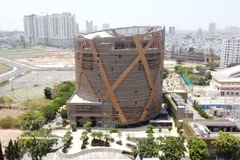
Hanoi’s New Opera House takes center stage for the global travel elite, drawing comparisons to the world’s most legendary architectural icons. (Photo: travelandleisureasia)

Asia’s leading luxury travel magazine hails Hanoi's new opera house: "Move aside, Sydney"

The magazine opened its feature with a bold declaration: "Move aside, Sydney. There’s a new iconic opera house on the water." The fact that Hanoi’s architectural masterpiece is being showcased by a platform that shapes the trends of the global travel elite is a clear testament to the project's worldwide appeal. International experts have already begun to place the Hanoi Opera House on the same scale as the most legendary icons on the planet.

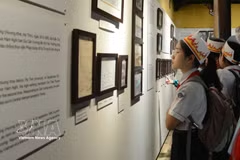
The display space of the archival photo exhibition “Echoes of a New Era” at the Imperial Citadel of Thang Long. (Photo: VNA)

Exhibition traces Vietnam’s post-reunification journey

Showcasing more than 70 documentary images, the exhibition highlights Vietnam’s journey from the 1975 Spring Victory through the early years of recovery and reconstruction, with a spotlight on the nationwide general election on April 25, 1976.

Prime Minister Le Minh Hung and members of Vietnam’s national U17 men’s football team pose for a group photo. (Photo: VNA)

PM hails U17 football team’s ASEAN triumph, sets sights higher

Presenting a certificate of merit to the team, the PM praised their championship run as a compelling and remarkable journey marked by resilience, determination, and a strong competitive spirit. The team remained unbeaten throughout the tournament, recording four wins and one draw while scoring 19 goals.

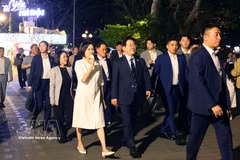
President of the Republic of Korea Lee Jae Myung and his spouse take a stroll around Hoan Kiem Lake in Hanoi during a visit to Vietnam in April 2026. (Photo: VNA)

Vietnamese cuisine gains global spotlight through leaders’ street food moments

In recent years, Vietnamese dishes have gained wider global recognition through travellers and international rankings. A social media group named “Vietnam Banh Mi Appreciation Society,” with nearly 200,000 foreign members, is dedicated to reviewing banh mi from street stalls to established shops, reflecting growing international enthusiasm for the dish.

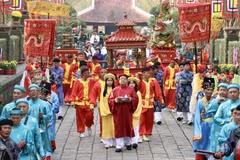
Offering of cylindrical glutinous rice cakes to Hung Kings at Thuong Temple in Ho Chi Minh City (Photo: VNA)

Vietnam Culture Day: Rendezvous of identity, internal strength

Culture has long been described as the spiritual foundation of society, an internal strength, and a driver of development; yet for that idea to truly take root in everyday life, it must be translated into concrete, visible, and tangible policies.

Visitors explore blooming plum orchards in Hom hamlet, Chieng Coi ward, Son La province. (Photo: VNA)

Northwest cultural showcase to open in Son La in May

Conceived as an integrated cultural space, the Huong sac vung cao (Highland Hues) exhibition will bring together archival and artistic images alongside artefacts to depict the cultural and social life of ethnic communities, underscore the Party and State’s focus on upland areas, and reflect local development progress.

Van Thuy Tu temple in Phan Thiet ward, a well-known destination offering insight into the unique whale worship (Photo: VNA)

Historic coastal communal houses keep folk fishing traditions alive

Stretching along the coastal belt of Lam Dong province, centuries-old communal houses and temples worshipping the “Ong” (Whale God) stand as quiet custodians of history, embodying the distinctive cultural and spiritual life of Vietnamese coastal communities, while increasingly emerging as compelling cultural tourism attractions.

A special art programme is held in Dien Bien province in 2025 to celebrate the 50th anniversary of the Liberation of the South and the national reunification, the 71st anniversary of the Dien Bien Phu Victory, and the 135th anniversary of the birth of President Ho Chi Minh. (Photo: VNA)

Boosting traditional arts talents key to preserving cultural heritage

Politburo’s Resolution No. 80 on developing Vietnamese culture places a stronger emphasis on nurturing talent in traditional arts. It is expected to breathe fresh life into Vietnam’s cultural heritage, as these art forms face mounting challenges in the modern entertainment landscape.

Internationally acclaimed pianist Kevin Kenner (Photo: VCMA)

World-renowned pianist Kevin Kenner to perform in Vietnam

Organised by the Vietnam Classical Music Association (VCMA) with support from Impressivo Production & Enterprise, the concerts are scheduled for May 22 at Ho Guom Opera House in Hanoi and May 24 at the Ho Chi Minh City Opera House, the Vietnam Classical Music Association announced on April 26.

Nearly 8,000 runners join AirAsia RedRun Da Nang 2026 (Photo: VNA)

Nearly 8,000 runners join AirAsia RedRun Da Nang 2026

Jointly organised by the Ministry of Culture, Sports and Tourism, the municipal People’s Committee and related agencies at East Sea Park, the two-day event featured 5km, 10km and 21km races, with runners competing along scenic routes in the city. The main race day was April 26, following activities launched a day earlier.