Stone lion statues - Symbol of stone sculpture art of Ly Dynasty

According to Buddhism, lion is the embodiment of intellectual power, but with stars on the body, the stone lions of the Ba Tam pagoda-temple also have the meaning of carrying the moving sky.
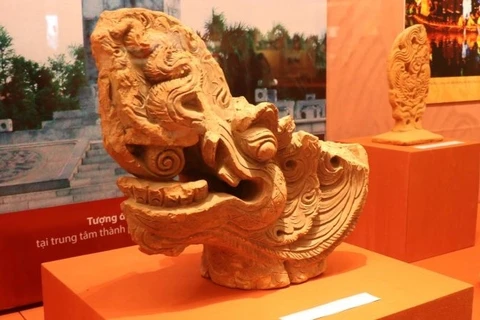
Stone lion statues - Symbol of stone sculpture art of Ly Dynasty ảnh 1Statues are made from sandstone with skillful techniques. (Photo: Vietnam Pictorial)

Hanoi (VNA) - A pair of stone lion statues at Ba Tam pagoda-temple complex is a symbol of the pinnacle of stone carving technique during the Ly Dynasty, showing the skillfulness and high aesthetic sense of artisans.

The site is a well-known relic of Hanoi associated with the life and career of Nguyen Phi Y Lan (Empress Mother Linh Nhan).

Hallmarks in the history of the Ly Dynasty were partly attributed by Nguyen Phi Y Lan - a talented woman who replaced the king as regent to look after the country. She was the pride of the nation in the resistance war against invaders of China’s Tang Dynasty, as well as in the cause of building a strong country in terms of politics, economy, culture, and expanding Buddhism in peacetime.

Construction of the complex was initiated by Empress Mother Y Lan and inaugurated in March 1115.

Located next to Highway 5 with high traffic flows, the complex still retains the quietness of a spiritual place.

From afar, the complex stands out with the pure bronze statue of Empress Mother Linh Nhan Y Lan which is 9.1m high and weighs 30 tonnes. Behind it is an embossment made of green stone covering an area of 140 sq.m.

Entering the gate is a space bearing the impression of Ly Dynasty style with a floating pavilion and a pair of dragon statues which were restored in 2000.

The Ba Tam temple is a place dedicated to Nguyen Phi Y Lan. It was built in the Ly Dynasty style with 72 gates, the oldest type in Vietnam.

It is also frequented by visitors as it is home to two national treasures which are a pair of stone lion statues and a gilded wooden altar.

In particular, the pair of stone lions - the original artifacts associated with this relic since its construction - were carved very delicately from a sandstone block. With a large size of 110cm high and 140cm wide, they are solemnly placed in the pagoda’s Buddhist trinity palace.

The work shows delicate carving lines, carrying the significance of Buddhist philosophy, and at the same time, clearly shows the majesty and power of a mascot in the history of the Vietnamese fine art in the 12th century.

Another unique feature is the mixture of round statues and embossment, a strength in the sculpture art of the Ly Dynasty.

Stone lion statues - Symbol of stone sculpture art of Ly Dynasty ảnh 2The pair of stone lions are placed in the main compartment of the temple (Photo: Vietnam Pictorial)

According to Buddhism, lion is the embodiment of intellectual power, but with stars on the body, the stone lions of the Ba Tam pagoda-temple also have the meaning of carrying the moving sky.

Instead of sticking to a certain pattern, artisans really created works of art bearing contemporary hallmarks.

Such requires a convergence of wisdom, imagination, affection and craftsmanship of master artisans.

Another national treasure at the complex is gilded wooden altar dating back to the 16th century. As a unique original artifact, it represents wood carving and gilding industry of the country and the Mac Dynasty in particular.

Measuring 170cm in height and 62cm in width, it is one of the three earliest known altars in art deco style, a typical product of the traditional 16th-century lacquer art.

In addition to its artistic value, the treasure offers an insight into architectural model of the Mac Dynasty, bringing the national art back to its traditional essence./.
VNA

See more

Visitors at Van Mieu - Quoc Tu Giam (The Temple of Literature) in central Hanoi. (Photo: hanoi.gov.vn)

Hanoi gears up for tourism boom during national holidays

For Hanoi tourism sector, the national holidays to commemorate Hung Kings (April 25-27), along with the national reunification celebration (April 30) and the Labour Day (May 1) are not only a peak time for welcoming visitors but also a test of its operational capacity, service organisation, and destination quality in the context of a volatile market.

The sea area off the southern coast of Phu Quoc Island. (Photo: VNA)

UK newspaper praises Phu Quoc’s unspoilt charm amid tourism boom

Phu Quoc is positioned as a compelling alternative – even a potential rival to Phuket – for travellers seeking authenticity in Southeast Asia. Its appeal lies not only in scenic beauty and fresh seafood, but also in the harmonious coexistence of modern tourism and enduring local culture.

Cua Viet beach is a magnet for both locals and visitors during holidays. (Photo: VNA)

Quang Tri seeks to unlock potential of marine tourism’s “golden triangle”

Cua Tung, Cua Viet and Con Co special zone are identified as three key destinations of marine tourism, and to transform this “tourism triangle” into premium and peaceful resorts, a new strategy is needed to enhance attractiveness to high-end travellers seeking private spaces as the strength of these places lies in their pristine and tranquil beauty.

Korean tourists on Ho Chi Minh City's book street (Photo: VNA)

Vietnamese destinations attracting Korean visitors amid “micro-trip” trend

Last year, Vietnam welcomed more than 4.3 million Korean visitors out of a total of nearly 29.6 million Koreans traveling abroad. This volume significantly outpaces Korean arrivals to neighbouring competitors like Thailand, Singapore, and the Philippines, cementing Vietnam’s status as a premier regional hub for East Asian tourism.

Ha Long Bay, located in northeast Vietnam, is beloved for its blue waters and spread of limestone islands - all occupied by tropical trees and wildlife. (Photo: VNA)

Vietnam named among world’s 28 most beautiful countries

In its latest list, the US-based magazine noted that while cities like Hanoi and Ho Chi Minh City attract millions of visitors each year, Vietnam’s true allure lies in its diverse natural landscapes and immersive travel experiences. The country, it said, is “a haven for outdoor enthusiasts” and anyone drawn to scenic beauty.

The blending of culture, architecture and art on Phu Quoc is shaping a cosmopolitan city. (Photo: Sun Group)

Phu Quoc: Where the world meets through architecture

The presence of diverse international architectural styles across Phu Quoc, rather than a single traditional architectural system, is not accidental but rooted in the island’s unique development context. Unlike cities with centuries of urban heritage such as Hoi An or Hue, Phu Quoc is a tourism destination that has grown rapidly over just the past few decades, without a clearly layered architectural legacy to inherit.

The luxurious resorts ecosystem contribute to elevating Phu Quoc's image in the eyes of international media. (Photo: Sun Group)

Phu Quoc and its luxury resorts "take the leaderboard by storm" in DestinAsian rankings

On March 6, 2026, the prestigious travel magazine DestinAsian officially announced its list of the top 10 islands in Asia for 2026 as part of its Readers' Choice Awards. Not only was it the sole representative from Vietnam, but Phu Quoc also made a remarkable impression by climbing to the runner-up position, continuing an impressive three-year upward trend.

A corner of Con Dao Island (Photo: VNA)

Con Dao emerges as bright spot on global tourism map

Prestigious fashion magazine Vogue has officially listed Con Dao Island, part of the great Ho Chi Minh City metropolitan area, among the world’s most ideal honeymoon destinations for 2026, underscoring the strong potential of the island district in capturing the high-end resort market.

Foreign tourists visit Hanoi on the Lunar New Year. (Photo: VNA)

Hanoi capital honoured with four top Tripadvisor awards

Specifically, the capital city was honoured in four categories: Top 25 Best Destinations in the World (4th place), Top 25 Best Cultural Destinations in the World (7th place), Top 25 Best Solo Travel Destinations in the World (7th place), and Top 25 Best Food Destinations in the World (11th place).

Luxury cruise ship Le Jacques Cartier marks first international arrival in Con Dao in 2026. (Photo: Published by VNA)

Con Dao welcomes first international cruise ship in 2026

In 2025, Con Dao welcomed more than 612,000 visitors, including around 25,600 international arrivals. The arrival of Le Jacques Cartier early in the year is expected to provide fresh momentum for the island’s tourism growth in 2026.

Con Dao is listed among theworld’s best honeymoon spots for 2026 (Photo: Booking)

Con Dao among top honeymoon destinations for 2026

According to the article, Con Dao ranked fifth worldwide and Vietnam is the travel destination on everyone’s lips for 2026, and for those eager to experience the Southeast Asian country’s most marvelous landscapes, minus the crowds, Con Dao is just the ticket.

At the tourism promotion programme for Hue and Quang Tri in Seoul. (Photo: VNA)

Hue, Quang Tri promote tourism, push direct air links with RoK

Binh said the programme sought to position Hue and Quang Tri as diverse and high-quality destinations in central Vietnam, combining rich cultural heritage, attractive natural landscapes and professional tourism services, while also promoting cooperation between Vietnamese and Korean tourism enterprises.