Vietnam’s energy transition on track, poised to become regional power hub: Malaysian expert

Vietnam is entering the most challenging phase—from planning to execution—where financial, infrastructural and governance challenges are all surfacing at once. Yet this stage also clarifies opportunities. If the country can overcome systemic bottlenecks and balance security, transition and cost considerations, it has the potential to emerge as a key energy pillar in Southeast Asia.

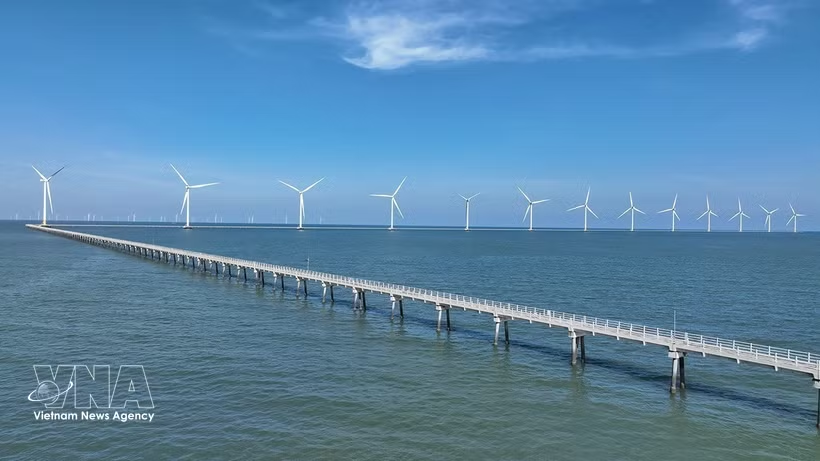
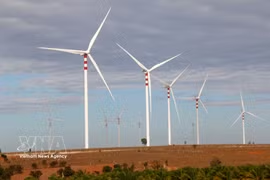
The Hoa Binh 1 and 2 wind power plants in Vinh Hau commune, Ca Mau province generate around 400 million kWh annually, contributing to the country’s energy security (Photo: VNA)

Hanoi (VNA) – Vietnam’s current energy roadmap is on the right track and highly ambitious, reflecting a shift from a “supply security” mindset to one focused on building a modern energy system, reflecting the country’s strong determination to modernise its economy under the vision of Party General Secretary and State President To Lam, according to a Malaysian scholar.

Talking to the Vietnam News Agency’s correspondents in Malaysia, Collins Chong Yew Keat, an analyst on foreign, security, and strategic affairs at University of Malaya (UM) said amid mounting geopolitical volatility, Vietnam faces a pivotal opportunity to recalibrate its energy model toward sustainability, self-reliance and regional competitiveness. According to the expert, this process centres on reshaping the power mix by increasing the portion of renewables and gradually reducing reliance on coal-fired power. This is not only an environmental imperative but also an economic strategy to leverage Vietnam’s strengths in offshore wind and solar energy. Specifically, the country aims to raise the share of non-hydropower renewables to 21% by 2030, while cutting coal share from 52% to 43%, tapping into two of Southeast Asia’s fastest-growing energy sectors (wind and solar power).
vnanet-dien-117.jpg
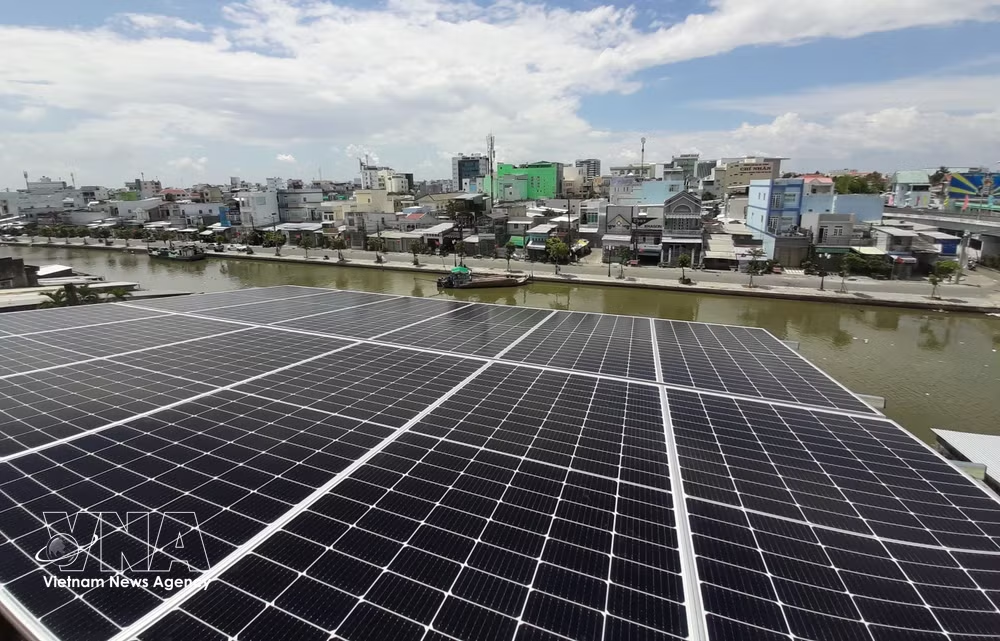
A rooftop solar power system installed at a household (Photo: VNA)

Collins stressed that Vietnam’s opportunity goes beyond meeting domestic demand, extending to the potential to become a regional hub for clean electricity supply. Power interconnection projects with Malaysia and Singapore mark initial steps toward joining the ASEAN Power Grid—an emerging regional energy architecture.

This means Vietnam could evolve from being merely an “energy consumer” into a “strategic supplier,” he said.

At the same time, market-based mechanisms such as direct power purchase agreements (DPPA) are also helping build a more flexible energy ecosystem, attracting investment while enabling businesses to meet stringent decarbonisation requirements across global supply chains, thereby safeguarding export competitiveness, he noted.

However, the path to realising green energy ambitions still faces serious systemic challenges, with the transmission network emerging as a key bottleneck. Grid congestion and curtailment have directly undermined the economic efficiency of many projects, reflecting a classic risk where the pace of power generation approvals outstrips grid upgrades.

To address this, Collins stressed the need to enhance system flexibility through investments in energy storage, reserve capacity, improved forecasting and digitalised grid management. Equally critical are consistent regulations and bankable policies, as the sector’s capital needs are substantial and investor confidence remains sensitive to policy uncertainty.

He cautioned that replacing fuel dependency with reliance on imported technology is not a sustainable solution. Vietnam, he said, must strengthen domestic capabilities across technology and material supply chains. Another key element under consideration in Vietnam’s evolving energy security strategy is the potential revival of nuclear power. If properly managed, nuclear energy could provide stable, low-emission baseload supply, complementing the intermittency of wind and solar while ensuring a balanced energy portfolio, avoiding overreliance on any single fuel source or technology.

More broadly, the concept of energy security in the new era is evolving from a narrow focus on supply to a system-wide approach encompassing grid infrastructure, digital systems, cybersecurity and technology supply chains, Collins said, stressing that Vietnam should treat energy transition and energy security as a unified strategy rather than separate objectives.

The scholar said in this context, prioritising early investment in grid and storage infrastructure while maintaining affordable energy prices will be crucial to avoid economic shocks. He advised that Vietnam should avoid pursuing decarbonisation pathways in a way that would trigger sharp shocks to industrial and household electricity prices.

He also recommended competitive bidding, electricity market reforms and targeted support for vulnerable groups, instead of broad subsidies that distort the market.

Strategic optionality will also be vital for resilience, including fuel stockpiling, diversification of LNG and oil supplies, and the development of domestic manufacturing for selected clean energy components, he noted.

According to the expert, Vietnam is entering the most challenging phase—from planning to execution—where financial, infrastructural and governance challenges are all surfacing at once. Yet this stage also clarifies opportunities. If the country can overcome systemic bottlenecks and balance security, transition and cost considerations, it has the potential to emerge as a key energy pillar in Southeast Asia.

In that scenario, energy security will evolve from a defensive shield into a strategic lever to elevate national standing, offering a long-term solution to challenges at present, he said./.

VNA

See more

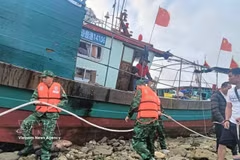
Officers and soldiers of the Hai Phong Border Guard assist a Chinese fishing vessel in securing its moorings while awaiting favourable weather conditions for being towed into the harbour shelter. (Photo: VNA)

Vietnamese border guards rescue two foreign fishing vessels in distress at sea

The prompt and successive rescue of the two foreign vessels underscores the professionalism and responsibility of Vietnam’s Border Guard force in safeguarding maritime sovereignty and security. It also serves as a clear demonstration of Vietnam’s commitment to promoting a peaceful, friendly, and humanitarian maritime environment in line with international law and practices.

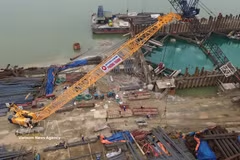
Construction site of Tu Lien bridge, along Nghi Tam Street (Photo: VNA)

Hanoi accelerates seven Red River bridge projects, many exceed 70% completion

ccording to the municipal Transport Construction Investment Project Management Board, the city is simultaneously implementing seven projects, namely Tu Lien, Ngoc Hoi, Tran Hung Dao, Thuong Cat, Van Phuc, Hong Ha and Me So bridges. Construction is being carried out on multiple fronts, focusing on bored piles, pile caps, piers and superstructure works.

Border guards of Dong Thap province present gifts and raise awareness on IUU fishing prevention for fishermen at Vam Lang fishing port, Gia Thuan commune, Dong Thap province. (Photo: VNA)

Dong Thap tightens fishing control to curb IUU fishing

The southern province has ensured 100% of fishing vessels are registered, licensed, and equipped with vessel monitoring systems (VMS). Authorities have strengthened inspections, particularly targeting vessels that lose tracking signals or fail to meet operational conditions.

Visitors tour Dien Bien Phu Victory Museum (Photo: VNA)

Dien Bien battlefield legacy powers tourism revival

Seventy-two years after the Dien Bien Phu Victory, its legacy still reverberates. The unity, self-reliance, and resilience forged in that historic triumph remain a powerful internal engine, now propelling Dien Bien toward fast and sustainable development.

Delegates cut the ribbon to inaugurate the Vietnam Pavilion at Foire de Paris. (Photo: VNA)

Vietnam space opens at Foire de Paris

The opening ceremony featured vibrant performances, including a traditional lion dance and musical showcases with the monochord (dan bau) and T’rung bamboo instrument, offering visitors an immersive introduction to Vietnamese culture. The festive atmosphere was further enhanced as lion dance troupes paraded through the Vietnamese exhibition area.

Vietnam’s fertility drops below replacement in recent years, from 2.11 children per woman in 2021 to 1.91 in 2024 and 1.93 in 2025, especially in major cities and more developed regions. (Photo: VNA)

Health ministry targets annual fertility rate of 2% by 2030

Vietnam’s fertility has dropped below replacement in recent years, from 2.11 children per woman in 2021 to 1.91 in 2024 and 1.93 in 2025, especially in major cities and more developed regions, prompting the need for coordinated measures to encourage childbirth.

Hung Ha Veston Factory under May 10 Corporation has invested in sewing machines using AI technology to serve production (Photo: VNA)

Digital technologies redraw jobs landscape

Vietnam’s labour market is entering an accelerated transition under digitalisation and AI. According to the International Labour Organization (ILO), about 11.5 million workers - one in five - are in jobs potentially affected by GenAI.

The Vietnam Education Publishing House is working to supply textbooks to localities (Photo: VNA)

Vietnam picks one textbook set for all schools, targets free books by 2030

The Ministry of Education and Training has selected the “Ket noi tri thuc voi cuoc song” (Connecting Knowledge with Life) series, published by state-owned Vietnam Education Publishing House (VEPH), from among three existing sets. The education minister approved the choice on December 26, 2025, locking in enough time for preparation before the new school year.

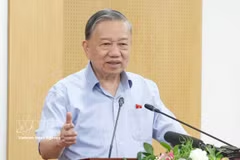
Party General Secretary and State President To Lam speaks at a meeting with voters from ten wards in central Hanoi on May 4. (Photo: VNA)

New opportunities open for Hanoi to make stronger breakthrough: Top leader

Party General Secretary and State President To Lam told voters from ten central Hanoi wards on May 4 that while Hanoi faces significant challenges, it also has unprecedented opportunities for breakthrough development befitting its role as the capital, as he and members of the city’s delegation to the 16th National Assembly met with constituents to hear their views and brief them on the legislature’s first session.

A requiem ceremony for Nguyen Van Tu held ahead of the park naming event. (Photo: VNA)

Berlin names park after Vietnamese victim of neo-Nazi violence

Nguyen Van Tu, born in 1963, was murdered on April 24, 1992, at the age of 29 amid a surge of far-right violence targeting immigrants in post-reunification Germany. His death remains a stark reminder of a difficult period for Vietnamese and other foreign communities in the country.

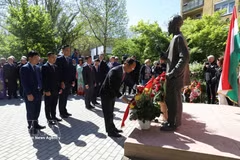
National Assembly Chairman Tran Thanh Man lays flowers in commemoration of President Ho Chi Minh, heroes and martyrs at the memorial site of the Nam Ky Uprising in Hoc Mon commune, Ho Chi Minh City, on May 4. (Photo: VNA)

NA Chairman pays tribute at Hoc Mon historic site

Writing in the memorial book, Chairman Tran Thanh Man said he was deeply moved to visit the site, which witnessed the Nam Ky Uprising on November 23, 1940 and preserved important milestones in the long struggle of the army and people of the 18 hamlets of betel gardens.

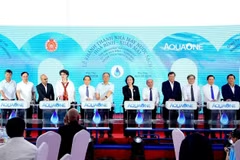
The opening ceremony of the Hoa Binh - Xuan Mai clean water plant. (Photo hanoimoi.vn)

5 trillion VND clean water plant opened in Phu Tho

Cplant’s launch marked a key milestone in developing technical infrastructure in Phu Thọ and surrounding regions, helping meet rising demand for clean water in Hanoi while supporting urban, industrial and services growth.

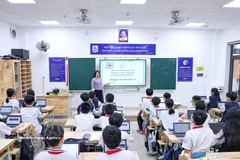
“Google Digital Classroom”, a space that inspires passion and builds core digital skills for students. (Photo: VNA)

Hanoi scales up high-quality schools, raises standards

In addition to 23 accredited institutions, the city plans to establish 37 more, lifting the total to 60. The move signals a shift in approach rather than a mere technical adjustment, aligning with the Politburo’s Resolution 71-NQ/TW on education breakthroughs and Hanoi’s Action Programme 05-CTr/TU.