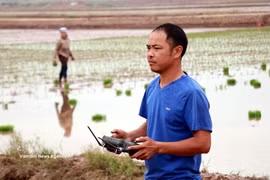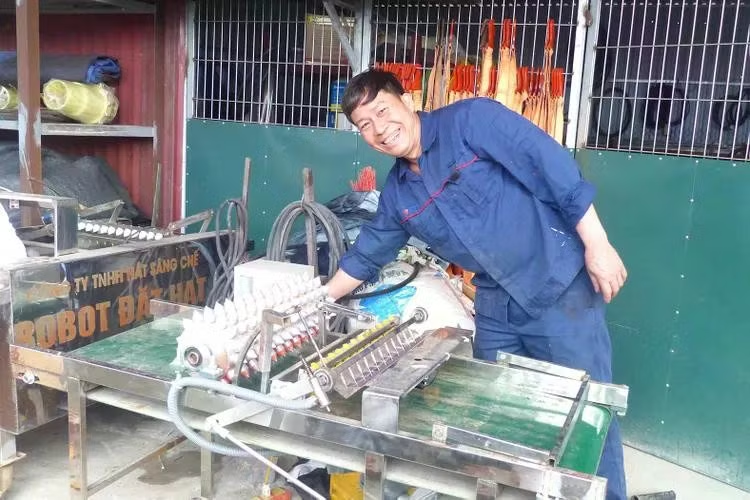
Hanoi (VNA) – Amid the windswept fields of Tan Ky commune in the northern city of Hai Phong, the nickname “Hat – the inventor” has long become synonymous with ingenuity and resilience. Despite leaving school after grade seven and lacking any formal engineering training, farmer-inventor Pham Van Hat has made a mark in Vietnam’s agricultural machinery sector.
He is best known as the creator of the made-in-Vietnam “Seed Sowing Robot,” now exported to 15 countries, alongside dozens of practical inventions that have eased labour for thousands of farmers.
From debt crisis to opportunity in Israel
Welcoming visitors to his workshop in oil-stained overalls, the sun-tanned inventor recalled how hardship pushed him toward innovation.
“People often ask how a farmer with only a seventh-grade education became an inventor. There was no miracle. Poverty cornered me and forced me to find a way out,” he said.
Before gaining recognition, Hat experienced a major business failure. In 2007, he invested 1.5 billion VND (about 570,000 USD) - a substantial amount at the time - into a 10-hectare safe vegetable farm. However, consumer demand for high-priced clean produce had yet to take shape. By 2010, the venture collapsed, leaving him with debts of 4 billion VND.
Facing mounting interest payments and financial ruin, Hat made a bold decision: travel to Israel as a worker, both to earn money and learn how agriculture thrived in a desert nation.
While working on a vegetable farm there, he noticed the exhausting manual process of spreading fertiliser across vast fields. Observing the farm’s tractors, he proposed building an automatic fertiliser spreader capable of replacing dozens of workers.
Initially sceptical, the farm owner even asked Vietnamese Embassy staff to verify Hat’s background before agreeing to supply materials for the experiment. After three days of intensive work, Hat produced the prototype. By the third version, the machine operated flawlessly, delivering productivity equivalent to nearly 40 workers.
The invention transformed his status overnight. Freed from manual labour, Hat was assigned to research and machinery improvement, received a salary increase and a 10,000-USD bonus, while Israeli partners helped register patents for many of his innovations.
Building machines farmers truly need
At the peak of his success abroad, Hat surprised many by returning to Vietnam in 2012 despite still carrying heavy debt.
“Working for others overseas could never make me truly successful. More importantly, I wanted my knowledge to serve Vietnamese farmers first,” he explained.
Back home, he started again from a modest corrugated-iron workshop. Ignoring criticism and rumours, he focused on developing machinery suited to local farming conditions.
His breakthrough product was the “Seed Sowing Robot.” Unlike imported models requiring multiple electronic components and consuming large amounts of electricity, Hat’s machine relied on a simple mechanical design, consumed far less power and cost only a fraction of foreign products while maintaining high precision and durability.
The invention quickly gained international recognition, reaching demanding markets such as Japan, the United States, Canada, Germany and New Zealand.
Within three years of returning home, Hat had fully paid his debts and expanded production. Since then, he has developed more than 60 machines serving agriculture, forestry and fisheries, including grain loaders, herb harvesters, pesticide sprayers and vegetable harvesters.
His business philosophy remains straightforward: “Don’t produce what you have – produce what farmers actually need.”
Turning down 30 billion VND for national pride
Beyond agriculture, Hat has recently turned his attention to urban safety. Concerned about fatal fires in mini apartment buildings and karaoke venues, he developed a mechanical high-rise emergency escape device that requires no electricity and can be operated by elderly people, children and people with disabilities.
During tests on a five-storey structure, the system reportedly evacuated 30 people safely in just one minute and 26 seconds.
The invention quickly attracted international interest. According to Hat, a Chinese corporation offered 30 billion VND to buy the technology outright after evaluating global escape-system models.
“I refused because Vietnamese people should benefit from it first,” he said. “I also want to prove that Vietnamese creativity can compete with the world. Money can come later, but human lives and national pride cannot be traded.”
Today, the inventor continues refining his ideas from his hometown workshop, where local farmers say his machines have transformed daily work in the fields.
Hat’s journey – from an indebted farmer to an internationally recognised inventor – stands as a vivid example of Vietnam’s grassroots creativity and determination. “Innovation does not always begin in million-dollar laboratories. Sometimes, it starts from the hardships of everyday life and the simple wish to help people suffer less,” he stated./.