Ho Chi Minh City views biotechnology industry as new groundbreaking growth driver

For Ho Chi Minh City, science, technology and innovation have been identified as key drivers of growth in the new development period. Biotechnology, therefore, is considered one of the sectors capable of generating high added value and promoting the transition towards a greener growth model.

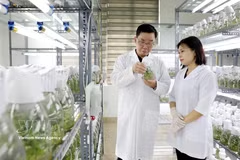
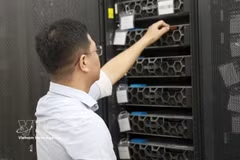
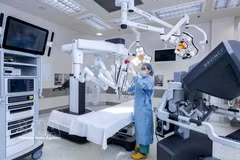
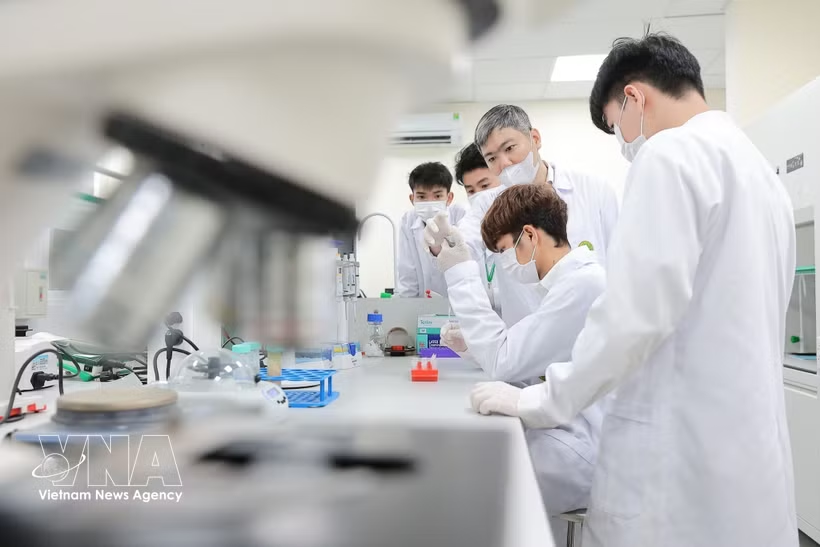
Illustrative photo (Photo: VNA)

Ho Chi Minh City (VNA) - Ho Chi Minh City is accelerating the development of the biotechnology industry, viewing it as a groundbreaking sector capable of supporting green growth and sustainable development.​

Biotechnology is increasingly regarded as a foundational industry of the knowledge-based economy, playing a strategic role in healthcare, high-tech agriculture, environmental protection and green economy. The global bio-economy is forecast to contribute more than 2.7 trillion USD annually in the coming years.

​Under the Politburo's Resolution No. 36-NQ/TW on the development and application of biotechnology for the country’s sustainable development in the new context, Vietnam aims to turn biotechnology into an important techno-economic sector and become one of Asia’s leading countries in several biotechnology fields.

​For Ho Chi Minh City, science, technology and innovation have been identified as key drivers of growth in the new development period. Biotechnology, therefore, is considered one of the sectors capable of generating high added value and promoting the transition towards a greener growth model.

​Director of the municipal Department of Science and Technology Lam Dinh Thang said the city, as the country’s economic, scientific and innovation centre, considers green transition and circular economy essential requirements for sustainable development.

According to Thang, these orientations also provide opportunities for the city to restructure its growth model, improve competitiveness and create new economic growth drivers.

​Since 2013, the city’s technology exchange platform has organised 24 specialised Techmart events in fields such as high-tech agriculture, biotechnology, healthcare, digital transformation and smart urban development. More than 1,500 organisations have introduced over 6,000 technologies and devices through these events, gradually forming technology connectivity networks linking research institutes, universities, enterprises and localities.

​Associate Prof., Dr Truong Hai Nhung, Dean of the Faculty of Biology and Biotechnology under Vietnam National University, Ho Chi Minh City (VNU-HCM)’s University of Science, said Ho Chi Minh City currently possesses the country’s largest biotechnology research and application ecosystem.

The ecosystem includes the VNU-HCM, the Biotechnology Centre, the Saigon Hi-Tech Park, specialised hospital networks, technology enterprises and experts from the Ho Chi Minh City Biology-Biotechnology Association. The close links among these components are helping establish a full chain covering research, testing, production and commercialisation of biotechnology products.

​With its network of leading hospitals, research universities, technology firms and innovation ecosystems, Ho Chi Minh City holds a strategic position to build a biotechnology industry capable of researching, manufacturing and commercialising high-tech products under Vietnamese brands.

​The city is also gradually building capabilities to master advanced biotechnology and biomedical technologies aligned with national strategic technology orientations. In addition to a large scientific workforce, the city already has relatively complete research infrastructure supporting biotechnology and high-tech industries.

​The Biotechnology Centre serves as a key applied research institution, implementing technologies in gene technology, microbiology, plant cell technology, enzyme-protein technology and high-tech agriculture. The centre has become a focal point for programmes supporting urban agriculture and biotechnology development.

​Meanwhile, the Research and Development Centre at Saigon Hi-Tech Park, known as SHTP Labs, operates as an international-standard high-tech laboratory focusing on semiconductor microchips, nanotechnology, advanced materials, biotechnology and systems integration.​

Experts said such infrastructure forms an important foundation for interdisciplinary research combining biology, advanced materials, microelectronics and artificial intelligence, while supporting the development of commercially viable high-tech products.​

According to Nhung, biotechnology plays a particularly important role in the development of urban agriculture, circular agriculture and post-harvest technologies in Ho Chi Minh City and the southeastern region.

Technologies such as gene editing, functional microorganisms, enzymes, alternative proteins and digital biology are expected to create high-value agricultural products, reduce emissions and improve climate resilience.

The orientation is consistent with the city’s Net Zero and circular economy strategies, as well as high-tech agricultural development programmes across southeastern localities.

To unlock resources for the sector, experts suggested that Ho Chi Minh City should pioneer controlled pilot mechanisms for new technologies, including gene and stem cell technologies, to shorten the time needed to bring products to the market.​

They also recommended promoting cooperation among the State, universities and enterprises through research and development alliances, in which the State provides shared infrastructure and major research orders, universities conduct research and verification, and businesses co-invest from the R&D stage.

In addition, specialists proposed establishing a regional biotechnology research-testing-production hub integrating shared laboratories, biological data centres, pre-clinical testing systems and startup acceleration spaces.​

Such a model is expected to become a core infrastructure platform for the biotechnology ecosystem in southern Vietnam while helping Ho Chi Minh City strengthen its ambition to emerge as a regional innovation and biotechnology centre./.

VNA

See more

Thai Binh Seed Group Joint Stock Company has applied science and technology in research and production to develop numerous high-yield, high-quality crop varieties. (Photo: VNA)

Localities aim for higher growth through science, technology

Experiences from localities nationwide show that Resolution 57 is fostering a marked transformation in development mindset. Science and technology, innovation and digital transformation are increasingly becoming foundational drivers of economic growth and opening new development space for localities in the years ahead.

Lieutenant Colonel Nguyen Dinh Do Thi of the Department of Cybersecurity and High-Tech Crime Prevention under the Ministry of Public Security speaks at a discussion session. (Photo: VNA)

Experts recommend ‘five don’ts’ to protect personal data

Vietnamese authorities handled more than 30 cases involving the illegal sale and theft of personal data between 2023 and 2025, affecting over 160 million data records across sectors including health, education, finance, banking and telecommunications.

Major General Nguyen Tung Hung, deputy commander of the Cyber Warfare Command under the Ministry of National Defence, addresses the event (Photo: VNA)

Protecting digital future in post-quantum, AI era

Participants highlighted the importance of building a proactive, synchronised and sustainable national cybersecurity ecosystem through closer cooperation among regulators, technology firms, research institutions and cybersecurity experts.

An engineer from the Digital Transformation Centre under the Khanh Hoa provincial Department of Science and Technology carry out equipment maintenance work. (Photo: VNA)

Vietnam pushes ahead with AI-powered legal infrastructure

Research by the Ministry of Justice (MoJ) shows that AI adoption in the legal sector remains constrained by fragmented, unstandardised and weakly connected legal databases. A unified national legal data ecosystem has yet to be established, while big data and AI applications are still largely confined to pilot programmes and have not been integrated across the full legislative process, including drafting, appraisal, review and inspection of legal documents.

Deputy Prime Minister Ho Quoc Dung speaks at the meeting. (Photo: VNA)

Deputy PM demands full disbursement for sci-tech in 2026

As of May 12, total disbursed capital reached 7.95 trillion VND, equivalent to 14.78% of the Prime Minister’s plan. Of this, central budget disbursement hit 4.06 trillion VND, or 14.8% of the target, while local budget disbursement exceeded 3.88 trillion VND, or 14.75%.

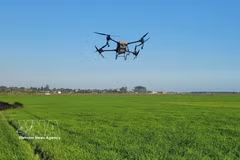
Using drones to spray pesticides in the An Nhut rice fields in Long Dien commune of Ho Chi Minh City. (Photo: VNA)

Solving technology challenge through the “three-party linkage”

According to Pham Duc Nghiem, Deputy Director of the Department of Startups and Technology Enterprises under the Ministry of Science and Technology, the “three party” linkage model involving the State, research institutes/universities and enterprises is becoming essential for developing strategic technologies. Enterprises provide practical problems, universities and research institutes develop technological solutions, while the State creates support mechanisms and policies to accelerate commercialisation.

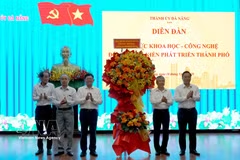
Da Nang city's leaders present flowers to congratulate the Union of Science and Technology Associations in Da Nang on Vietnam Science and Technology Day (May 18). (Photo: VNA)

Human capital key to Da Nang’s digital economy ambitions: experts

Vo Cong Tri, Chairman of the Union of Science and Technology Associations (VUSTA) in Da Nang, described high-quality human resources as a “key driver” in the city’s transformation. Da Nang is already regarded as one of Vietnam’s leading “university cities,” with 19 higher education institutions and a high concentration of students and skilled workers. The city is also home to a growing network of science and technology organisations that are helping to foster an innovation ecosystem.

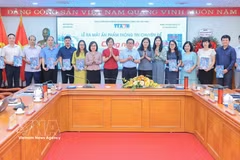
Delegates at the publication launching ceremony. (Photo: VNA)

Vietnam News Agency debuts monthly technology publication

Each 40-page issue is expected to pack 3-5 chapters, delivering a panoramic view of the global sci-tech landscape alongside in-depth analyses of emerging technology trends. The publication aims to explain strategic shifts that will shape the country’s development and examine the sci-tech, innovation and digital transformation policies of other nations.

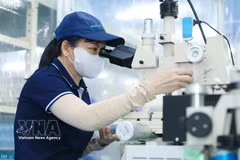
A worker assembles ultra-precision micro-components used in semiconductor chip production. (Photo: VNA)

Vietnam prioritises 70 high technologies for strategic development

Issued under Decision No. 23/2026/QD-TTg dated May 15, 2026, the list covers a wide range of technologies, including artificial intelligence (AI), big data and data analytics, cloud and edge computing, distributed and high-performance computing, Internet of Things (IoT), blockchain, quantum technology, renewable and clean energy, advanced energy storage, AI-powered real-time disaster forecasting and warning systems, and next-generation microbiology technologies.

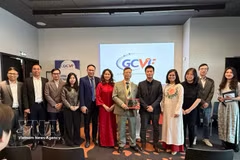
Vietnamese Ambassador to France Trinh Duc Hai (sixth from the right) and the leadership of Global Connect Vietnam France. (Photo: VNA)

Vietnamese association launched in France to foster technology, AI cooperation

In the context of the growing Comprehensive Strategic Partnership between Vietnam and France, Hai said GCVF should position itself as a bridge for knowledge and technology transfer, bringing scientific and technological achievements from France and Europe to support Vietnam’s practical development needs.

Party General Secretary and State President To Lam presents a statute of President Ho Chi Minh to VNU-Hanoi. (Photo: VNA)

Top Vietnamese leader’s vision puts scientists at core of growth drive

As the country enters a new era, the Party and State have designated sci-tech and and innovation as central priorities, Kiem said, adding that VNU-Hanoi, alongside other higher education establishments, must not only produce high-caliber talents but also function as a hub for knowledge transfer and groundbreaking innovation.

Illustrative image (Photo: VNA)

Korean robotics, AI firms interested in Vietnam

KOTRA said it is teaming up with the Korea Institute for Robot Industry Advancement to run the “K-Robot Pavilion"” at the 23rd Vietnam International Exhibition on Machinery, Equipment, Technology and Industrial Products (VINAMAC EXPO 2026) in Hanoi from May 14-16.