HCM City (VNS/VNA) - Biotechnology is not merely a scientific discipline but a form of strategic “knowledge infrastructure” essential for health, food and environmental security, while opening new economic growth opportunities.
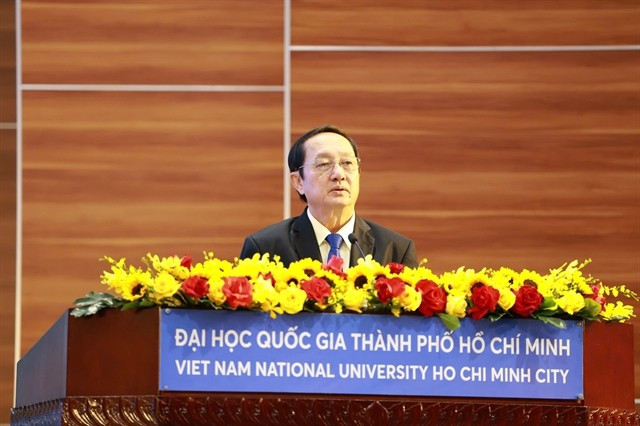
Dr. Huynh Thanh Dat, deputy head of the Party Central Committee's Commission for Information, Education and Mass Mobilisation, made the remark at a national scientific conference in HCM City on November 29.
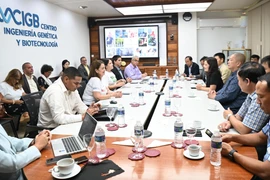
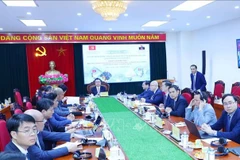
Speaking at the national scientific conference on the biotechnology development strategy for 2026–30, with a vision to 2045, hosted by the Vietnam National University-HCM City (VNU-HCM), Dat emphasised that the conference reflects strong political will and national development aspirations in a field widely regarded as a new engine of global competitiveness.
“We must candidly identify and address institutional, infrastructure and human-resource bottlenecks that are hindering the development of the biotechnology sector,” he said, stressing that biotechnology demands both long-term vision and decisive, immediate action.
“If we remain focused solely on research without transforming outputs into concrete products and commercial capacity, achieving the key targets set by the Party’s resolutions will be difficult,” he said.
He called on VNU-HCM to strengthen its role as a leading hub for interdisciplinary research, deepen university–industry collaboration, and promote the formation of spin-off enterprises to bring scientific findings into real-world application.
Speaking at the event, Nguyen Thi Thanh Mai, Vice Chancellor of VNU-HCM, warmly welcomed delegates, stressing the importance of shaping a breakthrough strategy for the country’s biotechnology development.
The global biotechnology market is valued at 1.8 trillion USD in 2025 and is expected to double by 2030, yet Vietnam accounts for less than 0.1%.
“Despite strong foundations in artificial intelligence and biotechnology, with more than 250 experts and researchers, our ability to translate research into commercial products remains limited,” she said.
She said the conference provides an important platform for experts and scientists to engage with industry and identify solutions to help Vietnam join the region’s leading biotechnology players.
“We expect all stakeholders to join forces and pool resources to keep pace with regional peers; if we do not act now, Vietnam risks missing the momentum of biotechnology’s rapid global growth,” she said.
With confidence in science and technology and the determination of the political system, she expressed hope that the workshop would generate breakthrough solutions and policy reforms to accelerate high-quality “Made in Vietnam” biotechnology products.
Prof. Soo Han Sen, Programme Director of MSCSI at the School of Chemistry, Chemical Engineering and Biotechnology (CCEB) of NTU Singapore, said the school was advancing frontier research and training the next generation of scientists and engineers.
“At CCEB, we believe interdisciplinary collaboration — spanning chemistry, biotechnology, biomedical engineering and data science — is essential to solving global challenges in healthcare, energy, food security and sustainable development,” he said.
He reaffirmed NTU’s commitment to equipping students through programmes such as the Master of Science in Chemical Sciences & Instrumentation (MSCSI), providing cutting-edge laboratory training, research capabilities and industry-relevant experience.
“We look forward to strengthening partnerships with Vietnamese universities, research institutions and industry to foster talent mobility, joint research and innovation that benefits both our nations and the wider region,” he said.
CT Group chairman Tran Kim Chung said this national conference served as a strategic forum shaping Vietnam’s biotechnology development pathway in the innovation era.
“The three-pillar partnership – linking the Government, academia and businesses — will be the key driver enabling Vietnam’s biotechnology sector to make breakthrough progress in the coming years,” he said.
CT Group reaffirmed its long-term commitment to working with central ministries and VNU-HCM, focusing on five priorities: R&D and technology transfer, biotech spin-off development, high-quality human resource training, national strategy advisory, and applying breakthrough technologies — including a national digital twin, near-space economy and quantum computing — to strengthen the country’s biotechnology capacity.
The group also called for the early launch of the “Pink Sun” programme, a corneal-transplant initiative that could restore sight to 600,000 visually impaired people nationwide and later expand across Southeast Asia, marking a milestone for regenerative medicine and biomedical technology in Vietnam./.
VNA