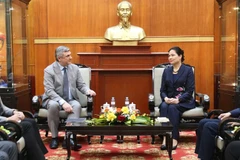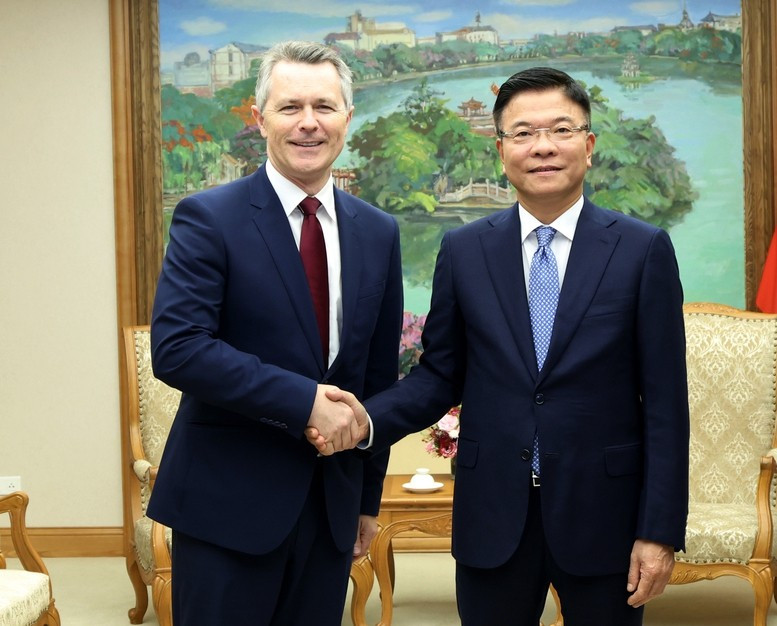
Hanoi (VNA) – Deputy Prime Minister Le Thanh Long on December 11 highlighted the special and increasingly important role of education-training cooperation within the thriving Comprehensive Strategic Partnership between Vietnam and Australia, while receiving Australian Minister for Education Jason Clare in Hanoi.
Long welcomed the productive discussions between the two countries’ education ministers and the signing of several important cooperation documents during Clare’s visit.
He said the Ministry of Education and Training of Vietnam is implementing doctoral and master’s training for lecturers under Scheme 89, and expressed delight that many of those sent for PhD studies have chosen Australia as their destination.
Vietnam considers education-training a top national policy and aims to build a high-quality workforce to meet development needs, the Deputy PM said. The nation hopes to receive further support and cooperation from international partners, especially traditional ones like Australia, he stated.
The official called on Australia to continue assisting Vietnam in English-language training to effectively implement its 2025-2035 project on making English a second language in schools; to encourage Australian universities to open university campuses in Vietnam; and to support Vietnamese students studying in Australia. He also suggested stronger cooperation in science-technology and innovation, which are key drivers of Vietnam’s future growth.
For his part, Clare said educational cooperation between Vietnam and Australia has a long-standing tradition and remains a pillar of the Comprehensive Strategic Partnership. Australia currently hosts around 36,000 Vietnamese students, while some 160,000 Vietnamese have graduated from Australian universities.
The minister voiced strong support for Australian universities expanding their cooperation with Vietnam.
During his working visit, Clare and Vietnamese Minister of Education and Training Nguyen Kim Son witnessed the signing of an agreement under Scheme 89 between the ministry’s International Cooperation Department and six Australian universities.
Clare expressed his belief that the agreement will further deepen bilateral education cooperation, and reaffirmed Australia’s readiness to support Vietnam in implementing its project to make English a second language in schools./.
Vietnam introduces unique tourism, travel cooperation potential in Australia
VNAT Deputy Director Ha Van Sieu stressed that Vietnam is recognised as one of the top travel destinations in Southeast Asia, offering endless beauty and rich cultural heritage, where visitors can explore UNESCO World Heritage sites, relax on tropical beaches stretching over 3,000 km nationwide, and enjoy world-class hotels, resorts, and entertainment services.