Hanoi (VNA) – Vietnam’s tourism sector continues to face a significant shortage of skilled labour, both in terms of quantity and quality, posing a serious challenge to its sustainable development, according to industry insiders.
Estimates suggest the industry needs around 40,000 new workers each year, but only about 20,000 are supplied. Even more concerning, only 43% of the existing tourism workforce has received formal professional training, and many of those still require retraining once employed.
“Vietnam’s tourism workforce faces not only a shortage in numbers but also a lack of quality," said Professor Dao Manh Hung, Chairman of the Vietnam Tourism Education Association (VITEA).
Although the number of tourism students is increasing, opportunities for hands-on training in real-world business environments remain limited. “Even the most supportive enterprises cannot accommodate hundreds of interns at once,” he noted. “This is a major bottleneck.”
Do Hong Xoan, Vice Chairwoman of VITEA, also highlighted the mismatch between educational outcomes and practical needs.
Vietnam faces a serious shortage of capable managers and skilled workers who meet international standards and possess strong foreign language fluency, she said, adding that businesses are struggling with high turnover rates, making talent retention increasingly difficult.
Xoan emphasised that training programmes must be better aligned with actual job requirements — ideally, with 70% practical content — to ensure graduates are immediately employable.
Trinh Cao Khai, Rector of the Hanoi Tourism College, warned that many experienced professionals left the tourism industry during the COVID-19 pandemic and have not returned, further exacerbating the shortage of high-quality personnel.
This puts even more pressure on educational institutions to fill the gap, he said.
Dr. Hoang Ngoc Tue, Rector of the School of Foreign Languages and Tourism under the Hanoi University of Industry, pointed to the lack of coordination between some domestic businesses and training institutions.
“Companies often complain about the poor quality of graduates but fail to actively participate in the training process,” he said. “This is in contrast to many international companies, which invest in training, send experts, and fund programmes to ensure workforce quality.”
More practice, less theory
To bridge the skills gap, Vietnam’s tourism education system needs structural reform. Employers are increasingly seeking graduates with practical skills, a strong service mindset, and language proficiency.
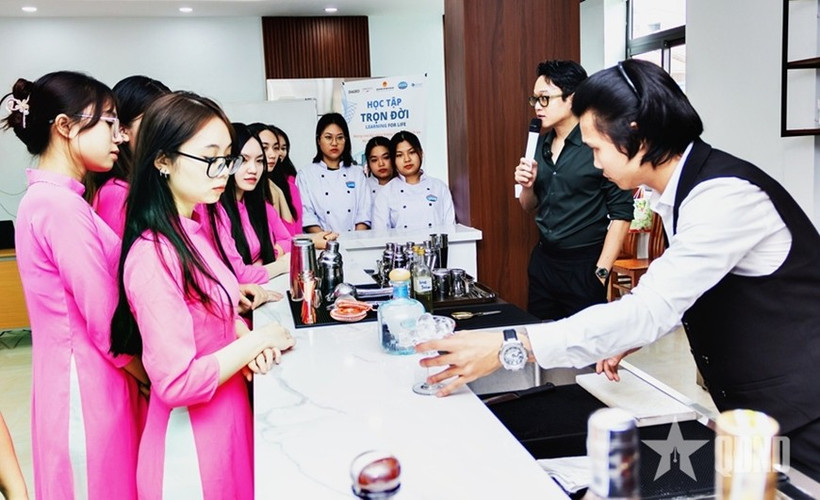
Some institutions have already begun innovating. A notable example is the Netspace Culinary Vocational School, which offers intensive 16-week training programmes that are well-regarded both in Vietnam and abroad. Many Netspace graduates secure employment overseas, and some foreign students even travel to Vietnam to attend the school.
"At Netspace, 95% of the curriculum is practical, and only 5% is theoretical. We integrate into hands-on sessions to avoid misconceptions in the profession," said Nguyen Quoc Y, VITEA Vice Chairman and Director of Netspace.
“Our programme emphasises cultural depth, especially in Vietnamese cuisine, which may explain our high enrollment — we’ve trained more than 20,000 students so far,” he noted.
The Imperial International Hospitality Management College in Vung Tau city has adopted a “hotel-in-school” model, in which students train in a fully operational hotel environment under the mentorship of experienced instructors, many of whom are department heads or higher.
Guests often can’t tell the difference between students and professional staff, said Professor Hung, who is also the school’s rector. “Our curriculum follows a 70% practical and 30% theoretical ratio, with theory based on real-world cases.”
In addition, many schools are exploring the use of artificial intelligence (AI) in training, including applications that enhance foreign language learning, simulate virtual practice environments, and enrich the overall learning experience.
Dr. Tue noted that students at his school use digital apps to preview lessons, engage in guided classroom activities, and practice using virtual tools, helping them develop practical competencies more effectively./.