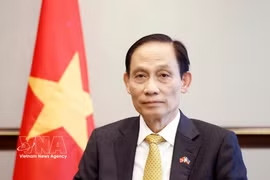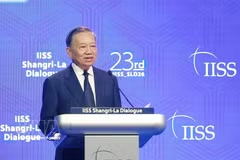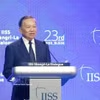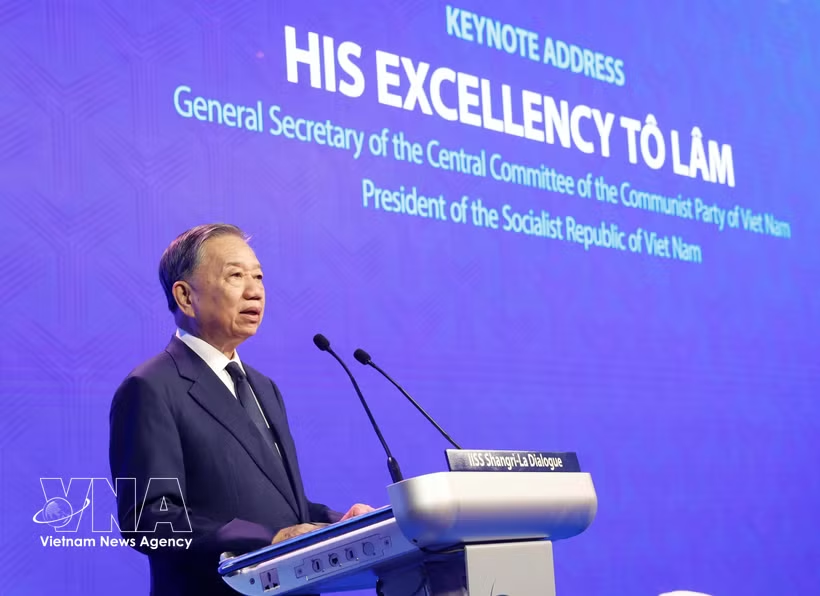
Singapore (VNA) – Singaporean Minister of Foreign Affairs Vivian Balakrishnan has said that the keynote address delivered by General Secretary of the Communist Party of Vietnam Central Committee and State President To Lam at the 23rd Shangri-La Dialogue reflected the alignment in strategic outlook between Singapore and Vietnam.
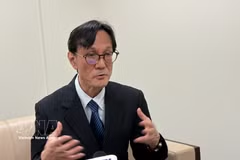
The minister made the remarks in an interview with the Vietnam News Agency (VNA)’s correspondent in Singapore. The following is the full text of the interview:
Reporter: What is the significance of General Secretary of the Communist Party of Vietnam, President of the Socialist Republic of Vietnam To Lam’s invitation and speech at this year’s Shangri-La Dialogue? What are your thoughts about General Secretary, President To Lam’s remarks?
Minister of Foreign Affairs Vivian Balakrishnan: General Secretary and President To Lam’s Keynote Address reflected the alignment in strategic outlook between Singapore and Vietnam. He spoke about three foundational crises:
First, a world order where international law and norms are being eroded, and where might makes right. This is particularly dangerous for small and medium states like Singapore and Vietnam. We depend on a rules-based order for governance and for disputes and disagreements to be settled peacefully on the basis of international law.
Second, countries are increasingly turning inwards and resorting to protectionist measures to deal with global pressures. This stifles market competitiveness and innovation, and narrows development pathways. We need more diversification and for like-minded partners to lower trade barriers and deepen integration. Multilateral institutions like ASEAN support these efforts.
Third, countries should engage in constructive dialogue and build trust through mutually beneficial cooperation.
Reporter: The global situation has become increasingly complicated and less predictable, with stability becoming difficult to maintain. In this context, how do you think Vietnam and Singapore can navigate the geopolitical situation?
Minister of Foreign Affairs Vivian Balakrishnan: Singapore and Vietnam are committed to supporting a rules-based international order, enhancing ASEAN integration and strengthening ASEAN resilience. We elevated our ties to a Comprehensive Strategic Partnership (CSP) last year. This was Singapore’s first CSP with an ASEAN member.
During General Secretary and President To Lam’s State Visit to Singapore, our leaders reaffirmed our commitment to strengthen supply chain resilience and to enhance strategic trust for strong bilateral relations and regional stability. That is why Singapore and Vietnam established the Singapore-Vietnam Strategic Dialogue to facilitate exchanges at the leadership level on governance and public administration, and to collectively manage the impact of geopolitical developments.
Singapore and Vietnam are also working closely together to promote economic cooperation and strengthen connectivity between our two countries. There are currently 22 Vietnam-Singapore Industrial Parks (VSIPs) in 15 provinces, which have attracted more than 28 billion USD in investments and created over 340,000 jobs in Vietnam. We are building greener and smarter VSIPs. There are also plans for Vietnam to export electricity to Singapore directly via subsea cables. This initiative can be an important component of the ASEAN Power Grid to enhance regional energy resilience.
In 2027, Singapore will be ASEAN Chair and Vietnam will be APEC Chair. This presents a unique opportunity for Singapore and Vietnam to support each other and work together to strengthen regional resilience and forge stronger partnerships with other key countries.
Reporter: How do you see Vietnam’s role in the region given the evolving geopolitical environment?
Minister of Foreign Affairs Vivian Balakrishnan: Under General Secretary and President To Lam’s leadership and vision of a “new era of national rise”, Vietnam has been one of the world’s fastest growing economies over the last few years and is on track to become the second-largest economy in ASEAN by 2031. With a young and dynamic population, high technology digital industries and as a key node in global supply chains, Vietnam will play a major role in the region in the years to come. ASEAN will be stronger if Vietnam works closely with other members to uphold ASEAN Centrality, support rules-based multilateralism and strengthen regional resilience. We look forward to working closely with Vietnam in engaging the region and contributing to stability and development in the Asia-Pacific.
Reporter: Thank you very much for your insights!