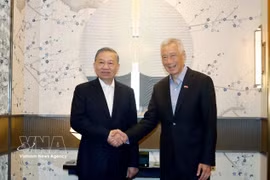
Singapore (VNA) - Vietnamese experts and intellectuals in Singapore voiced their belief that bilateral ties are facing many new opportunities for deeper cooperation in science and technology, artificial intelligence (AI), semiconductors, and innovation following Vietnamese Party General Secretary and State President To Lam’s recent state visit to Singapore.
They said the recent elevation of relations between Vietnam and Singapore to a Comprehensive Strategic Partnership has provided a favourable political and institutional foundation for expanding collaboration in strategic technologies, which are emerging as key drivers of growth across the region and the world.
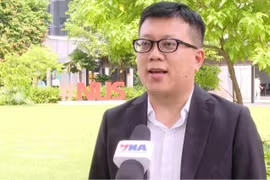
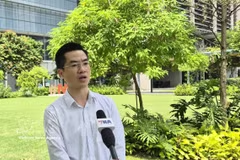
Speaking to the Vietnam News Agency’s correspondents in Singapore, Dr. Ha Son Tung from Singapore’s Agency for Science, Technology and Research (A*STAR), said the two countries are well positioned to strengthen cooperation, particularly in science, technology, and innovation. According to him, Singapore is among Asia’s early pioneers in developing strategic technology industries. The nation began implementing semiconductor development policies in the 1970s and has recently launched a new-generation semiconductor strategy to meet the strong development of AI and advanced technologies.
Singapore offers many practical lessons that are highly relevant to Vietnam, particularly in technology governance, developing research ecosystems, and training high-quality human resources, he stressed, noting that geographical proximity, cultural similarities, and increasingly close economic links create favourable conditions for the two countries to expand research cooperation programmes on a broader scale.
Building on the success of the Vietnam-Singapore Industrial Parks (VSIP) model, he suggested that the two sides could extend collaboration into high-tech sectors through joint research projects involving scientific and technological institutions from both countries. In particular, training highly skilled workers for the AI and semiconductor industries should be a top priority.
Human capital always plays a decisive role for strategic technology sectors, therefore cooperation in workforce training and the sharing of experience in developing hi-tech human resources between the two countries will holds a great significance, he said.
Another significant advantage, Tung said, is the growing community of Vietnamese intellectuals working in Singapore. Many now hold key positions at multinational technology firms, leading universities and research institutes in the country.
He described this overseas intellectual community as a “strategic bridge” capable of fostering research partnerships, facilitating technology transfer, and connecting resources between the two countries.
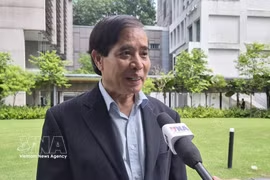
Meanwhile, Assoc. Prof. Dr. Luu Anh Tuan from the College of Computing and Data at Nanyang Technological University (NTU) said Vietnam and Singapore boast huge potential for cooperation in AI, digital transformation, and technology governance.
He noted that Singapore has accumulated extensive experience in building a national digital ecosystem and deploying AI applications, while Vietnam possesses a young and dynamic workforce and a strong capacity to adopt emerging technologies.
According to him, greater exchange of expertise and joint development of practical AI solutions could be a powerful catalyst for technological advancement not only in Vietnam and Singapore but also across Southeast Asia.
Experts said that amid intensifying global technological competition, stronger cooperation between Vietnam and Singapore in AI, semiconductors, and innovation will not only deliver economic benefits but also enhance both countries' competitiveness and resilience in adapting to future technological shifts.
Experts and scientists in Singapore also expressed hope that the visit by Party General Secretary and State President To Lam will provide fresh political momentum for bilateral science and technology cooperation programmes, while fostering deeper connections among the two countries’ intellectual communities, technology enterprises, and research institutions.
With the bilateral relations continuing to grow and the determination of both sides to advance innovation, cooperation in AI and high technology is expected to become one of the most dynamic pillars of Vietnam-Singapore relations in the coming time./.
See more
Vietnam, Israel deepen cooperation prospects in quantum technology
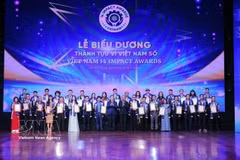
Outstanding tech performers in Vietnam's digital ecosystem honoured
After four editions of the Top Industry 4.0, this year, the programme was officially renamed “Vietnam I4 Impact Awards”, which is not just a change in name but a shift in development thinking and core values.
Fostering skilled workforce for innovation era: experts
Experts said close coordination among State management agencies, research institutes, universities, and businesses will improve training quality and serve the dual goals of quality education and practical research application.
Vietnam gains ground in technological fight against online piracy
To promote copyright protection, Vietnam is accelerating efforts to master core technologies and build integrated platforms capable of receiving, processing, distributing and protecting digital content on a unified system.
OV intellectuals pin hopes on stronger Vietnam – Singapore technology ties
OVs hope the two countries can establish an interconnected cooperation mechanism in the technology supply chain, from sharing research, testing, and development infrastructure to training human resources, thereby forming a technology alliance able to compete with others in the ASEAN region and the world.
Vietnam launches first national AI-native hackathon
Part of the Vietnam Innovation Challenge 2026, the programme goes beyond conventional coding competitions by requiring participants to develop AI-driven solutions to business challenges in real time.
New momentum for Vietnam – Singapore cooperation in science, technology
Many experts in Singapore expressed their hope that the General Secretary and President’s visit will pave the way for more substantive cooperation mechanisms between Vietnam and Singapore in high technology, innovation and human resources development.
Ho Chi Minh City: Rising hub for science, technology, innovation
Ho Chi Minh City currently hosts 143 science and technology enterprises, accounting for around 20% of the national total. Total factor productivity (TFP) contributes 59% to the city’s GRDP growth, with science and technology responsible for 74% of TFP growth.
Vietnam, Thailand step up cooperation in science, technology, innovation
Over recent years, NSTDA has built strong partnerships with Vietnamese research institutes and organisations in agriculture, biotechnology, energy and sustainable development. Notable examples include joint projects on cassava value chains, salt-tolerant rice, biotechnology products and an initiative on green energy cooperation and development in the Mekong basin.
Vietnam-Asia DX Summit discusses acceleration of digital transformation to create new growth drivers
Vietnam now needs more effective digital transformation to create higher productivity, new growth models and stronger competitiveness in the AI era, said participants at the plenary session of the Vietnam-Asia DX Summit 2026.
VNeID set to become Vietnam’s all-in-one digital super app
The project aims to transform VNeID into a modern, secure and highly scalable national digital platform capable of effectively serving citizens, businesses, agencies and organisations in handling administrative procedures, accessing online public services, conducting electronic transactions and using digital utilities.
Robocon Vietnam 2026 ignites students’ passion for technological innovation
More than just a major technology competition for engineering students, this year’s event provides a platform for innovation, artificial intelligence (AI) and practical industrial applications to converge.
UNODC: Hanoi Convention should be treated as long-term commitment, not single event
Regional Representative of the UNODC for Southeast Asia and the Pacific, Delphine Schantz, recommended that countries should treat the UN Convention against Cybercrime (Hanoi Convention) as a ‘starting point,’ instead of an ‘end goal.’
Five Vietnamese scientists named among Asia’s top 100 researchers in 2026
The inclusion of Vietnamese researchers in the 2026 Asian Scientist 100 list alongside Nobel laureates highlights Vietnam’s increasing integration into the global scientific community and its expanding research capabilities.
Ho Chi Minh City views biotechnology industry as new groundbreaking growth driver
For Ho Chi Minh City, science, technology and innovation have been identified as key drivers of growth in the new development period. Biotechnology, therefore, is considered one of the sectors capable of generating high added value and promoting the transition towards a greener growth model.
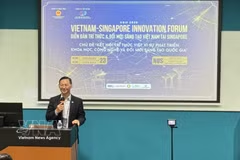
Vietnamese innovation community in Singapore drives science, technology cooperation
Addressing the forum, Vietnamese Ambassador Tran Phuoc Anh expressed appreciation for the initiative to connect Vietnamese intellectuals in Singapore and make the most of the city-state’s strengths in science, technology and innovation.
Localities aim for higher growth through science, technology
Experiences from localities nationwide show that Resolution 57 is fostering a marked transformation in development mindset. Science and technology, innovation and digital transformation are increasingly becoming foundational drivers of economic growth and opening new development space for localities in the years ahead.
Experts recommend ‘five don’ts’ to protect personal data
Vietnamese authorities handled more than 30 cases involving the illegal sale and theft of personal data between 2023 and 2025, affecting over 160 million data records across sectors including health, education, finance, banking and telecommunications.
Protecting digital future in post-quantum, AI era
Participants highlighted the importance of building a proactive, synchronised and sustainable national cybersecurity ecosystem through closer cooperation among regulators, technology firms, research institutions and cybersecurity experts.
Vietnam pushes ahead with AI-powered legal infrastructure
Research by the Ministry of Justice (MoJ) shows that AI adoption in the legal sector remains constrained by fragmented, unstandardised and weakly connected legal databases. A unified national legal data ecosystem has yet to be established, while big data and AI applications are still largely confined to pilot programmes and have not been integrated across the full legislative process, including drafting, appraisal, review and inspection of legal documents.